<think>The user wants me to translate a blog fragment from English to German. Let me carefully translate it while keeping all markdown syntax, URLs, image paths, and the brand name "GLMImage" intact.
Let me translate this naturally into German:
- The image alt text should be translated but the URL stays the same
- The body text needs fluent German translation
- All markdown links and URLs remain unchanged
- The brand name "GLMImage" stays in English
Let me work through this:
- "Museum-style botanical plate..." → German translation
- The body text about the heritage rose plate
- The verification note at the end
I need to make sure the German sounds natural and fluent.</think>

Diese Tafel einer historischen Rose — Blüte, Knospe, einesezierte Blüte, fünf Beschriftungen, Aquarell über Graphit — wurde aus einem einzigen Prompt generiert. Sie ist eines von dreißig Beispielen in dieser Galerie, jedes mit seinem exakten Prompt, seiner Beschriftungsliste und dem, was du vor der Verwendung überprüfen solltest. Kopiere jeden Prompt wie er ist, oder tausche die Betreffzeile aus, um ihn auf dein eigenes Thema umzulenken.
Erstelle deine eigene Tafel · Leitfaden zum Prompt-Workflow · Biologie-Prompt-Paket
Jedes der folgenden Bilder wurde im wissenschaftlichen Illustrationsmodul von glmimage.app (Modell: grok-imagine-image-2.0) generiert und hat unsere Prüfung zur Beschriftungs-Rechtschreibung bestanden, bevor es veröffentlicht wurde. „Prüfung bestanden" bedeutet, dass die Beschriftungen lesbar und korrekt geschrieben sind — es bedeutet nicht, dass die Anatomie anhand einer Referenz zertifiziert wurde. Die Hinweise zur Überprüfung sagen dir, was du kontrollieren solltest.
<think>The user wants me to translate a very short article fragment into German. The fragment is just "## Botany" which is a markdown heading. I need to translate it to natural German while keeping the markdown syntax intact.
"Botany" in German is "Botanik" - this is the standard translation for the scientific study of plants.
Since this is just a heading, the output should be just the translated heading with the markdown syntax intact.</think>
Botanik
<think>The user wants me to translate a blog fragment about botanical illustration into German. The fragment is about a heritage rose plate, includes an image, a prompt in English, and verification instructions.
I need to:
- Keep all markdown syntax intact
- Keep URLs and image paths exactly as-is
- Keep code blocks untranslated (but can translate comments if trivially safe - though in this case the prompt text is inside a code block, so it should NOT be translated since it's a code block)
- Keep "GLMImage" untranslated
- Use native, fluent German
Wait, let me reconsider. The code block contains a prompt that is being shown as an example. The instructions say "Keep code blocks and inline code untranslated (translate only comments inside them when trivially safe)." So the prompt in the code block should remain in English.
Let me translate the rest:
- Heading: "Heritage rose plate" → "Tafel einer historischen Rose" or "Erbe-Rosen-Tafel" or "Historische Rosentafel"
- Image alt text: I should translate this. "Heritage rose botanical plate labeled bloom, bud, stamens, pistil, leaflet" → "Botanische Tafel einer historischen Rose mit Beschriftungen Blüte, Knospe, Staubblätter, Stempel, Blättchen"
- Verify section: translate the German parts
Let me draft:
1. Historische Rosentafel

A museum-style botanical plate of one old garden rose: full bloom, a half-open bud,
a dissected flower showing stamens and pistil, and a leafy stem, in graphite contour
with specimen-true watercolor. Label "BLOOM", "BUD", "STAMENS", "PISTIL", "LEAFLET".
Title: "THE OLD ROSE".
Überprüfen: Anzahl und Anordnung der Staubblätter im Vergleich zur tatsächlichen Sorte; Blättchenzähnung (Alte Rosen haben gewöhnlich 5–7 Blättchen, niemals einfache).
Let me refine this. "Heritage rose" could be "Alte Rose" or "historische Rose" - in German horticulture, "Alte Rose" or "Historische Rose" is the typical translation for "heritage rose" or "old garden rose".
"Heritage rose plate" - I'll go with "Alte-Rosen-Tafel" or "Tafel einer historischen Rose". Let me use "Tafel einer historischen Rose" for natural German.
Actually, "Historische Rosentafel" works well too. Let me think about what's more natural...
"Heritage rose" in gardening context refers to old garden roses - "Alte Rosen" is the established German term. So "Alte-Rosen-Tafel" or "Tafel alter Rosen" works.
Let me use "Tafel einer historischen Rose" - sounds more like a museum specimen plate.
For the verify section:
- "stamen count and arrangement against the actual cultivar" → "Anzahl und Anordnung der Staubblätter im Vergleich zur tatsächlichen Sorte"
- "leaflet serration" → "Blättchenzähnung" or "Zähnung der Blättchen"
- "old roses are usually 5-7 leaflets, never simple" → "Alte Rosen haben gewöhnlich 5–7 Blättchen, niemals einfache"
This looks good. Let me finalize.</think>
1. Tafel einer historischen Rose

A museum-style botanical plate of one old garden rose: full bloom, a half-open bud,
a dissected flower showing stamens and pistil, and a leafy stem, in graphite contour
with specimen-true watercolor. Label "BLOOM", "BUD", "STAMENS", "PISTIL", "LEAFLET".
Title: "THE OLD ROSE".
Überprüfen: Anzahl und Anordnung der Staubblätter im Vergleich zur tatsächlichen Sorte; Blättchenzähnung (Alte Rosen haben gewöhnlich 5–7 Blättchen, niemals einfache).
<think>The user wants me to translate a blog fragment about moss life cycle into German. Let me translate it carefully, keeping all markdown syntax, URLs, code blocks, and the brand name "GLMImage" intact.
The text is about a moss life cycle illustration. I need to translate:
- The heading "Moss life cycle" to German
- The alt text for the image (which describes a moss life cycle plate)
- The prompt in the code block (keep untranslated as per rules - wait, the code block contains a prompt description, not actual code. Let me re-read the rules.)
Rule 3 says: "Keep code blocks and inline code untranslated (translate only comments inside them when trivially safe)."
So the code block should be kept untranslated. That makes sense as it's a prompt that would be used to generate an image.
Wait, but looking at it again, the prompt is in English and it's inside a code fence. According to the rules, code blocks should be kept untranslated. So I'll leave that as-is.
Let me translate the rest:
- "Moss life cycle" → "Moos-Lebenszyklus"
- The image alt description (this is actually an image alt text which describes the image) - should I translate it? It's an alt attribute description of the image. The URL should stay. The alt text is part of the markdown image syntax, so technically it's markdown. But alt text describes the image content. I think I should translate it to German for accessibility, but the URL stays the same.
Actually, looking more carefully, the image alt text in markdown is in English: "Moss life cycle plate showing gametophyte, capsule, seta, peristome and spores". This is the alt text which should be translated to German for accessibility.
Let me translate:
-
"Moss life cycle plate showing gametophyte, capsule, seta, peristome and spores" → "Moos-Lebenszyklus-Tafel mit Gametophyt, Kapsel, Seta, Peristom und Sporen"
-
The "Verify" section: "the sporophyte must grow from the gametophyte, not from soil; peristome teeth belong at the capsule mouth only."
→ "Überprüfen: Der Sporophyt muss aus dem Gametophyten wachsen, nicht aus dem Boden; Peristomzähne gehören ausschließlich an die Kapselöffnung."
Wait, I need to be careful about scientific terms. In German botanical usage, many Latin terms are kept (gametophyte = Gametophyt, sporophyte = Sporophyt, archegonium = Archegonium, antheridium = Antheridium, capsule = Kapsel, seta = Seta, peristome = Peristom, spores = Sporen, protonema = Protonema, operculum = Operculum). These are already in Latin and used in German as such.
Let me finalize my translation:
2. Moos-Lebenszyklus
[code block stays in English]
Überprüfen: Der Sporophyt muss aus dem Gametophyten wachsen, nicht aus dem Boden; Peristomzähne gehören ausschließlich an die Kapselöffnung.
Let me double-check the image alt text. It says "showing gametophyte, capsule, seta, peristome and spores". In German this would be: "mit Gametophyt, Kapsel, Seta, Peristom und Sporen"
That looks good. Let me also reconsider the "Title" label - actually that's inside the code block prompt, so it stays untranslated.
Wait, looking again at the image alt text, it says "peristome" - in German it would be "Peristom" (same spelling essentially, just German capitalization for nouns).
Let me also reconsider: "TWO GENERATIONS" - this is inside the code block prompt, so it stays in English per the rules.
One more consideration - the alt text uses lowercase for "peristome" because it's English. In German, it should be capitalized as "Peristom" because it's a noun. Good.
Final translation:
2. Moos-Lebenszyklus
[code block unchanged]
Überprüfen: Der Sporophyt muss aus dem Gametophyten wachsen, nicht aus dem Boden; Peristomzähne gehören ausschließlich an die Kapselöffnung.
This looks good. Let me make sure the formatting matches the original exactly.</think>
2. Moos-Lebenszyklus
An alternating-generations plate for a moss: leafy gametophyte, magnified antheridium
and archegonium, the sporophyte with seta and capsule, capsule operculum open with
peristome teeth releasing spores, and a protonema inset. Label "GAMETOPHYTE",
"CAPSULE", "SETA", "PERISTOME", "SPORES". Title: "TWO GENERATIONS".
Überprüfen: Der Sporophyt muss aus dem Gametophyten wachsen, nicht aus dem Boden; Peristomzähne gehören ausschließlich an die Kapselöffnung.
<think>The user wants me to translate the article fragment into natural, fluent German. The fragment is just "## Zoology" which is a heading. I need to translate it completely and keep the markdown syntax intact.
"Zoology" in German is "Zoologie".
Let me output only the translated markdown.</think>
Zoologie
<think>The user wants me to translate a fragment of a longer article into German. The fragment is about beetle morphology, with an image, a code block containing a prompt, and a verification note.
Let me translate this carefully:
- The heading "Beetle morphology" → "Morphologie des Käfers" or "Käfermorphologie"
- The image alt text should be translated but keep the image path intact
- The code block content should NOT be translated (keep untranslated), but the user said "translate only comments inside them when trivially safe" - this is a prompt, not really code with comments, so I should keep it untranslated.
- The Verify: part should be translated
Let me think about the German translation:
- "Beetle morphology" → "Käfermorphologie"
- "Stag beetle morphology plate labeled pronotum, elytron, flight wing, tarsus" → "Hirschkäfer-Morphologietafel mit Beschriftungen: Pronotum, Elytron, Flugflügel, Tarsus"
- The code block should stay in English as it's a prompt for image generation
- "Verify:" → "Überprüfen:" or "Verifizieren:"
- "tarsal segment count (5-5-5 for most beetles, but stag beetles vary)" → "Anzahl der Tarsenglieder (5-5-5 bei den meisten Käfern, variiert aber bei Hirschkäfern)"
- "the flight wing should fold under the elytron, not beside it" → "der Flugflügel sollte unter das Elytron gefaltet werden, nicht daneben"
Let me refine:
- "Beetle morphology" - heading. "Käfermorphologie" is good, native German.
- For the alt text: "Hirschkäfer-Morphologietafel mit Pronotum, Elytron, Flugflügel und Tarsus beschriftet"
Actually, let me look at the alt text more carefully: "Stag beetle morphology plate labeled pronotum, elytron, flight wing, tarsus"
German: "Hirschkäfer-Morphologietafel, beschriftet mit Pronotum, Elytron, Flugflügel, Tarsus"
For the code block - this is an image generation prompt. The instructions say "Keep code blocks and inline code untranslated". So I'll keep the code block as is.
Wait, the prompt has English labels like "PRONOTUM", "ELYTRON", etc. Should I translate these? No, because the code block should be untranslated. Also, these are anatomical terms that are often kept as Latin in scientific German anyway.
Let me finalize:
3. Käfermorphologie
A comparative coleopterology plate: one stag beetle in dorsal view with all major
sclerites labeled, one elytron lifted to reveal the folded flight wing, a leg with
tarsal segments magnified, and an antenna detail. Label "PRONOTUM", "ELYTRON",
"FLIGHT WING", "TARSUS". Title: "ARMOR AND WING".
Überprüfen: Anzahl der Tarsenglieder (5-5-5 bei den meisten Käfern, variiert jedoch bei Hirschkäfern); der Flugflügel sollte unter das Elytron gefaltet sein, nicht daneben.
Actually, let me reconsider "Überprüfen" - in scientific context, "Verifizieren" might be more appropriate but "Überprüfen" is more natural. Or just "Prüfen:" Hmm. The original says "Verify:" which is a bit imperative-like. "Überprüfen:" or "Verifizieren:" works. I'll go with "Überprüfen:" as it's more natural German.
Also for "stag beetle" - in German it's "Hirschkäfer" (literally "stag beetle"). Good.
For "tarsus" - "Tarsus" is the German scientific term. Good.
For "pronotum" - "Pronotum" is also used in German. Good.
For "elytron" - "Elytron" or "Flügeldecke". I'll use "Elytron" since it matches the Latin scientific term that's also used in German.
For "flight wing" - "Flugflügel" is the correct German term.
Let me double-check the translation of "the flight wing should fold under the elytron, not beside it":
- "der Flugflügel sollte unter das Elytron gefaltet werden, nicht daneben"
Or more natural: "der Flugflügel sollte unter das Elytron gefaltet sein, nicht daneben"
I think "geklappt" might be better than "gefaltet" for wings. Actually "gefaltet" is fine for wings (they fold). Let me use "gefaltet" or "eingeklappt". Hmm, beetle wings actually fold, so "gefaltet" is appropriate.
Actually, in scientific context about beetle wings, the term "gefaltet" is used. So:
"der Flugflügel sollte unter das Elytron gefaltet sein, nicht daneben"
Final version looks good. Let me write it out.
One more consideration - the image URL must stay exactly the same. ✓
The code block content stays untranslated. ✓
Markdown syntax is preserved. ✓
Brand "GLMImage" - not mentioned here but would be kept if present. ✓
I think my translation is good. Let me finalize.</think>
3. Käfermorphologie
A comparative coleopterology plate: one stag beetle in dorsal view with all major
sclerites labeled, one elytron lifted to reveal the folded flight wing, a leg with
tarsal segments magnified, and an antenna detail. Label "PRONOTUM", "ELYTRON",
"FLIGHT WING", "TARSUS". Title: "ARMOR AND WING".
Überprüfen: Anzahl der Tarsenglieder (5-5-5 bei den meisten Käfern, variiert jedoch bei Hirschkäfern); der Flugflügel sollte unter das Elytron gefaltet sein, nicht daneben.
<think>The user wants me to translate an article fragment about hummingbird flight mechanics into German. Let me translate it carefully, keeping all markdown syntax, URLs, image paths, and code blocks intact. The brand "GLMImage" should remain untranslated.
Let me work through this:
-
The heading "4. Hummingbird flight mechanics" → "4. Flugmechanik des Kolibris"
-
The image alt text needs translation, but the URL stays the same. The alt text is "Hummingbird hovering figure labeled wing path, stroke cycle, lift vector, feeding" → "Schwebeflug-Darstellung eines Kolibris mit Beschriftung des Flügelwegs, des Schlagzyklus, des Auftriebsvektors und der Nahrungsaufnahme"
Wait, looking again at the input - the image markdown has the alt text inline. Let me keep that URL exact but translate the alt text description. Actually, looking at the rules: "Keep every URL, image path, and HTML tag EXACTLY as-is." The alt text is part of the markdown image syntax. Hmm, typically alt text would be translated as it's user-facing content. But strictly speaking, it's inside the image tag. Let me translate the alt text since it's user-facing descriptive content, but keep the URL exactly as is.
-
The code block contains an image generation prompt - I should keep this untranslated as it's code/instruction text.
-
The "Verify" note should be translated to German.
Let me draft the translation:
4. Flugmechanik des Kolibris
A hovering-flight figure: hummingbird in hover with figure-eight wing-path stroke
cycle, shoulder rotation at reversal points, a nectar-feeding posture inset, and
lift-vector arrows during downstroke and upstroke. Label "WING PATH", "STROKE CYCLE",
"LIFT VECTOR", "FEEDING". Title: "FEATHERED HELICOPTER".
Überprüfung: Die Auftriebspfeile sollten zwischen den Schlägen annähernd symmetrisch sein – Kolibris erzeugen auch beim Aufschlag Auftrieb, anders als die meisten Vögel.
Let me refine this. "Schwebeflug-Darstellung" might be better as "Schwebeflugabbildung". Actually "Schwebeflug-Darstellung" is fine.
For "feeding" - in the context of the figure it refers to nectar feeding, so "Nahrungsaufnahme" works.
For the verify note: "Auftriebspfeile" is good for lift arrows. "beim Aufschlag" is good for upstroke. Let me make sure the German flows naturally.
Actually, let me reconsider the alt text translation. The English alt text reads: "Hummingbird hovering figure labeled wing path, stroke cycle, lift vector, feeding"
German: "Kolibri im Schwebeflug – beschriftete Abbildung mit Flügelweg, Schlagzyklus, Auftriebsvektor und Nahrungsaufnahme"
Hmm, I think keeping it descriptive but natural is best.
Let me finalize:
4. Flugmechanik des Kolibris

A hovering-flight figure: hummingbird in hover with figure-eight wing-path stroke
cycle, shoulder rotation at reversal points, a nectar-feeding posture inset, and
lift-vector arrows during downstroke and upstroke. Label "WING PATH", "STROKE CYCLE",
"LIFT VECTOR", "FEEDING". Title: "FEATHERED HELICOPTER".
Überprüfen: Die Auftriebspfeile sollten zwischen den Schlagphasen annähernd symmetrisch sein – Kolibris erzeugen auch beim Aufschlag Auftrieb, anders als die meisten Vögel.
I think "Schlagphasen" or "Schlägen" both work. Let me use "Schlägen" as it's more concise.
Also, thinking about "Verify" - the German "Überprüfung" or "Prüfen" - the bold formatting suggests it's a heading-like instruction. "Prüfen:" or "Überprüfung:" - I'll go with "Prüfen:" as it sounds more like a directive.
Actually "Verify" in context means "check/verify this" so it's an instruction. "Prüfen:" works well.
Let me finalize my answer.</think>
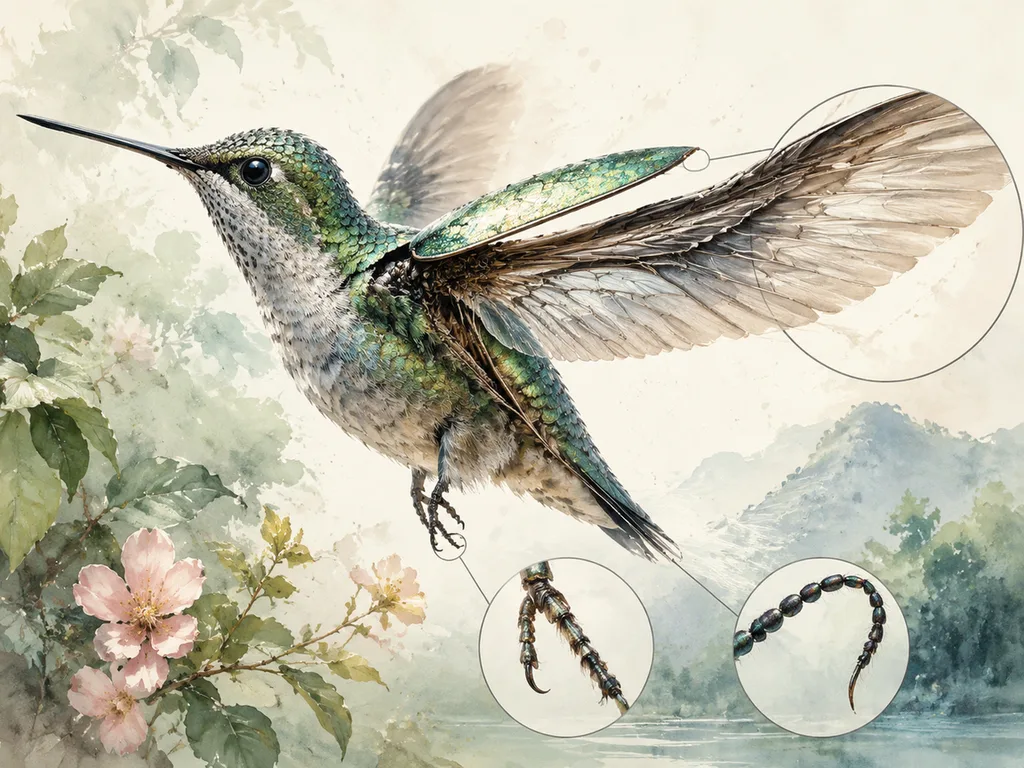
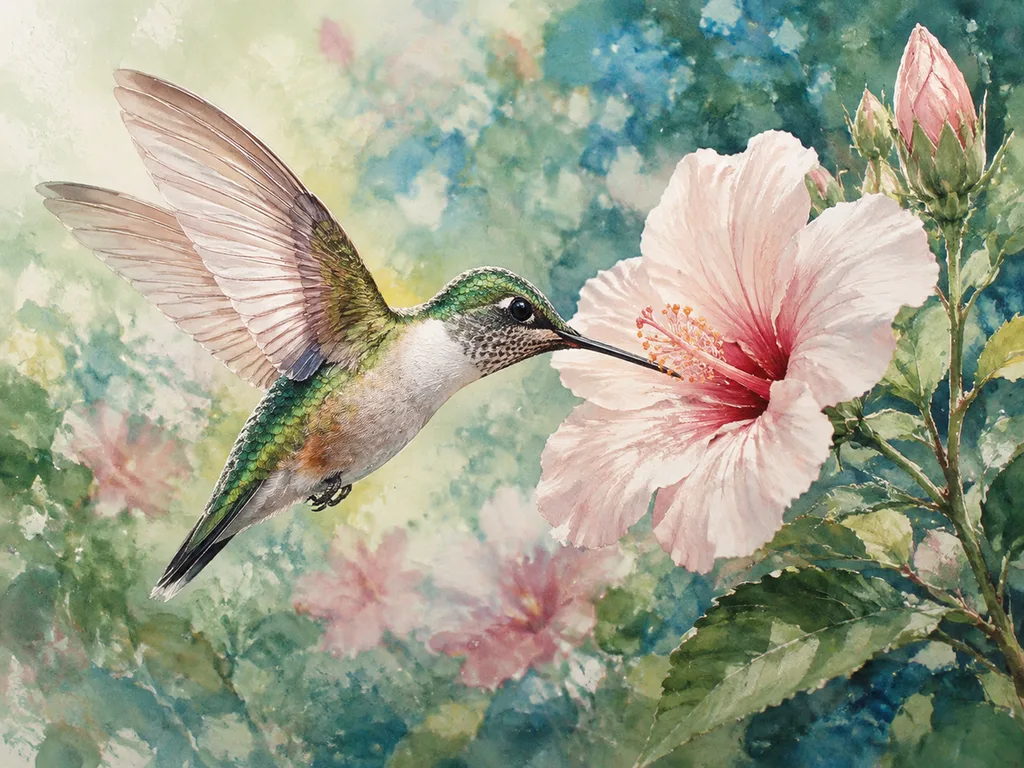
4. Flugmechanik des Kolibris

A hovering-flight figure: hummingbird in hover with figure-eight wing-path stroke
cycle, shoulder rotation at reversal points, a nectar-feeding posture inset, and
lift-vector arrows during downstroke and upstroke. Label "WING PATH", "STROKE CYCLE",
"LIFT VECTOR", "FEEDING". Title: "FEATHERED HELICOPTER".
Prüfen: Die Auftriebspfeile sollten zwischen den Schlägen annähernd symmetrisch sein – Kolibris erzeugen auch beim Aufschlag Auftrieb, anders als die meisten Vögel.
<think>The user wants me to translate an article fragment into German. The fragment is just "## Medicine" - a markdown heading. I need to translate this into German, keeping the markdown syntax intact.
"Medicine" in German is "Medizin".
So the translation would be:
Medizin</think>
Medizin
<think>The user wants me to translate this article fragment into natural, fluent German. Let me go through it carefully:
- The heading "5. Alzheimer pathology in the hippocampus" should be translated
- The image URL stays the same
- The code block (prompt) should stay in English (code blocks are not translated)
- The "Verify:" paragraph should be translated
- The brand "GLMImage" stays untranslated
Let me translate:
- "Alzheimer pathology in the hippocampus" → "Alzheimer-Pathologie im Hippocampus"
- "Verify:" → "Überprüfung:" or "Verifizieren:" - I'll use "Überprüfen:" or "Hinweis:"
- "hippocampal anatomy in a coronal plane is easy to get subtly wrong" → "Die Anatomie des Hippocampus in einer koronalen Ebene kann leicht subtil falsch dargestellt werden"
- "compare against a neuroanatomy atlas before teaching use" → "vor der Verwendung im Unterricht mit einem Neuroanatomie-Atlas abgleichen"
Let me make sure all markdown syntax is intact
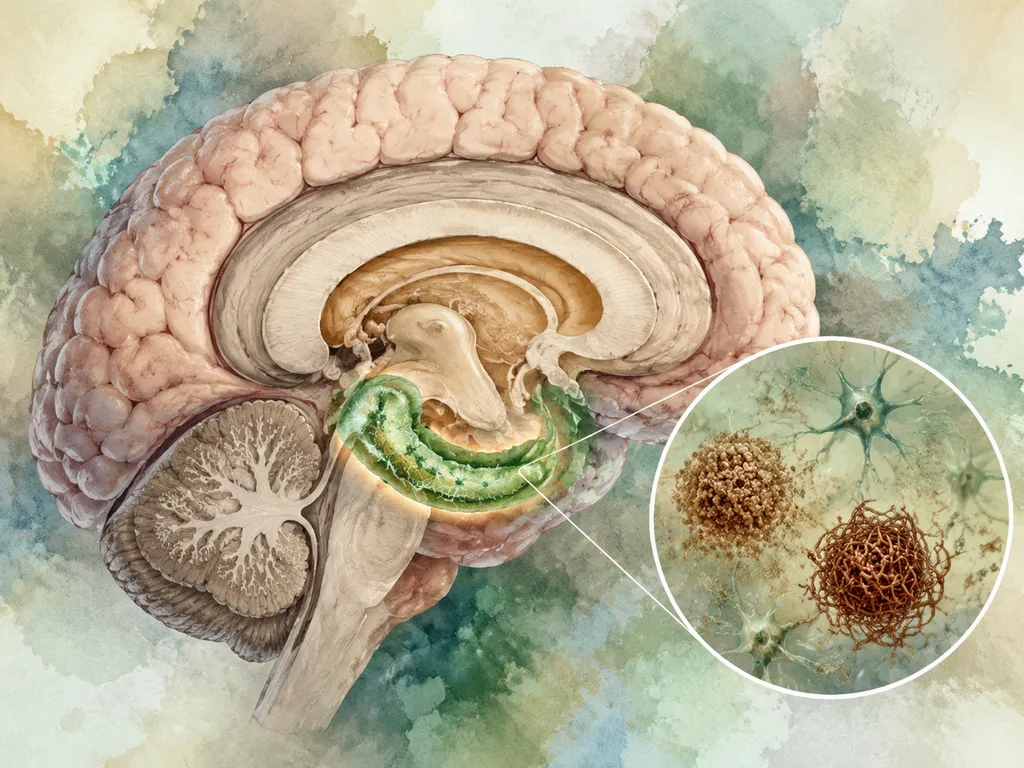
5. Alzheimer-Pathologie im Hippocampus

A coronal brain section highlighting the hippocampus in Alzheimer disease, with
amyloid plaques as small extracellular deposits and neurofibrillary tangles inside
neurons, plus one magnified inset of a plaque and a tangle. Label "HIPPOCAMPUS",
"PLAQUE", "TANGLE", "NEURON". Title: "ALZHEIMER PATHOLOGY".
Überprüfen: Die Anatomie des Hippocampus in einer koronalen Ebene kann leicht unmerklich falsch dargestellt werden – vor dem Einsatz im Unterricht mit einem Neuroanatomie-Atlas abgleichen. Siehe unseren Leitfaden für medizinische Illustrationen.
<think>The user wants me to translate a fragment of an article into German. The fragment is about a blood cell family tree illustration. Let me translate it carefully, keeping all markdown syntax, URLs, and the brand name "GLMImage" intact.
Let me translate:
6. Blood cell family tree → ### 6. Stammbaum der Blutzellen
The image caption: "Hematopoiesis tree from stem cell through progenitors to mature blood cells" → "Stammbaum der Hämatopoese von der Stammzelle über Vorläuferzellen zu reifen Blutzellen"
The code block (which should stay untranslated except for comments):
A classic hematopoiesis tree: the hematopoietic stem cell at the root branching
through progenitors into red cells, platelets, granulocytes, monocytes and
lymphocytes, each mature cell drawn at the leaf. Label "STEM CELL", "PROGENITOR",
"RED CELL", "PLATELET", "LYMPHOCYTE". Title: "BLOOD LINEAGES".
Wait - the instructions say "Keep code blocks and inline code untranslated (translate only comments inside them when trivially safe)." This isn't really a code block with comments - it's a prompt/description. But the instruction is to keep code blocks untranslated. However, this is a prompt for image generation, which is content, not code. Let me think about this...
Actually, looking at this more carefully, the instruction says "Keep code blocks and inline code untranslated". This content inside the code fence is in English and appears to be an image generation prompt. The strict interpretation would be to keep it untranslated. But this is part of the article content that needs translation.
Looking at the article structure, this appears to be an example of an illustration prompt, which is part of the educational content of the article. The reader needs to understand what prompt was used.
However, the instructions are clear: "Keep code blocks and inline code untranslated". I should keep the content within the code fence untranslated. But the instruction also says "translate only comments inside them when trivially safe." This isn't a comment, so I shouldn't translate it.
Wait, let me re-read: "translate only comments inside them when trivially safe" - this means I CAN translate comments if it's safe, but otherwise keep code untranslated. The content here is a prompt/description, not actual code or comments.
I think the safest interpretation is to keep the code block content as-is since the user explicitly said to keep code blocks untranslated. The image prompt is preserved as-is.
Actually, on reflection - this is a prompt for image generation, which is the educational content the article is about. Translating it would be helpful for German readers to understand. But the instruction is clear about code blocks.
Let me keep the code block untranslated as per instructions. The "Verify:" part at the bottom should be translated though.
Verify: common ancestor nodes — the myeloid/lymphoid split must happen early; platelets should be fragments, not nucleated cells.
→ Überprüfen: gemeinsame Vorfahrenknoten — die myeloische/lymphoide Aufspaltung muss früh erfolgen; Blutplättchen sollten Fragmente sein, keine kernhaltigen Zellen.
Let me finalize:
6. Stammbaum der Blutzellen

A classic hematopoiesis tree: the hematopoietic stem cell at the root branching
through progenitors into red cells, platelets, granulocytes, monocytes and
lymphocytes, each mature cell drawn at the leaf. Label "STEM CELL", "PROGENITOR",
"RED CELL", "PLATELET", "LYMPHOCYTE". Title: "BLOOD LINEAGES".
Überprüfen: gemeinsame Vorfahrenknoten — die myeloische/lymphoide Aufspaltung muss früh erfolgen; Blutplättchen sollten Fragmente sein, keine kernhaltigen Zellen.
This looks good. Let me double-check:
- Markdown syntax intact ✓
- URLs preserved ✓
- Image path preserved ✓
- Brand "GLMImage" preserved ✓
- Code block untranslated ✓
- Native German expression ✓
- No preamble or commentary ✓</think>
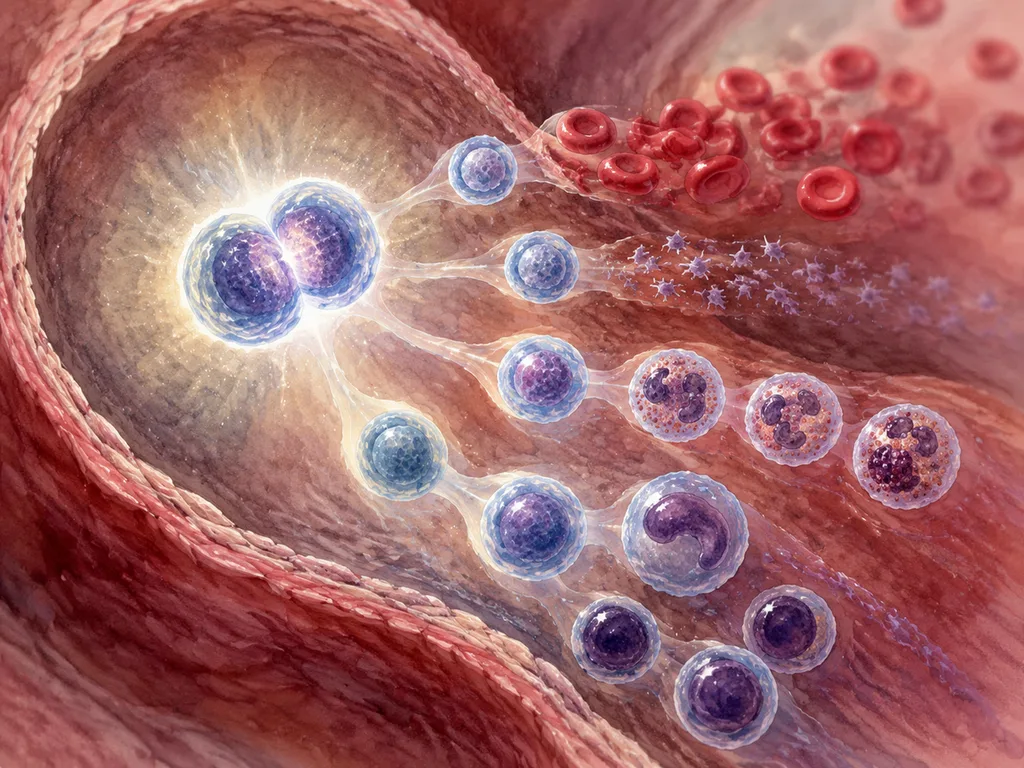
6. Stammbaum der Blutzellen
A classic hematopoiesis tree: the hematopoietic stem cell at the root branching
through progenitors into red cells, platelets, granulocytes, monocytes and
lymphocytes, each mature cell drawn at the leaf. Label "STEM CELL", "PROGENITOR",
"RED CELL", "PLATELET", "LYMPHOCYTE". Title: "BLOOD LINEAGES".
Überprüfen: gemeinsame Vorläuferknoten — die myeloische/lymphoide Aufspaltung muss früh erfolgen; Blutplättchen sollten Fragmente sein, keine kernhaltigen Zellen.
<think>The user wants me to translate an article fragment into German. However, the fragment only contains a heading "## Molecular biology" without any additional content. Let me translate this heading into natural German.
"Molecular biology" in German is "Molekularbiologie".</think>
Molekularbiologie
<think>The user wants me to translate a blog fragment about antibody structure into German. I need to:
- Keep all markdown syntax intact
- Keep URLs, image paths, and HTML tags exactly as-is
- Keep code blocks untranslated (translate only comments if trivially safe)
- Keep "GLMImage" untranslated
- Translate naturally to fluent German
- Output only the translated markdown
Let me translate the content:
- "Antibody structure" → "Antikörperstruktur"
- The alt text description needs translation (since it's not code, it's just descriptive text in markdown image syntax - but wait, the image alt text is part of the markdown. Let me think... The alt text is descriptive content, not a URL. I should translate it to German for accessibility.)
- The code block contains English description - I should keep it untranslated based on rules, but translate comments inside if trivially safe. There are no comments in this code block, just a description.
- "Verify" section needs translation
- "Y-shape symmetry" → "Y-förmige Symmetrie"
- "both Fab arms should be identical" → "beide Fab-Arme sollten identisch sein"
- "the paratope is on the antibody, the epitope on the antigen" → "der Paratop befindet sich auf dem Antikörper, das Epitop auf dem Antigen"
- "they get swapped constantly" → "sie werden ständig vertauscht"
For the image alt text, since it's descriptive content for the image (not a URL), I should translate it to German.
Let me write the translation:</think>
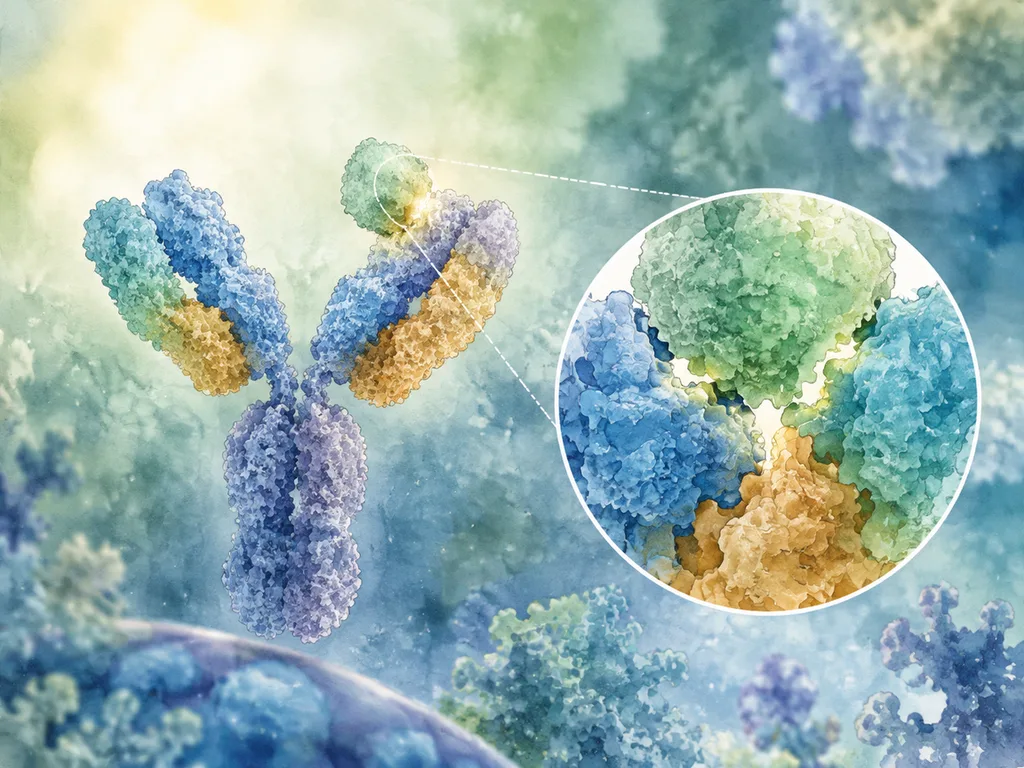
7. Antikörperstruktur
A molecular figure of an antibody with its two heavy and two light chains, the
antigen-binding sites gripping a small antigen, and one magnified inset of the
paratope-epitope interface. Label "HEAVY CHAIN", "LIGHT CHAIN", "PARATOPE",
"EPITOPE". Title: "ANTIBODY STRUCTURE".
Überprüfen: Y-förmige Symmetrie – beide Fab-Arme sollten identisch sein; der Paratop befindet sich auf dem Antikörper, das Epitop auf dem Antigen (sie werden ständig vertauscht).
<think>The user wants me to translate an article fragment about the T4 bacteriophage into German. I need to:
- Keep all markdown syntax intact
- Keep all URLs, image paths, and HTML tags exactly as-is
- Keep code blocks untranslated (only translate comments if trivially safe)
- Keep "GLMImage" untranslated
- Use native, fluent German
- Output only the translated markdown
Let me translate this carefully:
- "Bacteriophage T4" → "Bakteriophage T4"
- The alt text for the image is in English - I should probably translate it to German since it's descriptive text, but the user says keep URLs and image paths EXACTLY as-is. The alt text inside the brackets is part of the markdown but not a URL. I think I should translate it to be natural.
- The code block contains a prompt - I should keep it untranslated per rule 3
- "Verify:" → "Überprüfung:" or "Verifizieren:"
- The technical terms should be translated naturally
Let me think about the image alt text. It's descriptive text for accessibility. I'll translate it to German to be consistent with the rest of the localized content.
Actually, re-reading rule 2: "Keep every URL, image path, and HTML tag EXACTLY as-is. Do not translate or alter them." This refers to URLs and image paths (the URL itself). The alt text within the markdown image syntax is separate. I'll translate it.
Let me write the German version:
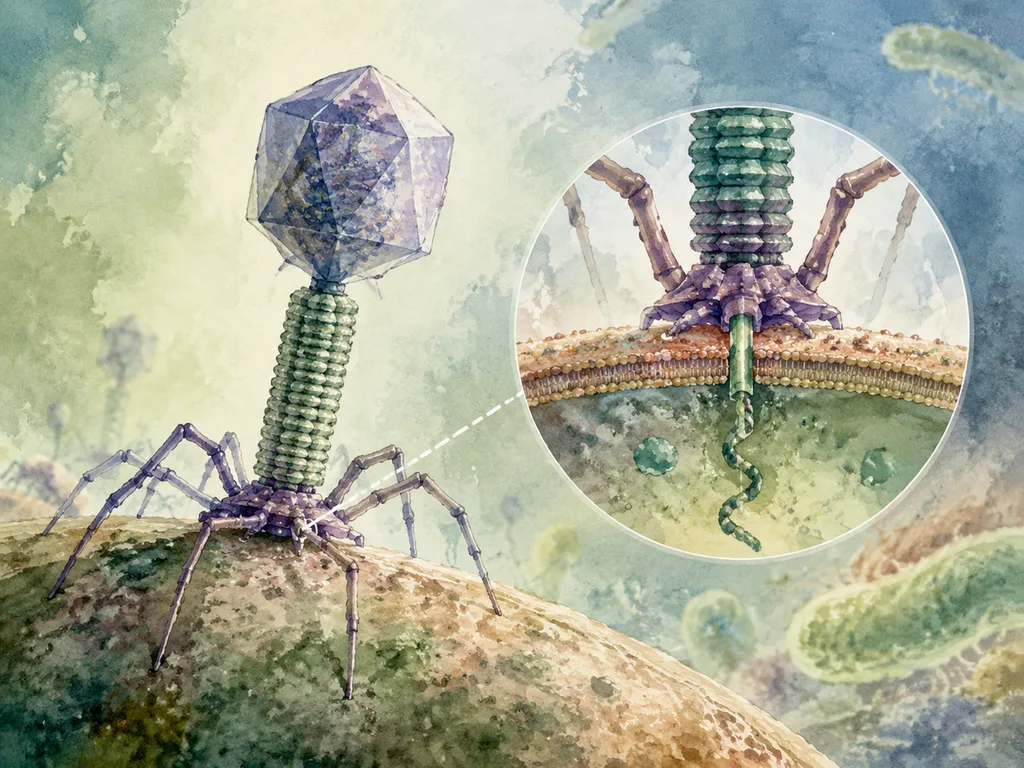
8. Bakteriophage T4
A structural figure of the T4 bacteriophage with its icosahedral head, contractile
sheath, tail fibers and base plate, plus one inset showing the tail injecting DNA
into a bacterial envelope. Label "HEAD", "SHEATH", "TAIL FIBER", "BASE PLATE",
"DNA". Title: "T4 PHAGE".
Überprüfung: Schwanzfasern heften sich an die bakterielle Oberfläche bevor sich die Scheide zusammenzieht; der Kopf ist länglich (prolat), kein reguläres Ikosaeder.
Wait, let me reconsider the alt text. It says "labeled head, sheath, tail fiber, base plate, DNA". In German this would be: "mit Beschriftung Kopf, Scheide, Schwanzfaser, Grundplatte, DNA" or similar. Let me make it natural.
For the "Verify:" section - the user wrote it in italics: before. I should preserve that.
Let me also think about the technical terms:
- "Bacteriophage" → "Bakteriophage"
- "head" → "Kopf"
- "sheath" → "Scheide"
- "tail fiber" → "Schwanzfaser"
- "base plate" → "Grundplatte"
- "tail" → "Schwanz"
- "DNA" → "DNA" (or DNS in German, but DNA is also commonly used)
- "verify" → "Überprüfen" or "Verifizieren"
- "sheath contraction" → "Scheidenkontraktion" or "Kontraktion der Scheide"
- "head is elongated (prolate)" → "der Kopf ist länglich (prolat)"
- "icosahedron" → "Ikosaeder"
In German, "DNA" is commonly used, though "DNS" (Desoxyribonukleinsäure) is the German acronym. I'll use "DNA" since it's widely recognized.
Let me finalize:</think>
8. Bakteriophage T4
A structural figure of the T4 bacteriophage with its icosahedral head, contractile
sheath, tail fibers and base plate, plus one inset showing the tail injecting DNA
into a bacterial envelope. Label "HEAD", "SHEATH", "TAIL FIBER", "BASE PLATE",
"DNA". Title: "T4 PHAGE".
Überprüfen: Schwanzfasern binden an die Bakterienoberfläche, bevor sich die Scheide zusammenzieht; der Kopf ist länglich (prolat), kein reguläres Ikosaeder.
<think>The user wants me to translate an article fragment into German. However, the fragment provided is just a heading "## Earth science" with no content. I need to translate this heading into German while keeping the markdown syntax intact.
"Earth science" in German would be "Geowissenschaften" or "Erdwissenschaften". "Geowissenschaften" is the more commonly used term in German academic contexts.
Let me provide just the translated heading.</think>
Geowissenschaften
<think>
We need translate fragment completely German, preserving markdown URLs/image paths/code fences. Need translate heading, image alt likely translate? Rule URLs exact, image paths exact, HTML exact. Alt text? "Translate article fragment"; likely translate image alt description, but path exact. Code block: code blocks untranslated, only comments inside when trivially safe. Here content in code fence is English prompt; rule says keep code blocks and inline code untranslated (translate only comments inside them when trivially safe). So preserve code block entirely? Need translate perhaps code fence content? Explicit keep code blocks untranslated, so exact English. Need translate Verify paragraph, italic perhaps preserve. Need output only markdown.
Need determine natural German. Heading "### 9. Subduction zone anatomy" => "### 9. Anatomie einer Subduktionszone". Image alt text: "Subduction zone cross-section labeled trench, slab, dewatering, magma, volcanic arc" translated likely "Querschnitt einer Subduktionszone mit Trench, abtauchender Platte, Entwässerung, Magma und vulkanischem Bogen" but image alt itself perhaps translate all. Code block exact. Verify: "Überprüfen: Die Punkte für die Erdbebentiefe müssen mit der Platte in die Tiefe gehen (Wadati-Benioff-Zone); der vulkanische Bogen liegt landeinwärts versetzt vom Trench entfernt, nicht direkt darüber." Need perhaps "Graben" rather than Trench, but scientific German "Tiefseegraben". Image labels in code unchanged. Ensure italic around Wadati-Benioff zone maintained: source "Wadati-Benioff zone" must retain markdown syntax and translated content. "with the slab" -> "mit der abtauchenden Platte in die Tiefe"; dots deepen. "offset inland from the trench" -> "landeinwärts versetzt vom Tiefseegraben". Could translate "Verify" as "Überprüfen:". Keep bold. Need no commentary.
Question whether code fence content includes title and labels; exact. Need preserve line wraps perhaps. Image URL exact. Alt path? Markdown syntax intact. We can translate alt text; URL unchanged. Let's formulate.
Potential issue source heading uses "Subduction zone anatomy" and "Subduction zone cross-section labeled..." all translate. Code block no translation due rule. "earthquake-depth dots" translate. Use "Erdbeben-Tiefenpunkte" awkward. "Punkte für die Erdbebentiefe müssen ... tiefer werden". Wadati-Benioff zone italic. "der vulkanische Bogen liegt ... versetzt landeinwärts vom Tiefseegraben, nicht darüber." Good.
Need perhaps image alt text is "Querschnitt einer Subduktionszone, beschriftet mit Tiefseegraben, abtauchender Platte, Entwässerung, Magma und vulkanischem Bogen". Keep exact URL.
Let's ensure all markdown syntax. Output only.
</think>
9. Anatomie einer Subduktionszone
A detailed subduction cross-section: oceanic plate bending into the trench, slab
descending into the mantle, water released triggering melt, magma rising through
the overriding plate to a volcanic arc, and earthquake-depth dots coloring the
slab. Label "TRENCH", "SLAB", "DEWATERING", "MAGMA", "VOLCANIC ARC".
Title: "THE SINKING FLOOR".
Überprüfen: Die Punkte für die Erdbebentiefe müssen mit der abtauchenden Platte in die Tiefe gehen (Wadati-Benioff-Zone); der vulkanische Bogen liegt landeinwärts versetzt vom Tiefseegraben, nicht direkt darüber.
<think>The user wants me to translate a fragment of an article about cloud classification into German. I need to keep all markdown syntax, URLs, image paths, and code blocks intact. The brand "GLMImage" stays untranslated. Let me provide a natural, fluent German translation.</think>
10. Wolkenklassifikationsdiagramm
A meteorological plate of the ten principal cloud genera arranged by altitude band:
high cirrus family, mid alto group, low stratus family, and vertical cumulus column,
each cloud with its altitude label. Label "CIRRUS", "ALTOCUMULUS", "STRATUS",
"CUMULONIMBUS". Title: "READING THE SKY".
Überprüfung: Die Platzierung von Nimbostratus ist der klassische Fehler – er gehört in das mittlere bis tiefe Band und ist diejenige Gattung, die am häufigsten auf der falschen Höhe eingezeichnet wird.
<think>The user wants me to translate a fragment of an article about Astronomy into German. However, the fragment provided is just the heading "## Astronomy" with no content. I should translate this heading into German while keeping the markdown syntax intact.
The German translation of "Astronomy" is "Astronomie".
Let me output just the translated markdown.</think>
Astronomie
<think>The user wants me to translate an article fragment about the Sun's interior into German. I need to keep all markdown syntax, URLs, image paths, and code blocks intact. The brand "GLMImage" stays untranslated. I need to provide natural, fluent German.
Let me translate the content:
- The heading "Solar interior and activity" → "Sonneninneres und Aktivität"
- The image alt text → translate to German but keep the URL
- The code block with the prompt → translate the English prompt text into German (since it's the prompt for GLMImage, it should probably stay in English or be translated - the instruction says "Keep code blocks and inline code untranslated" - so I should keep the prompt in English since it's code content. Wait, let me re-read: "Keep code blocks and inline code untranslated (translate only comments inside them when trivially safe)."
Hmm, but this is a prompt, not really code. Looking at it again, it's in a code fence. The rule says keep code blocks untranslated. But this isn't really code - it's a prompt template. However, the rule is clear: keep code blocks untranslated. So I should keep the prompt in English inside the code fence.
Wait, let me re-read more carefully. "Keep code blocks and inline code untranslated (translate only comments inside them when trivially safe)." So the code block should remain untranslated. The prompt inside is the code, so it stays in English.
Actually, looking at this more carefully - the prompt is in a code block but it's not really code. However, following the rules strictly, I should keep it as-is. But actually, I think the intent is that this is meant to be a prompt that the user could use, and translating it would change its meaning for the AI. So keeping it in English makes sense.
Let me think about this again - the instruction says keep code blocks untranslated. The prompt inside is technically inside a code block. So I should keep it in English.
Now for the rest:
- "Verify:" → "Überprüfen:" or "Verifizieren:"
- "zone order (core → radiative → convective)" → "Zonenreihenfolge (Kern → Strahlungszone → Konvektionszone)"
- "the corona should read as hotter than the photosphere, which usually needs a note since the drawing alone implies otherwise" → "die Korona sollte als heißer als die Photosphäre dargestellt werden, was normalerweise einen Hinweis erfordert, da die Zeichnung allein das Gegenteil suggeriert"
Let me write this out properly.</think>
11. Sonneninneres und Aktivität
A solar anatomy figure: cutaway through the core, radiative and convective zones to
the photosphere, with a sunspot group, a prominence and the corona on the limb, plus
a granulation inset of the surface. Label "CORE", "RADIATIVE ZONE", "CONVECTIVE
ZONE", "SUNSPOT", "CORONA". Title: "OUR STAR INSIDE OUT".
Überprüfen: Zonenreihenfolge (Kern → Strahlungszone → Konvektionszone); die Korona sollte als heißer als die Photosphäre dargestellt werden, was normalerweise einen erklärenden Hinweis erfordert, da die Zeichnung allein das Gegenteil nahelegt.
<think>The user wants me to translate an article fragment about the HR diagram (Hertzsprung-Russell diagram) and star life cycle into natural, fluent German. Let me carefully translate this while maintaining all markdown syntax, URLs, image paths, and code blocks intact.
Key points:
- Keep markdown formatting (headings, bold, images, code blocks)
- Keep URLs and image paths exactly as they are
- Keep code blocks untranslated (only translate comments if trivially safe)
- Keep "GLMImage" untranslated
- Natural, fluent German expression
Let me translate:
"Star life cycle on the HR diagram" → "Sternenlebenszyklus im HR-Diagramm"
For the verify text - I need to translate this to German while keeping it natural.
Let me write out the full translation:</think>
12. Sternenlebenszyklus im HR-Diagramm
An astronomy teaching figure: a Hertzsprung-Russell diagram with the main sequence,
giant and white-dwarf branches, and small star icons along the tracks showing a
sun-like and a massive star's life path. Label "MAIN SEQUENCE", "RED GIANT",
"WHITE DWARF", "SUPERNOVA". Title: "LIVES OF STARS".
Überprüfen: Richtung der Achsen – die Temperatur muss nach links zunehmen; der sonnenähnliche Pfad sollte zum Riesenast und dann nach unten in den Weiße-Zwerg-Bereich verlaufen, niemals zurück zur Hauptsequenz kreuzen.
<think>The user wants me to translate an article fragment into German. The fragment is just a heading "## Natural history". I need to translate this completely while keeping markdown syntax intact.
"Natural history" in German can be translated as "Naturgeschichte" or "Naturkunde". In scientific context, especially for biology/ecology articles, "Naturgeschichte" is commonly used.
Let me output just the translated markdown.</think>
Naturgeschichte
<think>The user wants me to translate a blog fragment about trilobite morphology into German. Let me carefully translate everything while maintaining the markdown structure and rules.
Key things to keep:
- All markdown syntax
- URLs unchanged
- Code blocks untranslated (but the image alt text/description block - that's a code fence, so leave untranslated? Actually looking again, the code fence contains English description text. The instruction says "Keep code blocks and inline code untranslated". But this is more of an image description. Let me re-read...
"Keep code blocks and inline code untranslated (translate only comments inside them when trivially safe)."
The code block contains an English description of the image. Since it's in a code block, I should keep it untranslated. But wait, this is more of an alt-text style description that provides image details. Looking at it more carefully, it's enclosed in triple backticks, so technically it's a code block.
However, this is image alt text/descriptive content rather than actual code. Let me think about this. The instruction is clear: keep code blocks untranslated. So I'll keep the English text inside the code fence.
Actually, re-reading: "translate only comments inside them when trivially safe" - this suggests that comments in code can be translated. But the content here isn't really comments in code, it's just descriptive text in a code block.
I'll keep the code block content untranslated as instructed. The description labels like "CEPHALON", "THORAX", "PYGIDIUM", "HOLOCHRAL EYE" are part of the image and should remain in English (they're part of the actual image labels).
Wait, but the title "ANCIENT ARMOR" is also a label in the image. Yes, keep these untranslated.
Let me translate the surrounding text:
"13. Trilobite morphology" → "13. Trilobitenmorphologie"
The image alt text stays in English since it's describing the image labels.
"Verify:" → "Überprüfen:" or "Verifizieren:"
"segment count against the actual species if you name one" → "Segmentanzahl mit der tatsächlichen Art abgleichen, falls du eine benennst"
"enrollment should show the pygidium tucking under the cephalon" → "beim Einrollen sollte das Pygidium unter das Cephalon geschoben werden"
"More vintage-style plates in our" → "Weitere Vintage-Stil-Tafeln in unserem"
"[natural history guide]" → "[Naturkunde-Leitfaden]" - this is the link text, should be translated. But the URL stays the same.
Let me finalize the translation now.</think>
13. Trilobitenmorphologie

A paleontology plate of one trilobite species: complete dorsal specimen with
cephalon, segmented thorax and pygidium labeled, an enrolled specimen beside it,
one holochral eye magnified, and a size scale. Label "CEPHALON", "THORAX",
"PYGIDIUM", "HOLOCHRAL EYE". Title: "ANCIENT ARMOR".
Überprüfen: Segmentanzahl mit der tatsächlichen Art abgleichen, falls du eine benennst; beim Einrollen sollte das Pygidium unter das Cephalon geschoben werden. Weitere Vintage-Tafeln findest du in unserem Naturkunde-Leitfaden.
<think>The user wants me to translate an article fragment from English to German. The fragment contains a heading and a table with scientific illustration plates. Let me translate it carefully:
- Heading "17 more, one line each" - translate to German
- The introductory sentence
- The table headers and all content
- Keep all URLs, markdown syntax intact
- Keep "GLMImage" untranslated
Let me translate:
"17 more, one line each" → "17 weitere, je eine Zeile"
"Every plate below is live in our galleries with its full prompt — follow the link, copy the prompt, swap the subject:" → "Jede der folgenden Tafeln ist mit ihrem vollständigen Prompt in unseren Galerien verfügbar — folge dem Link, kopiere den Prompt und tausche das Motiv aus:"
Table headers:
- "#" → "#"
- "Discipline" → "Fachgebiet"
- "Plate" → "Tafel"
- "Link" → "Link"
Table content (rows 14-30):
-
Botany → Botanik
-
Plant drought response (ABA, guard cells, stomata) → Pflanzenreaktion auf Trockenheit (ABA, Schließzellen, Stomata)
-
Open → Öffnen
-
Fern sorus detail (frond, sorus, indusium, sporangia) → Detail des Farn-Sorus (Wedel, Sorus, Indusium, Sporangien)
-
Cactus adaptation anatomy (ribs, pith, areole, roots) → Anatomie der Kaktusanpassung (Rippen, Mark, Areole, Wurzeln)
-
Seed dispersal strategies (samara, plume, burr, berry, pod) → Strategien der Samenverbreitung (Flügelfrucht, Haarschopf, Klettfrucht, Beere, Hülse)
-
Pollination syndrome flowers (four forms, four pollinators) → Bestäubungssyndrom-Blüten (vier Formen, vier Bestäuber)
-
Zoology → Zoologie
-
Barn owl hunting plate (facial disc, silent flight) → Schleiereule-Jagdstudie (Schleier, lautloser Flug)
-
Octopus anatomy (arms, gills, ink sac, chromatophores) → Anatomie des Kraken (Arme, Kiemen, Tintenbeutel, Chromatophoren)
-
Horse gaits study (walk, trot, canter, gallop) → Gangarten des Pferdes (Schritt, Trab, Galopp, Rennpass/Carrière)
-
Shark dentition comparison (grabbing, slicing, crushing) → Vergleich des Haifischgebisses (Greifen, Schneiden, Quetschen)
-
Ecology → Ökologie
-
Temperate forest food web (canopy to decomposers) → Nahrungsnetz des gemäßigten Waldes (vom Kronendach bis zu den Zersetzern)
-
Mangrove ecosystem services → Ökosystemleistungen der Mangroven
-
Earth science → Geowissenschaften
-
Glacier motion and moraines → Gletscherbewegung und Moränen
-
River delta formation types → Typen der Flussdeltabildung
-
Permafrost thaw feedback → Rückkopplung beim Auftauen des Permafrosts
-
Astronomy → Astronomie
-
Aurora mechanism → Mechanismus der Polarlichter/Aurora
-
Natural history → Naturgeschichte/Naturkunde
-
Dodo skeletal reconstruction → Skelettrekonstruktion des Dodos
-
Amber inclusions gallery → Galerie der Bernsteineinschlüsse
Wait, let me think about the horse gaits more carefully. "walk, trot, canter, gallop" - Schritt, Trab, Galopp, Carrière (or full gallop = Vollgalopp). In German, the four basic gaits are: Schritt (walk), Trab (trot), Galopp (canter/gallop). But the English differentiates between canter (a slower gallop) and gallop (full speed). In German equestrian terminology: Schritt, Trab, Galopp, and Rennpass is a specific gait, but that's not the same as gallop. Actually, in German, "Canter" is sometimes used as anglicism for a three-beat gallop, and "Galopp" can be used for both canter and gallop. Let me use: Schritt, Trab, Galopp (Canter), Vollgalopp/Carrière. Actually, the German riding terms (in the Reitabzeichen/Dressurprüfung system) typically distinguish: Schritt, Trab, Galopp. For more refined distinction: Schritt, Trab, Arbeitsgalopp, Verstärkter Galopp (or Canter and Gallop in English). I'll go with: Schritt, Trab, Galopp, Carrière - which is standard German equestrian terminology.
Actually, let me reconsider. The most common German translation would be: "Gangarten des Pferdes (Schritt, Trab, Galopp, Vollgalopp)" or with the anglicisms kept: "(walk, trot, canter, gallop)". Since the original keeps the English terms in parentheses, I could either translate them or keep them. I think translating is better for a German article. Let me use: Schritt, Trab, Galopp, Carrière - Carrière is the standard German term for the extended/fast gallop in dressage.
Hmm, actually, looking at this again - for a science illustration context, I think keeping it simple with German terms is best. Let me use: Schritt, Trab, Galopp, Vollgalopp or Schritt, Trab, Galopp, Carrière.
Let me also reconsider some translations:
- "Botany" → "Botanik" (standard)
- "Zoology" → "Zoologie" (standard)
- "Ecology" → "Ökologie" (standard)
- "Astronomy" → "Astronomie" (standard)
- "Earth science" → "Geowissenschaften" or "Geowissenschaft" or "Erdwissenschaften" - I'll use "Geowissenschaften"
- "Natural history" → "Naturkunde" or "Naturgeschichte" - I'll use "Naturkunde"
For the table content translations, I need to keep the parenthetical technical terms accurate. Some terms like "ABA" (abscisic acid), "stomata", "sorus", "indusium", "sporangia", "areole", "samara", "chromatophores", "canopy", "decomposers", "moraines", "delta", "permafrost", "aurora", "amber inclusions" - these are scientific terms. Many of them are used in German as loanwords (Stomata, Sorus, Indusium, etc.) or have direct German equivalents.
Let me finalize:
-
Plant drought response (ABA, guard cells, stomata) → Reaktion der Pflanze auf Trockenstress (ABA, Schließzellen, Spaltöffnungen)
- Actually "stomata" in German can stay as "Stomata" or be translated as "Spaltöffnungen". I'll use Spaltöffnungen since Schließzellen are part of Spaltöffnungen.
- But the original list says "guard cells, stomata" - in botany, guard cells (Schließzellen) are the cells, stomata (Stomata/Spaltöffnungen) are the openings. So they're distinct.
- I'll keep "Stomata" as the German scientific term.
-
Fern sorus detail (frond, sorus, indusium, sporangia) → Farn-Sorus im Detail (Wedel, Sorus, Indusium, Sporangien)
- "frond" = "Wedel" (specifically for ferns) or "Blatt" - I'll use "Wedel" since it's more specific to ferns
- "sorus" stays as "Sorus"
- "indusium" stays as "Indusium"
- "sporangia" = "Sporangien"
-
Cactus adaptation anatomy (ribs, pith, areole, roots) → Anatomie der Kakteenanpassungen (Rippen, Mark, Areole, Wurzeln)
- "areole" stays as "Areole" - it's a specialized term for cacti
-
Seed dispersal strategies (samara, plume, burr, berry, pod) → Strategien der Samenausbreitung (Flügelfrucht, Haarschopf, Klettfrucht, Beere, Hülse)
- "samara" = "Flügelfrucht" or "Samara" - I'll use "Flügelfrucht" but "Samara" might be clearer
- Actually, "Samara" is the technical term in German too. Let me keep it as "Samara" to preserve the technical accuracy.
- "plume" (as in plumed seed) = "Haarschopf" or "Federschopf" - I'll use "Haarschopf"
- "burr" = "Klettfrucht" or "Klette" - I'll use "Klettfrucht"
- "berry" = "Beere"
- "pod" = "Hülse" (specifically for legumes) or "Schote" - "Hülse" is more general
-
Pollination syndrome flowers (four forms, four pollinators) → Blüten mit Bestäubungssyndromen (vier Formen, vier Bestäuber)
-
Barn owl hunting plate (facial disc, silent flight) → Schleiereule bei der Jagd (Schleier, lautloser Flug)
- "facial disc" = "Schleier" or "Gesichtsschleier" - in German owl terminology, "Schleier" is the term for the facial disc
-
Octopus anatomy (arms, gills, ink sac, chromatophores) → Anatomie des Kraken (Arme, Kiemen, Tintenbeutel, Chromatophoren)
- "arms" of octopus - in German, the correct term is "Arme" (8 arms), not tentacles. I'll keep "Arme".
- "ink sac" = "Tintenbeutel"
- "chromatophores" stays as "Chromatophoren"
-
Horse gaits study (walk, trot, canter, gallop) → Studie der Gangarten des Pferdes (Schritt, Trab, Galopp, Vollgalopp)
- Or I could use: "Gangarten des Pferdes (Schritt, Trab, Canter, Galopp)" keeping the English anglicisms
- I think Schritt, Trab, Galopp, Vollgalopp is more natural German
-
Shark dentition comparison (grabbing, slicing, crushing) → Vergleich des Haigebisses (Greifen, Schneiden, Quetschen)
- Or "Haifischgebisses" - both work, "Haigebiss" is more compact
-
Temperate forest food web (canopy to decomposers) → Nahrungsnetz des temperaten Waldes (vom Kronendach bis zu den Destruenten)
- "temperate forest" = "gemäßigter Wald" or "temperater Wald" - I'll use "gemäßigten Waldes"
- "decomposers" = "Destruenten" or "Zersetzer" - I'll use "Destruenten"
-
Mangrove ecosystem services → Ökosystemleistungen der Mangrove
- "Mangrove" or "Mangroven" - both are used; "Mangrove" is the singular forest, "Mangroven" can be plural. I'll use "Mangrove" or "Mangroven". Let me use "Mangroven" since it refers to the ecosystem as a whole.
-
Glacier motion and moraines → Gletscherbewegung und Moränen
-
River delta formation types → Typen der Flussdeltabildung
- or "Bildungstypen von Flussdeltas"
-
Permafrost thaw feedback → Rückkopplung beim Tauen des Permafrosts
- or "Rückkopplung des Permafrost-Tauens"
-
Aurora mechanism → Mechanismus der Polarlichter
- or "Aurora-Mechanismus" - I'll use "Mechanismus der Polarlichter" for clarity
-
Dodo skeletal reconstruction → Skelettrekonstruktion des Dodos
-
Amber inclusions gallery → Galerie der Bernsteineinschlüsse
- or "Bernsteineinschluss-Galerie"
Let me write the final version now.
Actually, for the heading "17 more, one line each" - I could also translate as "Noch 17, je eine Zeile" or "Weitere 17, je eine Zeile". I think "17 weitere, je eine Zeile" is natural German.
For the body: "Every plate below is live in our galleries with its full prompt — follow the link, copy the prompt, swap the subject:"
→ "Jede der folgenden Tafeln ist in unseren Galerien mit ihrem vollständigen Prompt verfügbar — folge dem Link, kopiere den Prompt und tausche das Motiv aus:"
Let me check the table structure once more to make sure I keep all the URLs intact and the markdown formatting.
Final answer coming up.</think>
17 weitere, je eine Zeile
Jede der folgenden Tafeln ist in unseren Galerien mit ihrem vollständigen Prompt verfügbar — folge dem Link, kopiere den Prompt und tausche das Motiv aus:
| # | Fachgebiet | Tafel | Link |
|---|---|---|---|
| 14 | Botanik | Reaktion der Pflanze auf Trockenstress (ABA, Schließzellen, Stomata) | Öffnen |
| 15 | Botanik | Farn-Sorus im Detail (Wedel, Sorus, Indusium, Sporangien) | Öffnen |
| 16 | Botanik | Anatomie der Kakteenanpassungen (Rippen, Mark, Areole, Wurzeln) | Öffnen |
| 17 | Botanik | Strategien der Samenausbreitung (Samara, Haarschopf, Klettfrucht, Beere, Hülse) | Öffnen |
| 18 | Botanik | Blüten mit Bestäubungssyndromen (vier Formen, vier Bestäuber) | Öffnen |
| 19 | Zoologie | Schleiereule bei der Jagd (Gesichtsschleier, lautloser Flug) | Öffnen |
| 20 | Zoologie | Anatomie des Kraken (Arme, Kiemen, Tintenbeutel, Chromatophoren) | Öffnen |
| 21 | Zoologie | Gangarten des Pferdes (Schritt, Trab, Galopp, Vollgalopp) | Öffnen |
| 22 | Zoologie | Vergleich des Haigebisses (Greifen, Schneiden, Quetschen) | Öffnen |
| 23 | Ökologie | Nahrungsnetz des gemäßigten Waldes (vom Kronendach bis zu den Destruenten) | Öffnen |
| 24 | Ökologie | Ökosystemleistungen der Mangroven | Öffnen |
| 25 | Geowissenschaften | Gletscherbewegung und Moränen | Öffnen |
| 26 | Geowissenschaften | Bildungstypen von Flussdeltas | Öffnen |
| 27 | Geowissenschaften | Rückkopplung beim Auftauen des Permafrosts | Öffnen |
| 28 | Astronomie | Mechanismus der Polarlichter | Öffnen |
| 29 | Naturkunde | Skelettrekonstruktion des Dodos | Öffnen |
| 30 | Naturkunde | Galerie der Bernsteineinschlüsse | Öffnen |
<think>The user wants me to translate a blog fragment into German. Let me carefully translate while keeping all markdown syntax, URLs, code blocks, and the brand name "GLMImage" intact.
The text is about a pattern for creating prompts, specifically discussing a structure for image generation prompts. Let me translate it naturally into German.
Key points to maintain:
- All markdown syntax
- Code blocks remain in English (only translate comments if trivially safe - there are no comments here)
- URLs/paths unchanged
- "GLMImage" stays as-is
- Native, fluent German
Let me translate:
The pattern behind all 30 → ## Das Muster hinter allen 30
"Strip away the disciplines and every prompt above has the same skeleton:" → "Entfernt man die Fachrichtungen, hat jeder der obigen Prompts dasselbe Grundgerüst:"
The code block stays as-is.
"Three habits make the difference between a decoration and a usable figure:" → "Drei Gewohnheiten machen den Unterschied zwischen einer Dekoration und einer brauchbaren Abbildung:"
- The label list comes from the reference, not from memory. → Die Beschriftungsliste stammt aus der Referenz, nicht aus dem Gedächtnis.
- Panels are named in the prompt. → Die Bildtafeln werden im Prompt benannt.
- Everything gets the verify pass. → Alles wird verifiziert.
Let me write the full translation now.</think>
Das Muster hinter allen 30
Entfernt man die Fachrichtungen, hat jeder der obigen Prompts dasselbe Grundgerüst:
A [STYLE] plate of [SUBJECT]: [MAIN VIEW], [INSET/DETAIL], [SECOND DETAIL].
Label "TERM 1", "TERM 2", "TERM 3", "TERM 4". Title: "SHORT TITLE".
Drei Gewohnheiten machen den Unterschied zwischen einer bloßen Dekoration und einer brauchbaren Abbildung:
- Die Beschriftungsliste stammt aus der Referenz, nicht aus dem Gedächtnis. Schlage eine echte Quelle auf, übernehme deren exakte Fachbegriffe und setze sie in Anführungszeichen.
- Die Bildtafeln werden im Prompt benannt. „Gesamtansicht, eine Nahaufnahme, ein Detailausschnitt" – Layouts, die konkret beschrieben werden, werden auch so gezeichnet; bei vage geäußerten Wünschen wird geraten.
- Alles durchläuft die Verifikationsrunde. Jedes der obigen Beispiele enthält eine eigene Prüfnotiz, weil jedes sein eigenes klassisches Fehlerbild hat.
<think>The user wants me to translate a markdown fragment about a scientific review checklist into German. I need to keep all markdown syntax intact, translate naturally, and follow all the rules.
Let me translate this checklist:
- "Scientific review checklist" → "Checkliste für wissenschaftliche Überprüfung"
- The items need to be translated naturally:
- "Are all labels spelled correctly?" → "Sind alle Beschriftungen korrekt geschrieben?"
- "Are all requested structures present?" → "Sind alle angeforderten Strukturen vorhanden?"
- "Are positions and proportions reasonable against your reference?" → "Sind Positionen und Proportionen im Vergleich zu Ihrer Referenz angemessen?"
- "Do arrows show the correct direction?" → "Zeigen die Pfeile in die richtige Richtung?"
- "Are stages shown in the correct order?" → "Sind die Stadien in der richtigen Reihenfolge dargestellt?"
- "Has it been checked against a trusted source?" → "Wurde es mit einer vertrauenswürdigen Quelle abgeglichen?"
Let me make these sound natural in German.</think>
Checkliste für die wissenschaftliche Überprüfung
Bevor eine dieser Tafeln Schülern, Lesern oder Gutachtern vorgelegt wird:
- [ ] Sind alle Beschriftungen korrekt geschrieben?
- [ ] Sind alle geforderten Strukturen vorhanden?
- [ ] Sind Positionen und Proportionen im Vergleich zur Referenz plausibel?
- [ ] Zeigen die Pfeile in die richtige Richtung?
- [ ] Sind die Stadien in der korrekten Reihenfolge dargestellt?
- [ ] Wurde das Ergebnis anhand einer vertrauenswürdigen Quelle überprüft?
<think>The user wants me to translate a markdown fragment into German. It's a "Where to go next" section with links to various blog posts and pages about scientific illustration. I need to keep all markdown syntax, URLs, and links exactly as they are. I should only translate the visible text, not the URLs or the brand name "GLMImage" (which doesn't appear here, but the rule applies).
Let me translate:
- "Where to go next" → "Wo Sie als Nächstes hingehen können" or more natural "Weiterführende Links" or "Wohin als Nächstes"
- "The full workflow behind these plates:" → "Der vollständige Workflow hinter diesen Abbildungen:"
- "How to create a scientific illustration with AI" → "Wie man eine wissenschaftliche Illustration mit KI erstellt"
- "Discipline packs:" → "Disziplin-Pakete:"
- "biology" → "Biologie"
- "anatomy" → "Anatomie"
- "botany" → "Botanik"
- "zoology" → "Zoologie"
- "earth science" → "Erdwissenschaft" or "Geowissenschaft"
- "physics & engineering" → "Physik & Ingenieurwesen"
- "chemistry" → "Chemie"
- "Or start from a discipline preset on the" → "Oder starten Sie mit einer Disziplin-Voreinstellung auf der"
- "scientific illustration page" → "Seite für wissenschaftliche Illustrationen"
- "and paste any prompt above." → "und fügen Sie einen der oben stehenden Prompts ein."
Let me refine the translations to be more natural German:
- "Where to go next" → "Weiterführende Inhalte" or "Nächste Schritte" or "Wo es weitergeht"
- I think "Weiterführende Inhalte" is clean and natural
Let me finalize:
- "biology" - keep as "Biologie"
- "anatomy" - "Anatomie"
- "botany" - "Botanik"
- "zoology" - "Zoologie"
- "earth science" - "Geowissenschaften" (more natural in German)
- "physics & engineering" - "Physik & Ingenieurwesen"
- "chemistry" - "Chemie"
For "The full workflow behind these plates" - "Der vollständige Workflow hinter diesen Abbildungen" - actually "plates" in scientific illustration context refers to printed illustrations/figures. In German, "Abbildungen" or "Tafeln" could work. "Abbildungen" is more common for figures/plates in scientific context.
Let me write it out:</think>
Weiterführende Inhalte
- Der vollständige Workflow hinter diesen Abbildungen: Wie man eine wissenschaftliche Illustration mit KI erstellt
- Disziplin-Pakete: Biologie · Anatomie · Botanik · Zoologie · Geowissenschaften · Physik & Ingenieurwesen · Chemie
- Oder starten Sie mit einer Disziplin-Voreinstellung auf der Seite für wissenschaftliche Illustrationen und fügen Sie einen der oben stehenden Prompts ein.