ミツバチ1匹、2視点、6ラベル、翅脈のインセット——プロンプト1つ。動物科学イラストは図鑑の慣例と解剖学が出会う場所です。丸ごとの標本図に拡大ディテールを並べ、1枚の図版に載せる。この20選はその慣例に従い、解剖の誠実さを保つ確認ポイントをそれぞれに付けます。
動物プリセットを開く · ワークフロー完全版 · 実例30選
図鑑文化について:日本の図鑑文化は深く、理科の観察スケッチも動物から入ることが多い——このプロンプトセットの「丸ごと標本+ディテール」構造は、まさに図鑑のレイアウトの骨格です。プロンプトは英語のまま使います(図中ラベルは英語大文字が最も安定)。
昆虫
1. ミツバチの解剖
A honeybee in dorsal and lateral views with an enlarged wing-vein inset and a small
pollination vignette. Label "ANTENNA", "COMPOUND EYE", "FOREWING", "ABDOMEN",
"POLLEN BASKET", "STINGER".
確認:頭・胸・腹の3区分、翅4枚、脚6本。花粉かごは後脚にある。
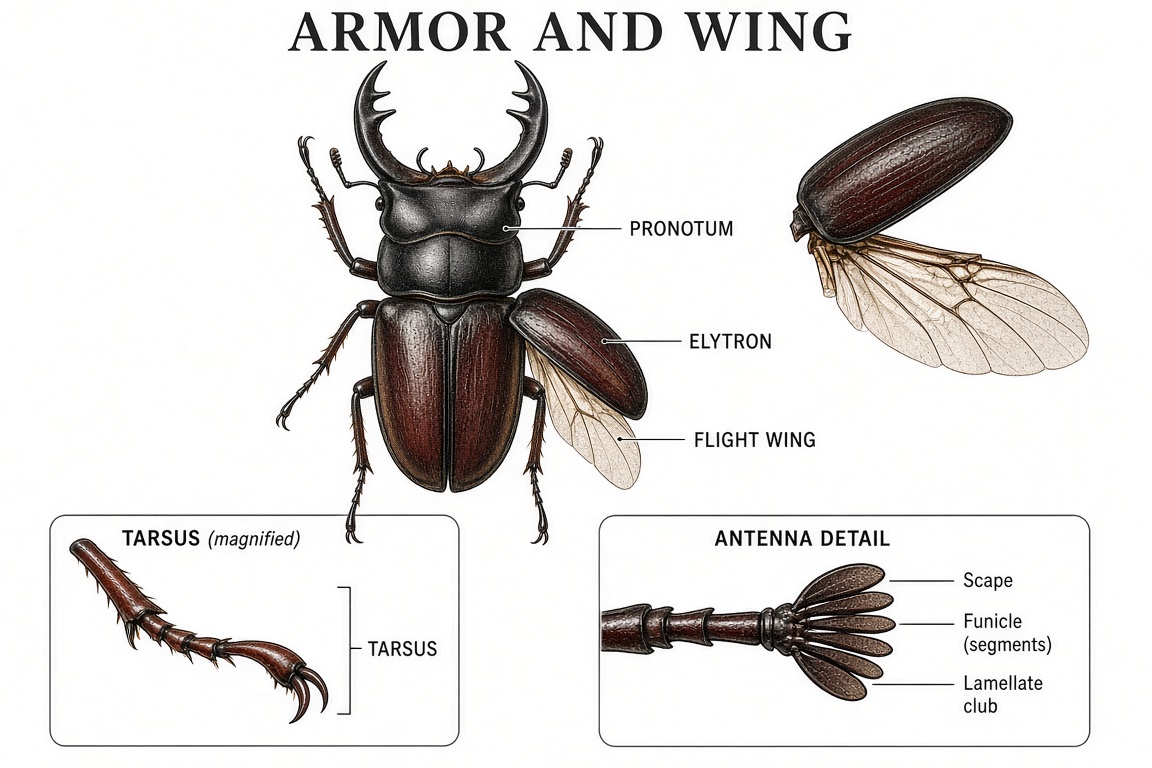
2. 甲虫の形態
A comparative coleopterology plate: one stag beetle in dorsal view with all major
sclerites labeled, one elytron lifted to reveal the folded flight wing, a leg with
tarsal segments magnified, and an antenna detail. Label "PRONOTUM", "ELYTRON",
"FLIGHT WING", "TARSUS". Title: "ARMOR AND WING".
確認:脚6本は胸部から。後翅は鞘翅の下に畳まれる(横ではない)。
3. チョウの翅の鱗粉
A lepidopteran figure bridging macro and micro: whole butterfly dorsal side, a wing
patch magnified to overlapping shingle-like scales, one scale at higher power
showing ridge ridges, and a structural-color diagram inset. Label "FOREWING",
"SCALES", "RIDGES", "STRUCTURAL COLOR". Title: "SHINGLES OF LIGHT".
確認:鱗粉は瓦のように基部から外向きに重なる。モルフォの青は構造色で色素ではない——インセットがそれを言っているか。

4. 翅脈図
A lepidopteran wing-venation plate: forewing and hindwing spread, veins traced and
named, one fritillary scale detail, and a wing-coupling mechanism inset.
Label "COSTA", "RADIUS", "MEDIAL", "FRENULUM". Title: "VEIN MAP".
確認:翅脈名は Comstock-Needham 体系に従う。翅係軛(フレヌラム)はガの連結器で、チョウにはない。
鳥類
5. キョクアオフクロウの狩り図版
A field-guide plate of the barn owl in three studies: perched frontal showing the
heart-shaped facial disc, wings spread from above, and a silent-flight hunting
dive, plus a feather-edge silence inset. Label "FACIAL DISC", "TALONS", "SECONDARY
FRINGE", "ASYMMETRIC EARS". Title: "SILENT HUNTER".
確認:顔盤はハート型で嘴を縁取る。耳孔は左右非対称(左が高い)——音源定位の源泉。

6. ハチドリのホバリング力学
A hovering-flight figure: hummingbird in hover with figure-eight wing-path stroke
cycle, shoulder rotation at reversal points, a nectar-feeding posture inset, and
lift-vector arrows during downstroke and upstroke. Label "WING PATH", "STROKE
CYCLE", "LIFT VECTOR", "FEEDING". Title: "FEATHERED HELICOPTER".
確認:上げ・下げ両ストロークで揚力。正面から見た翼軌道は8の字。

海洋生物
7. タコの解剖
A cephalopod anatomy figure: whole octopus in ventral view with arms numbered,
mantle cutaway exposing gills, ink sac and digestive gland, a chromatophore skin
inset, and a sucker magnification. Label "MANTLE", "GILL", "INK SAC",
"CHROMATOPHORES", "SUCKER". Title: "THE EIGHT-ARMED ENIGMA".
確認:腕8本、触腕なし(それはイカ・コウイカ)。吸盤は腕の口側のみ。

8. サメの歯型比較
A comparative odontology plate of three shark feeding strategies: pointed grabbing
teeth of the mako, triangular slicing teeth of the white shark, and flat crushing
plates of the nurse shark, each row with jaw arc and one tooth enlarged.
Label "GRABBING", "SLICING", "CRUSHING", "JAW ARC". Title: "TEETH TELL THE DIET".
確認:歯型と食性の対応(魚→捕獲、鰭脚類→切断、底生無脊椎→圧砕)。歯列は複数列で予備の歯が後ろに。

9. 深海の深度帯
A vertical ocean-trench cross-section from sunlit surface through twilight and
midnight zones to the hadal trench floor, with representative species at each depth
band and a pressure scale beside. Label "TWILIGHT ZONE", "MIDNIGHT ZONE",
"HADAL ZONE", "PRESSURE". Title: "THE DEEP LADDER".
確認:種は実際の深度帯に配置——定番ミスはハダカイワシ類を表層に描くこと。
比較解剖
10. ウマの歩容
A locomotion study plate of the horse's four natural gaits: walk, trot, canter and
gallop in sequence rows, each with footfall phase marks beneath and stride-length
arrows, drawn with anatomically correct legs. Label "WALK", "TROT", "CANTER",
"GALLOP", "FOOTFALL". Title: "GAIT STUDY".
確認:歩容の拍子——常歩4拍、速歩2拍、駈歩3拍、襲歩4拍+空中相。マイブリッジの連続写真が基準。

12のクイックバリエーション
| # | トピック | 一行変更 |
|---|---|---|
| 11 | 魚の外形 | "A perch in lateral view with fins, operculum and lateral line labeled, plus a scale detail inset… Label 'DORSAL FIN', 'OPERCULUM', 'LATERAL LINE', 'PECTORAL FIN'" |
| 12 | 魚のえら | "A fish head with operculum lifted showing gill filaments, one filament magnified with countercurrent flow arrows… Label 'GILL FILAMENT', 'COUNTERCURRENT'" |
| 13 | カエルの骨格 | "A frog skeleton in dorsal view with limbs spread, one leg magnified showing fused radioulna… Label 'VERTEBRAE', 'RADIOULNA', 'UROSTYLE'" |
| 14 | 鳥卵の発達 | "A cross-section of a bird egg at mid incubation with embryo, membranes and air cell… Label 'ALBUMEN', 'CHALAZA', 'AMNION', 'AIR CELL'" |
| 15 | ヘビの頭骨 | "A viper skull with hinged fangs shown closed and open, plus a venom duct path… Label 'FANG', 'VENOM DUCT', 'MAXILLA'" |
| 16 | ガとチョウ | "A paired comparison of moth and butterfly: antennae, wing coupling, resting posture… Label each difference" |
| 17 | クモの解剖 | "A spider dorsal and ventral view with spinnerets and book lungs inset… Label 'CEPHALOTHORAX', 'SPINNERET', 'BOOK LUNG'" |
| 18 | サンゴポリプ | "A coral colony surface with one polyp magnified showing tentacles, mesentery and zooxanthellae… Label 'TENTACLE', 'MESENTERY', 'ZOOXANTHELLAE'" |
| 19 | 変態 | "A five-stage tadpole-to-frog sequence with gills to lungs transition… Label 'GILLS', 'HIND LIMB', 'FORELIMB', 'TAIL RESORPTION'" |
| 20 | プランクトン | "A plankton sheet of eight forms: diatoms, copepod, jellyfish larva, foraminifera… Label each" |
ライフサイクル図(カエル・チョウ・変態系列)の完全な文法は専用ガイドで。
よくある質問
種レベルの模様はどの程度正確ですか?
普通種(ミツバチ、フクロウ)は図鑑の描写が学習空間を支配しているため、かなり近いものが出ます。稀種や類似種は科の平均像に寄ります——図鑑から識別点をプロンプトに足し、それから検証する、というのが定石です。「種名」の主張をモデルの一般概念に任せないこと。
背面図と側面図の指定の仕方は?
主語スロットで視点を名指し——"dorsal view"、"ventral view"、"lateral view"。対にするなら両方を明示:"dorsal and lateral views side by side"(ミツバチの図版のように)。視点を言わないと、どのラベルからも離れた斜め前视图になりがちです。
絶滅動物は描けますか?
描けます——古生物学の図版は意外に安定します(実例30選の三葉虫、スタイル比較の復古版画参照)。ただし復元上の主張(姿勢・色・軟組織)は科学的な主張です。現在の文献と照合し、学界が論争中なら、その論争を描くか、推定であることを図注で示します。
図鑑図版と解剖図の違いは?
丸ごと標本+識別点 対 内部構造。フクロウの図版は図鑑レジスター(丸ごと3姿)、タコの図版は解剖レジスター(断面で内部を出す)。プロンプトの違い:「field-guide plate, three studies」対「anatomy figure, cutaway exposing」。パネルを言わずに混ぜると、どちらの仕事もできない図になります。
インセットと縮尺の正直さは?
動物図版は拡大インセットに頼ります——翅鱗、胞子囊群、跗節——そしてインセットは縮尺の嘘が死ぬ場所です。機能する慣例:各インセットに倍率注記(×40)、主図にスケールバー、プロンプトに関係を明記("one scale at ×8 life size, inset at ×40")。絶対に機能しない:無言の拡大——拡大して描かれたディテールが実寸の解剖に読まれてしまう。インセットを最も厳しく検証してください(チェックリストの最後2項目がここで働きます)。
検証チェックリスト
- [ ] すべてのラベルのつづりは正しいか?
- [ ] 指定した構造はすべて描かれているか?
- [ ] 図鑑と比べて、位置と比率は妥当か?
- [ ] 矢印は正しい方向か?
- [ ] 行動系列(歩容・飛行)は正しい順序か?
- [ ] 信頼できる情報源と照合したか?
次のステップ
動物プリセットでこれらのプロンプトを実行してください。関連:実例30選 · 植物プロンプト · 生物図解プロンプト · スタイル比較。