SN2機構——求核剤、脱離基、遷移状態、傘反転、カーブドアロー——がプロンプト1つで。化学はAI下書きの地図で生物と工学の間にあります。機構とワークフローはきれいに描け、下付きと立体化学の精密構造は検証か専門描画が必要。この15選は描ける側に立ててあり、各プロンプトに確認ポイントを付けます。
化学プリセットを開く · ワークフロー完全版 · 生物プロンプト
化学特有のルール:ラベルの化学式は綴りで(CO₂ ではなく CO2)——下付きはラベル描画が崩れる場所だからです。結合角と立体が精密な構造式はChemDrawの領域。下書きできるのは「物語としての機構」です。
反応機構
1. SN2背面攻撃
An organic-chemistry mechanism figure: nucleophile approaching the stereocenter
from the side opposite the leaving group, the transition-state inset with dashed
bonds, umbrella-like inversion of configuration in the product, and a
curved-arrow notation panel. Label "NUCLEOPHILE", "LEAVING GROUP", "TRANSITION
STATE", "INVERSION". Title: "BACKSIDE ATTACK".
確認:求核剤は脱離基の正対(180°)から接近。反転=傘が裏返るような立体配置の反転。
2. 共有有機構造(COF)
A two-dimensional materials figure of a covalent organic framework: a periodic
honeycomb-like sheet of alternating organic linkers and vertex units, a magnified
inset of one vertex chemistry, and the stacked layers forming porous channels.
Label "LINKER", "VERTEX", "PORE", "STACKED LAYERS". Title: "COF SHEET".
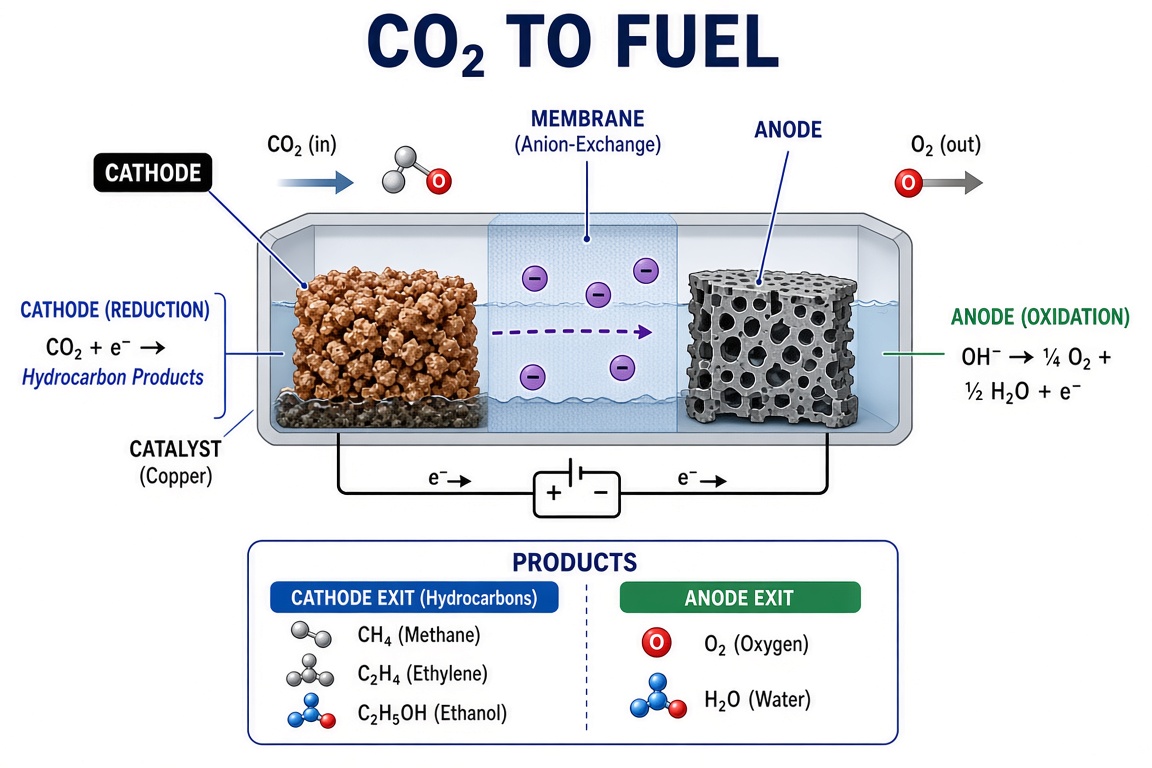
3. 電気化学CO2還元
An electrochemistry cell figure converting carbon dioxide: cathode with a copper
catalyst turning carbon dioxide into hydrocarbon products, anion-exchange
membrane in the middle, anode releasing oxygen, and a product palette listing
what exits each side. Label "CATHODE", "CATALYST", "MEMBRANE", "ANODE",
"PRODUCTS". Title: "CO2 TO FUEL".
確認:還元はカソード、酸化はアノード——決して逆にしない。CO2はカソード側へ。
4. 標的送達
An organ-targeted delivery figure: a nanoparticle with ligand keys on its
surface, circulating in a capillary, binding its receptor on the target organ's
cells, releasing its cargo inside, and one magnified inset of the ligand-receptor
docking. Label "NANOPARTICLE", "LIGAND", "RECEPTOR", "CARGO".
Title: "ADDRESSED DELIVERY".
装置とワークフロー
5. 単蒸留
A classic simple-distillation apparatus: round-bottom flask with boiling liquid
on a heat source, thermometer at the side-arm head, condenser with water in at
the bottom and out at the top, and the receiver collecting distillate.
Label "FLASK", "THERMOMETER", "CONDENSER", "RECEIVER".
Title: "SIMPLE DISTILLATION".
確認:凝縮水は蒸気と対向流(下から入り上から出す)。温度計の球部は側管の位置で、液中ではない。
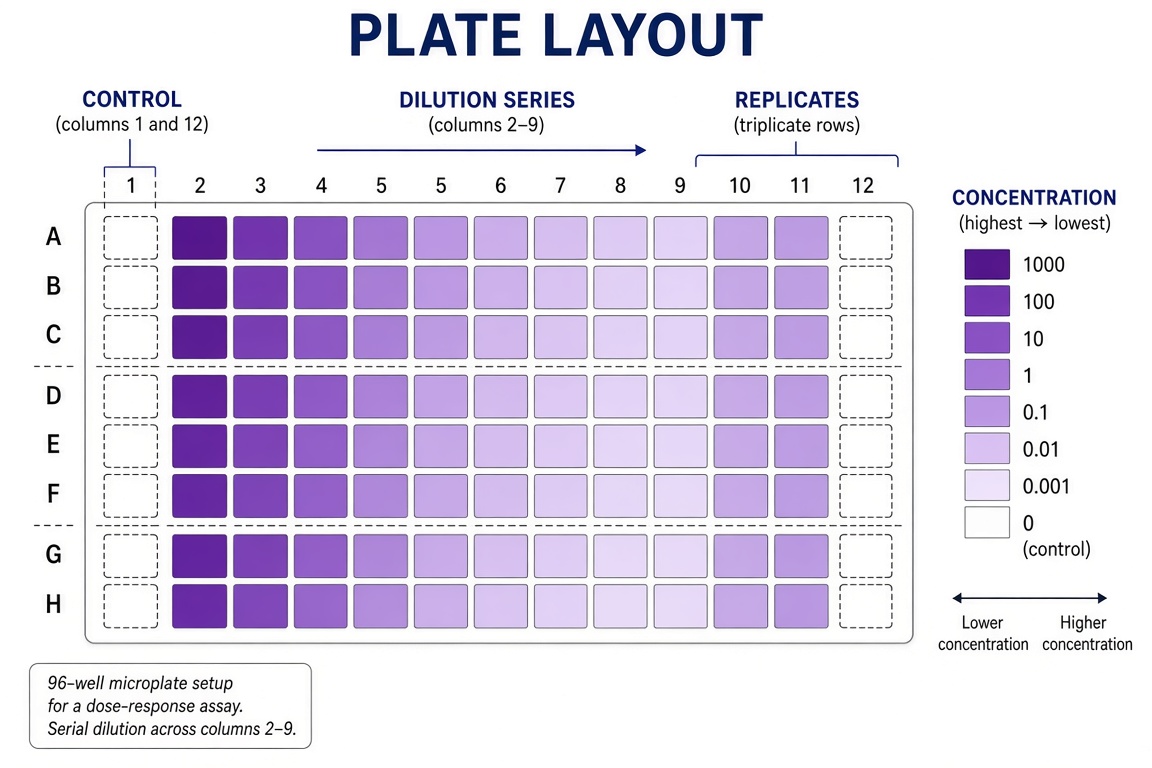
6. 96ウェルプレート配置
A top-down layout of a 96-well microplate set up for a dose-response assay:
eight rows by twelve columns, control wells in the outer columns, a serial
dilution gradient across the middle, and triplicate rows. Label "CONTROL",
"DILUTION SERIES", "REPLICATES" and add a small color-concentration legend.
Title: "PLATE LAYOUT".
確認:希釈勾配は一方向に列をまたぐ。トリプリケートは行。
7. サンドイッチELISA
A four-step laboratory workflow for a sandwich ELISA from coating the plate through
blocking and sample incubation to detection, each step as a small labeled panel
connected by arrows. Label "COATING", "BLOCKING", "INCUBATION", "DETECTION".
Title: "SANDWICH ELISA WORKFLOW".
確認:捕獲抗体が先、検出抗体が上。

8. RT-qPCR
A bench workflow figure for a quantitative PCR run: template and master mix on ice,
plate setup with standards and controls in a layout grid, thermal cycling profile
with annealing step, and melt-curve verification at the end. Label "MASTER MIX",
"STANDARDS", "THERMAL CYCLE", "MELT CURVE". Title: "THE QPCR RUN".

9. 滴定
An acid-base titration figure: buret over a flask with indicator, and beside it
the pH curve with buffer region, equivalence point marked and endpoint color
change annotated. Label "BURET", "EQUIVALENCE POINT", "BUFFER REGION".
Title: "THE TITRATION".
確認:強酸-強塩基の当量点はpH7。飛躍の急峻さが具体的数値より重要——「概略」と注記。
10のクイックバリエーション
| # | トピック | 一行変更 |
|---|---|---|
| 10 | カラムクロマト | "A column chromatography figure: stationary phase, sample band loading, elution and separated bands… Label 'STATIONARY PHASE', 'MOBILE PHASE', 'ELUTION'" |
| 11 | ろ過 vs 傾瀉 | "A two-panel comparison of gravity filtration and decantation setups… Label each" |
| 12 | 三態 | "A three-panel particle view of solid, liquid and gas with particle spacing and motion… Label each state" |
| 13 | pH目盛り | "A horizontal pH scale from 0 to 14 with example substances and color gradient… Label 'ACIDIC', 'NEUTRAL', 'BASIC'" |
| 14 | 衝突説 | "A figure of two reacting molecules with insufficient energy bouncing and sufficient energy reacting… Label 'ACTIVATION ENERGY'" |
| 15 | ル・シャトリエ | "An equilibrium disturbed by added reactant, with the system's shift and re-equilibration… Label 'STRESS', 'SHIFT'" |
よくある質問
AIは構造式を正しく描けますか?
描けません。結合角、立体くさび、電子対の位置は「精密幾何」の類で、生成はそこでそれっぽい誤りを生産します。機構の物語(誰が誰を攻め、何が離れる)は上のSN2図のようにきれいに下書きできますが、本物の構造はChemDraw等の領域です。機構はプロンプトで、分子は描画ソフトで。
実験レポートの装置図に使えますか?
概念装置——何が何に繋がり、水がどちらへ流れるか——には十分で、クリップアートより良い。採点対象の規範図(すり合わせ規格など)は课程の定める記号で。ハイブリッド:レポートの概観にAI図、付録に規範図。
化学式を綴りで書く理由は?
下付きは描画の弱点——モデルはわずかに誤った小さな「2」を描き、図版サイズではノイズに読めます。CO2、H2Oと綴ればきれいに描けます。最終図に本物の下付きが必要なら、ベクター化で5分、タイポグラフィはあなたのものになります。
図に数値を入れられますか——濃度、温度、収率?
生成図の数値はプレースホルダとして扱う。描かれますが、モルの概念を知らないシステムが打ったものです。意味を持つ数値は後から自分で活字化し、プレースホルダを学生や同僚が引用するかもしれないものに残さない。
微生物プレート——画線、阻止円は?
配置の図としてはきれいに描けます。四分区画の画線、ディスク拡散の阻止円。生物を確認——区画の進行、阻止円はプレート中心でなくディスクを中心に対称、実測の直径は図注に打刻で(偽の縮尺で描かない)。
実験レポートに何枚くらい使えますか?
概観図1枚(装置の接続と流れ)+工程図1枚(手順の順序)の2枚で十分です。それ以上はレポートが図集になり、文章で書くべき考察を置き換えてしまいます。数値・条件は必ず本文側に——図は配置、文は測定という分担を守ってください(ラベル数ルールも参照)。
実験レポート:図と文の分担
機能する分担:図は配置(装置の順序、工程の段階、プレート配置)を、文は測定(すべての数値、すべての条件)を運ぶ。手順として意味のある段階——「コンデンサーは下から水を」——は文章より図が適任。定量的に意味のある段階は、どんな図にも載せない。ラベル数ルールは実験図で倍加します——装置ラベルは長く(CONDENSER、THERMOCOUPLE)、すぐ混みます。
検証チェックリスト
- [ ] すべてのラベルのつづりは正しいか(化学式は綴り表記)?
- [ ] 指定した装置はすべて接続され、順序は正しいか?
- [ ] 矢印は正しい方向か(水流、蒸気経路、電子の流れ)?
- [ ] 機構は化学どおりか(背面攻撃は背面か)?
- [ ] 定量的なものは「概略」と明記されているか?
- [ ] 信頼できる情報源と照合したか?