この二重らせん——逆向き平行鎖、色分けされた塩基対、溝の注記、解鎖インセット——は40語のプロンプト1つでできています。以下は同じ水準の生物図解プロンプト25選です。トピック別に整理し、それぞれにラベル一覧と確認すべき事実を付けました。そのまま生成器に貼るか、題材だけ差し替えて使ってください。
生物プリセットを開く · ワークフロー完全版 · 実例30選
このパックの読み方:どのプロンプトも同じ文法に従います——主語、パネル、引用符付きラベル、タイトル。引用符ラベルが文字を正しく描画させ、名指しされたパネルが「壁掛けアート」ではなく「図」を出力させます。授業の題材と合わなければ、主語行だけ変えて構造を残します。プロンプトは英語のまま使います(図中ラベルは英語大文字が最も安定)。説明は日本語で書いて構いません。
細胞
1. DNA二重らせん
An elegant structural figure of the DNA double helix: two antiparallel strands,
base pairs as rungs with the four bases color-coded, a major and minor groove
callout, and one unzipping replication inset. Label "STRAND", "BASE PAIR", "MAJOR
GROOVE", "MINOR GROOVE". Title: "THE DOUBLE HELIX".
確認:2本の鎖は逆向き平行(一方は5'→3'、他方は3'→5')。A-T対は水素結合2本、G-Cは3本——インセットで均一化されていないか。
2. DNA複製フォーク
A DNA replication fork with the parental double helix opening into a leading strand
and a lagging strand with Okazaki fragments, helicase at the fork and DNA polymerase
on the new strand, synthesis in the 5' to 3' direction. Label "HELICASE", "LEADING
STRAND", "LAGGING STRAND", "OKAZAKI FRAGMENT", "DNA POLYMERASE".
Title: "THE REPLICATION FORK".
確認:ラギング鎖の岡崎フラグメントはフォークから離れる向き。両新鎖とも5'→3'で合成——逆に描かれていたら方向を明記して再生成。

3. 動物細胞の細胞小器官
A large cutaway animal cell with its organelles arranged realistically, each
organelle shown once with a short functional caption beside it in a small grid
around the cell. Label "NUCLEUS", "MITOCHONDRION", "ROUGH ER", "GOLGI",
"LYSOSOME". Title: "THE ANIMAL CELL".
確認:粗面小胞体は核に接する。中心体は核の近くで膜の近くではない。
4. 動物細胞 vs 植物細胞
A paired cutaway comparison of an animal cell and a plant cell at matching scale,
with shared organelles in the middle band and unique structures at the outer edges,
plus a small legend for the color coding. Label "NUCLEUS", "MITOCHONDRION", "CELL
WALL", "CHLOROPLAST", "VACUOLE". Title: "ANIMAL VS PLANT".
確認:大きな中央液胞と細胞壁は植物側のみ。色の凡例が実際の描画と一致しているか。

5. 4種の分化した動物細胞
A comparative row of four specialized cells at matching scale: a neuron with
dendrites and long axon, a red blood cell as a biconcave disc, a sperm cell, and a
macrophage spreading pseudopods, each with two functional labels.
Title: "CELL SPECIALISTS".
確認:スケールの主張は危険——赤血球は約7 µm、ニューロンの軸索は1 mに達するため、「縮尺不同」を明記(スケールバーを付けるなら別)。
光合成と植物生理
6. 光化学系Z図(Zスキーム)
A Z-scheme figure of the light reactions: photosystem two splitting water and
sending electrons through plastoquinone, cytochrome, plastocyanin to photosystem
one, ferredoxin reducing NADP, and the proton gradient feeding ATP synthase.
Label "PSII", "PSI", "PLASTOQUINONE", "NADP", "ATP SYNTHASE".
Title: "Z SCHEME".
確認:電子の流れはPSII→PSI。水はPSIIで分解され(酸素はそこで放出)、ATPシンターゼはチラコイド膜に埋まり、プロトンはルーメン側に溜まる。

7. 葉緑体のプロトン輸送
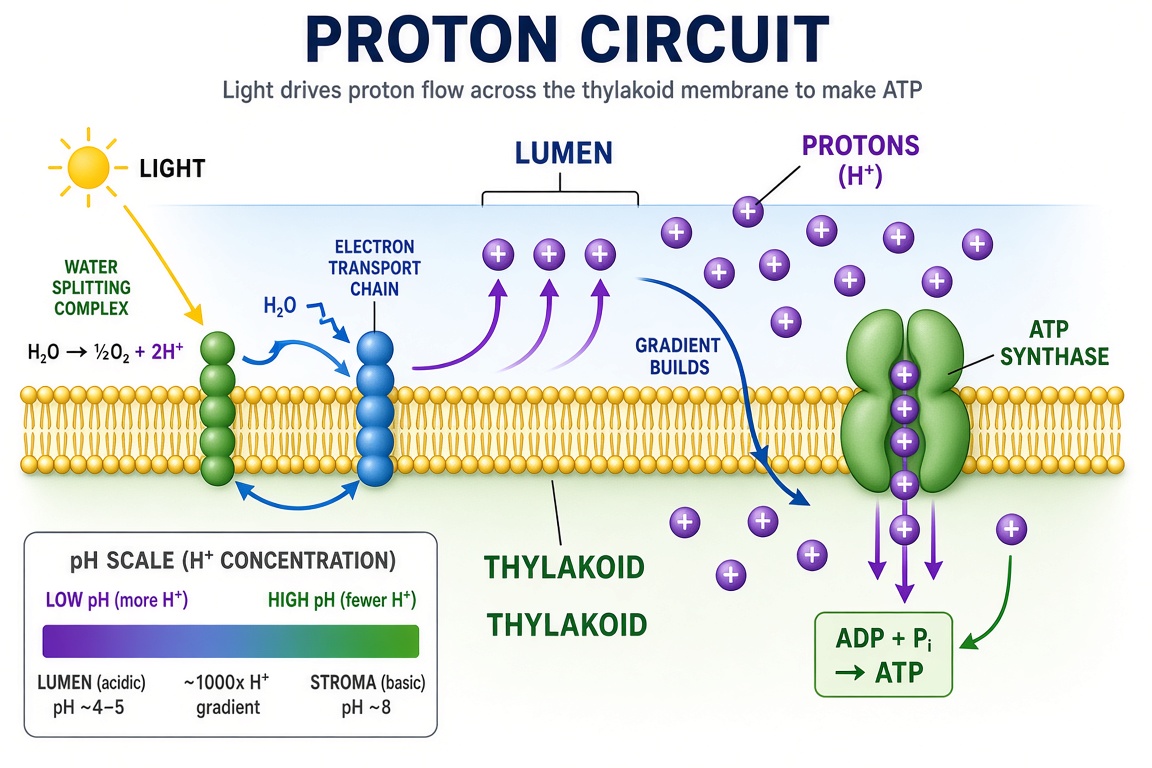
A chloroplast figure centered on the thylakoid membrane: protons pumped into the
lumen by the electron transport chain flowing back out through ATP synthase,
stroma-side NADP reduction, and one granum stack inset showing where all this sits.
Label "LUMEN", "STROMA", "PROTON", "ATP SYNTHASE", "NADP".
Title: "PROTON TRAFFIC".
確認:ルーメンとストロマの両側——プロトンはルーメン内に蓄積。カルビン回路はストロマで、ルーメンではない。
8. 植物の乾燥ストレス応答
A plant-physiology figure of drought response: roots sensing dry soil, abscisic
acid traveling up the xylem, guard cells closing stomata, leaf rolling and
osmoprotectant accumulation, with a healthy versus stressed plant pair.
Label "ABA", "GUARD CELL", "STOMATA", "OSMOPROTECTANT". Title: "SURVIVING DRYNESS".
確認:ストレス株では気孔が閉じ(孔辺細胞が萎軟)、ABAの矢印は木部を通って根→葉。
遺伝と分子
9. CRISPR-Cas9のメカニズム
A gene-editing mechanism figure: the Cas9 protein as a bilobed clamp, guide RNA
threaded inside base-pairing with the target DNA, the HNH and RuvC domains cutting
both strands, and a repaired insert outcome panel. Label "CAS9", "GUIDE RNA",
"TARGET DNA", "CUT SITE", "INSERT". Title: "GENE EDITING".
確認:ガイドRNAは標的鎖と塩基対合。PAM配列は切断直後の非標的鎖側にある。
10. 抗体と抗原の結合
A molecular figure of an antibody with its two heavy and two light chains, the
antigen-binding sites gripping a small antigen, and one magnified inset of the
paratope-epitope interface. Label "HEAVY CHAIN", "LIGHT CHAIN", "PARATOPE",
"EPITOPE". Title: "ANTIBODY STRUCTURE".

11. T4ファージ
A structural figure of the T4 bacteriophage with its icosahedral head, contractile
sheath, tail fibers and base plate, plus one inset showing the tail injecting DNA
into a bacterial envelope. Label "HEAD", "SHEATH", "TAIL FIBER", "BASE PLATE",
"DNA". Title: "T4 PHAGE".
確認:感染インセットでは尾繊維の付着が先、鞘の収縮が後。
12. アミロイドβの凝集段階
A four-stage molecular figure of peptide aggregation: free monomers, small oligomer
rings, a growing fibril strand shown as a twisted beta-sheet ladder, and a dense
senile plaque mass with microglia reacting at the edge. Label "MONOMER", "OLIGOMER",
"FIBRIL", "PLAQUE". Title: "AGGREGATION".
確認:繊維の断面はβシートの積層。αヘリックスに見えたら再生成。
微生物学と実験
13. 96ウェルプレートのレイアウト
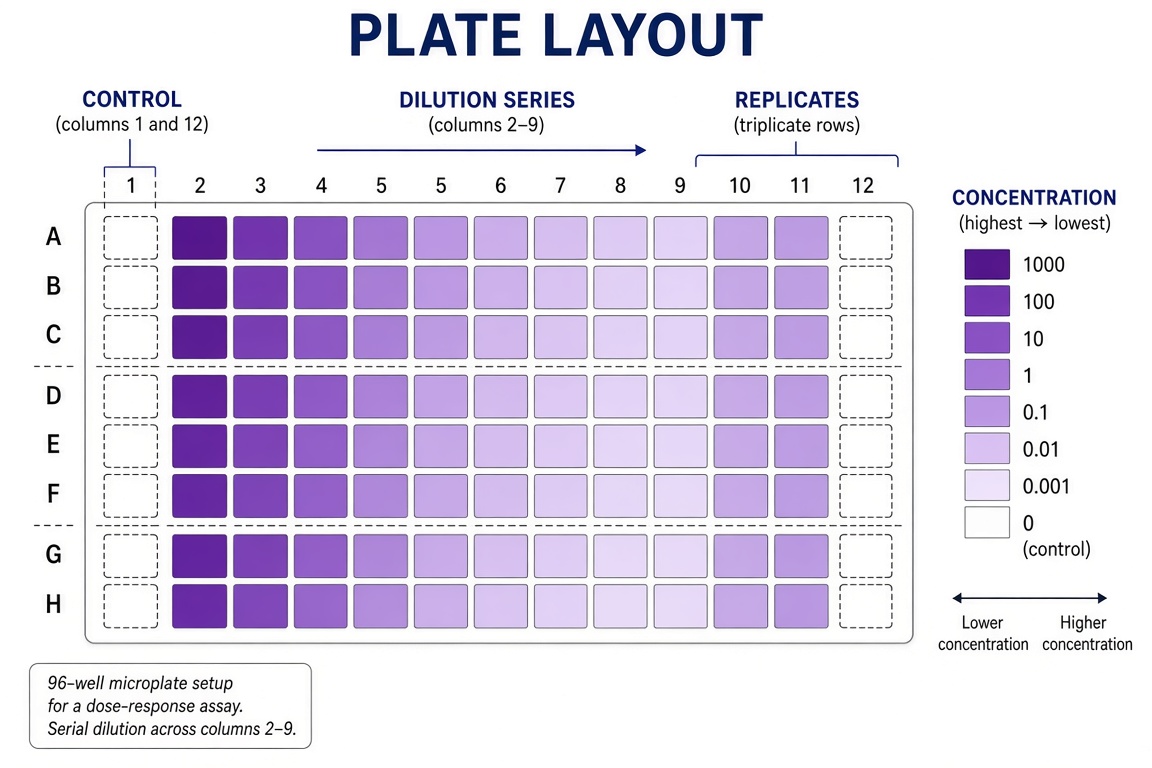
A top-down layout of a 96-well microplate set up for a dose-response assay:
eight rows by twelve columns, control wells in the outer columns, a serial
dilution gradient across the middle, and triplicate rows. Label "CONTROL",
"DILUTION SERIES", "REPLICATES" and add a small color-concentration legend.
Title: "PLATE LAYOUT".
確認:希釈勾配は一方向に列をまたぐ。トリプリケートは行であって列ではない。
14. RT-qPCRの流れ
A bench workflow figure for a quantitative PCR run: template and master mix on ice,
plate setup with standards and controls in a layout grid, thermal cycling profile
with annealing step, and melt-curve verification at the end. Label "MASTER MIX",
"STANDARDS", "THERMAL CYCLE", "MELT CURVE". Title: "THE QPCR RUN".

15. サンドイッチELISA
A four-step laboratory workflow for a sandwich ELISA from coating the plate through
blocking and sample incubation to detection, each step as a small labeled panel
connected by arrows. Label "COATING", "BLOCKING", "INCUBATION", "DETECTION".
Title: "SANDWICH ELISA WORKFLOW".
確認:捕獲抗体が先にプレートに、検出抗体がその上——「サンドイッチ」の順序は授業で一番間違えられる部分。

発生とシステム
16. バイオプリンティング
A figure of extrusion bioprinting: a printhead depositing parallel bioink strands
onto a grid scaffold, cells visible inside the strands in a magnified inset, and
the finished layered tissue construct on the right. Label "PRINTHEAD", "BIOINK",
"CELLS", "SCAFFOLD", "CONSTRUCT". Title: "BIOPRINTING".
17. 血球の家系図
A classic hematopoiesis tree: the hematopoietic stem cell at the root branching
through progenitors into red cells, platelets, granulocytes, monocytes and
lymphocytes, each mature cell drawn at the leaf. Label "STEM CELL", "PROGENITOR",
"RED CELL", "PLATELET", "LYMPHOCYTE". Title: "BLOOD LINEAGES".
8つのクイックバリエーション
主語を差し替えて文法を維持:
| # | トピック | 一行変更 |
|---|---|---|
| 18 | 原核 vs 真核 | "A paired comparison of a bacterial cell and a eukaryotic cell… Label 'NUCLEOID', 'RIBOSOMES', 'PILI', 'NUCLEUS'" |
| 19 | 体細胞分裂 | "A five-panel row of mitosis stages: prophase, prometaphase, metaphase, anaphase, telophase… Label each panel" |
| 20 | 減数分裂交叉 | "A tetrad with chiasmata crossing over between homologous chromosomes… Label 'TETRAD', 'CHIASMA', 'RECOMBINANT'" |
| 21 | 酵素反応速度 | "A lock-and-key figure plus a Michaelis-Menten curve inset… Label 'SUBSTRATE', 'ACTIVE SITE', 'VMAX', 'KM'" |
| 22 | 窒素循環 | "A four-reservoir cycle figure: atmosphere, soil, plants, decomposers… Label 'N2', 'NITRIFICATION', 'ASSIMILATION', 'DENITRIFICATION'" |
| 23 | シナプス | "A chemical synapse with vesicles fusing, neurotransmitters crossing the cleft, receptors on the postsynaptic side… Label 'VESICLE', 'CLEFT', 'RECEPTOR'" |
| 24 | 細胞膜 | "A fluid-mosaic membrane cross-section with phospholipids, channel protein, glycoprotein… Label 'PHOSPHOLIPID', 'CHANNEL', 'GLYCOPROTEIN'" |
| 25 | 転写 | "A DNA strand opening with RNA polymerase transcribing mRNA, one gene with promoter and terminator… Label 'PROMOTER', 'RNA POLYMERASE', 'mRNA'" |
ライフサイクル図(カエル・チョウ・植物・恒星)の完全な文法は専用ガイドで。
検証チェックリスト
- [ ] すべてのラベルのつづりは正しいか?
- [ ] 指定した構造はすべて描かれているか?
- [ ] 参考文献と比べて、位置と比率は妥当か?
- [ ] 矢印は正しい方向を向いているか?
- [ ] 段階は正しい順序か?
- [ ] 信頼できる情報源と照合したか?
よくある質問
日本語の授業(理科・生物)でそのまま使えますか?
プロンプトを英語のまま貼り付ければ、図は英語ラベル付きで生成されます。授業では「英語ラベル+口頭で日本語対応を示す」運用が最も手軽です(専門英語の教材にもなります)。日本語ラベルが必須のプリントは、ベクター化ワークフローで後から文字を打ち直すのが確実です。
一度に何枚くらい作るのが現実的ですか?
1枚5〜10分(生成2分+検証5分+保存3分)。単元ごとに5枚そろえるなら1時間弱で、翌年からはファイルを開くだけです。教師向けガイドに年間運用の考え方をまとめてあります。
次のステップ
生物プリセットで任意のプロンプトを実行し、授業前に教科書と照合してください。関連:人体解剖図プロンプト · 植物プロンプト · よくある失敗と修正。