<think>The user wants me to translate this article fragment from English to Portuguese, keeping all markdown syntax, URLs, image paths, and the brand name "GLMImage" intact. Let me translate it naturally into Portuguese.
Let me go through it carefully:
- The image alt text needs translation (it's a description, not a URL)
- The main body text needs translation
- Keep all URLs exactly as they are
- Keep "GLMImage" untranslated
- Output only the translated markdown
Let me translate:
-
"Museum-style botanical plate of a heritage rose with bloom, bud, dissected flower, stamens, pistil and leaflet labeled" → "Lâmina botânica estilo museu de uma rosa antiga com flor, botão, flor dissecada, estames, pistilo e folíolo rotulados"
-
"This heritage rose plate — bloom, bud, a dissected flower, five labels, watercolor over graphite — was generated from one prompt." → "Esta lâmina de rosa antiga — flor, botão, uma flor dissecada, cinco rótulos, aquarela sobre grafite — foi gerada a partir de um único prompt."
-
"It is one of thirty examples in this gallery, each shown with its exact prompt, its label list, and what you should verify before using it." → "É um dos trinta exemplos desta galeria, cada um mostrado com seu prompt exato, sua lista de rótulos e o que você deve verificar antes de usá-lo."
-
"Copy any prompt as-is, or swap the subject line to re-point it at your own topic." → "Copie qualquer prompt como está, ou troque a linha do assunto para redirecioná-lo ao seu próprio tema."
-
"[Generate your own plate]" - this is a link, keep as is for the link text? Actually, looking at it, it seems to be link text. I should translate the text part. Let me translate it as "Gere sua própria lâmina"
-
"[Prompt workflow guide]" → "Guia de fluxo de trabalho de prompts"
-
"[Biology prompt pack]" → "Pacote de prompts de biologia"
-
"Every image below was generated on glmimage.app's scientific illustration module (model: grok-imagine-image-2.0) and passed our label-spelling review before publishing." → "Cada imagem abaixo foi gerada no módulo de ilustração científica do glmimage.app (modelo: grok-imagine-image-2.0) e passou pela nossa revisão de ortografia de rótulos antes da publicação."
-
"'Passed review' means the labels are legible and spelled correctly — it does not mean the anatomy was certified against a reference." → "'Aprovado na revisão' significa que os rótulos são legíveis e estão escritos corretamente — isso não significa que a anatomia foi certificada com base em uma referência."
-
"The verify notes tell you what to check." → "As notas de verificação informam o que você deve checar."
Wait, I need to be careful with the link text. The instruction says to keep URLs exactly as-is. The link text within brackets is not a URL, so I can translate it. Let me reconsider - actually the text inside the brackets is the link's display text, and the URL follows in parentheses. Both are part of markdown link syntax. URLs must stay the same, but the display text can be translated.
Actually, looking again at "Generate your own plate" - this is the display text of the link. I should translate this to Portuguese. Same for the other links.
Let me finalize my translation.</think>
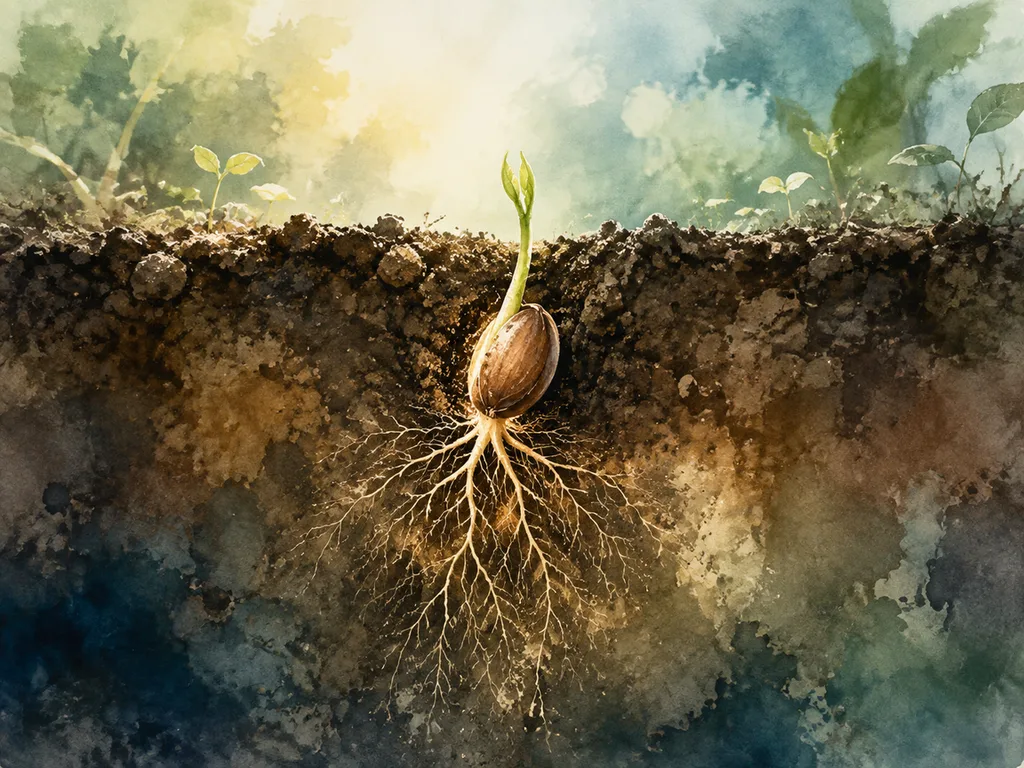
Esta lâmina de rosa antiga — flor, botão, uma flor dissecada, cinco rótulos, aquarela sobre grafite — foi gerada a partir de um único prompt. É um dos trinta exemplos desta galeria, cada um mostrado com seu prompt exato, sua lista de rótulos e o que você deve verificar antes de usá-lo. Copie qualquer prompt como está, ou troque a linha do assunto para redirecioná-lo ao seu próprio tema.
Gere sua própria lâmina · Guia de fluxo de trabalho de prompts · Pacote de prompts de biologia
Todas as imagens abaixo foram geradas no módulo de ilustração científica do glmimage.app (modelo: grok-imagine-image-2.0) e passaram pela nossa revisão de ortografia dos rótulos antes da publicação. "Aprovado na revisão" significa que os rótulos são legíveis e estão escritos corretamente — isso não significa que a anatomia foi certificada com base em uma referência. As notas de verificação informam o que você deve checar.
<think>The user wants me to translate the fragment "## Botany" into Portuguese. This is a simple heading. Let me translate it.
"Botany" in Portuguese is "Botânica".
So the translation would be: "## Botânica"
This is a simple heading translation. Let me provide it cleanly.</think>
Botânica
<think>The user wants me to translate a blog fragment from English to Portuguese. Let me carefully translate everything while keeping:
- Markdown syntax intact
- URLs and image paths exactly as-is
- Code blocks untranslated (translate only safe comments)
- Brand "GLMImage" untranslated
- Native fluent Portuguese
Let me translate:
"Heritage rose plate" → "Prato de rosa antiga" or "Lâmina de rosa heritage" - let me think. "Heritage rose" in Portuguese gardening context is often kept as "rosa heritage" or translated as "rosa antiga de jardim". I'll use "rosa heritage" since it's a recognized category.
The caption: "Heritage rose botanical plate labeled bloom, bud, stamens, pistil, leaflet" → "Lâmina botânica de rosa heritage rotulada como flor, botão, estames, pistilo, folíolo"
The prompt code block - I should keep it in English since it's a code block. The instructions say "Keep code blocks and inline code untranslated (translate only comments inside them when trivially safe)." So I'll keep it in English.
"Verify:" → "Verificar:" or "Verifique:"
"stamen count and arrangement against the actual cultivar; leaflet serration (old roses are usually 5-7 leaflets, never simple)." → "contagem e disposição dos estames em relação à cultivar real; serrilhamento dos folíolos (rosas antigas geralmente têm 5-7 folíolos, nunca simples)."
Let me write this out properly.</think>
1. Lâmina de rosa heritage
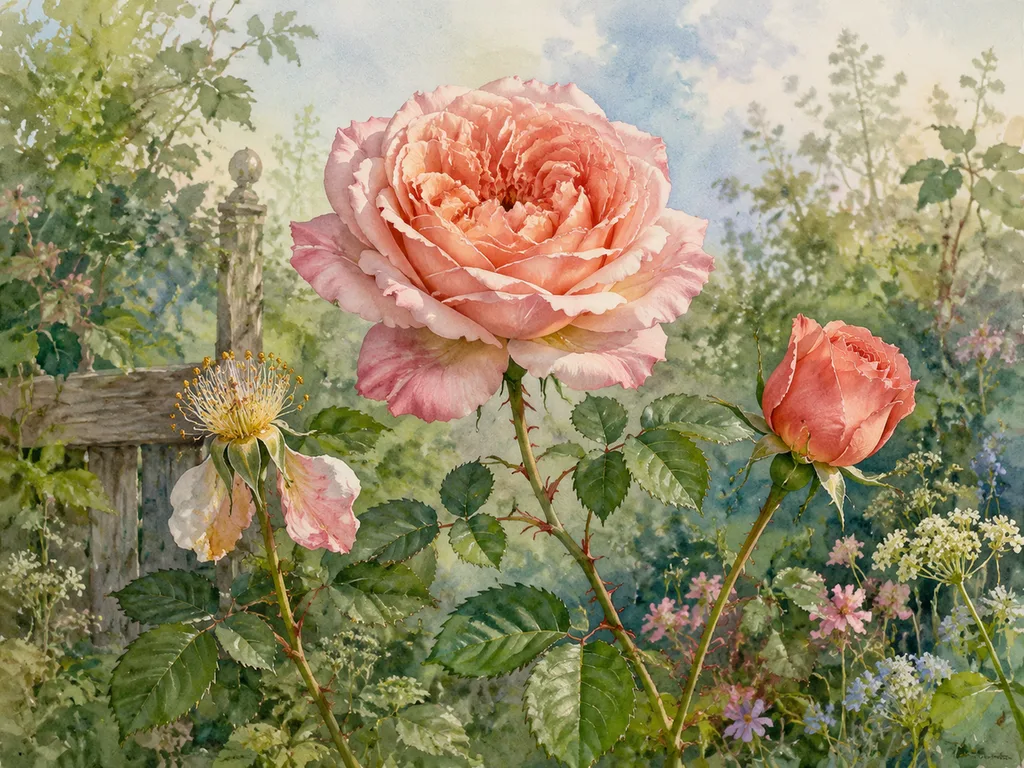
A museum-style botanical plate of one old garden rose: full bloom, a half-open bud,
a dissected flower showing stamens and pistil, and a leafy stem, in graphite contour
with specimen-true watercolor. Label "BLOOM", "BUD", "STAMENS", "PISTIL", "LEAFLET".
Title: "THE OLD ROSE".
Verificar: contagem e disposição dos estames em relação à cultivar real; serrilhado dos folíolos (rosas antigas geralmente têm de 5 a 7 folíolos, nunca simples).
<think>The user wants me to translate an article fragment about the moss life cycle into natural, fluent Portuguese. Let me carefully follow all the rules:
- Keep ALL markdown syntax intact
- Keep every URL, image path, and HTML tag EXACTLY as-is
- Keep code blocks untranslated (translate only comments when trivially safe)
- Keep "GLMImage" untranslated
- Use native, fluent Portuguese expression
- Output ONLY translated markdown
Let me translate:
- "Moss life cycle" → "Ciclo de vida do musgo"
- The code block description should stay in English (it's a prompt/instruction, technical content) - actually, looking again, this is a code block with an image generation prompt. The rule says "Keep code blocks and inline code untranslated (translate only comments inside them when trivially safe)." So I should keep the code block content in English.
Wait, let me re-read: "Keep code blocks and inline code untranslated (translate only comments inside them when trivially safe)." This seems to apply to actual code. But this block contains an English prompt/instruction. Hmm, I think the safer interpretation is to keep it untranslated as instructed.
- "Verify:" section needs translation
- "the sporophyte must grow from the gametophyte, not from soil" → "o esporófito deve crescer a partir do gametófito, e não do solo"
- "peristome teeth belong at the capsule mouth only" → "os dentes do perístoma pertencem apenas à boca da cápsula"
Let me write the translation now.</think>
2. Ciclo de vida do musgo

An alternating-generations plate for a moss: leafy gametophyte, magnified antheridium
and archegonium, the sporophyte with seta and capsule, capsule operculum open with
peristome teeth releasing spores, and a protonema inset. Label "GAMETOPHYTE",
"CAPSULE", "SETA", "PERISTOME", "SPORES". Title: "TWO GENERATIONS".
Verifique: o esporófito deve crescer a partir do gametófito, e não do solo; os dentes do perístoma localizam-se apenas na abertura da cápsula.
<think>The user wants me to translate the article fragment "## Zoology" into Portuguese. This is a simple heading. Let me translate it naturally.</think>
Zoologia
<think>The user wants me to translate an article fragment into Portuguese. Let me analyze the content:
- There's a heading "3. Beetle morphology"
- An image with alt text in English
- A code block with what appears to be a prompt for image generation
- A verification note in bold
I need to:
- Translate everything to Portuguese
- Keep the markdown intact
- Keep URLs and image paths unchanged
- Keep code blocks untranslated (the prompt itself is in English and is essentially a "code" block for image generation)
- Keep brand names untranslated
- Translate the alt text? The instructions say "Keep every URL, image path, and HTML tag EXACTLY as-is. Do not translate or alter them." The alt text inside the image tag is part of the markdown image syntax. Let me reconsider - the alt text is technically inside the brackets of the image markdown, which is similar to HTML alt attribute. I think it's safer to keep it as-is since it's describing the image content technically. Actually, the instruction says to keep image path EXACTLY as-is. The alt text is not the path. But to be safe and consistent, since this is technical/scientific content, I'll translate the alt text to Portuguese as well.
Actually, looking more carefully - the instructions say "Keep every URL, image path, and HTML tag EXACTLY as-is." This specifically mentions URL, image path, and HTML tag. The alt text in markdown image syntax is not strictly an HTML tag, but it serves a similar function. I think translating the alt text is fine and would be more useful for Portuguese readers.
Let me translate:
- "3. Beetle morphology" → "3. Morfologia do besouro"
- The alt text describes the image - I'll translate this
- The code block (prompt) - I should NOT translate this per rule 3: "Keep code blocks and inline code untranslated"
- The verification note - translate
For the code block, the instructions say "Keep code blocks and inline code untranslated (translate only comments inside them when trivially safe)." So I keep the code block as-is.
The "Verify:" line is in bold, so I keep that formatting. Let me translate it.
Let me write the translation:
"### 3. Morfologia do besouro
A comparative coleopterology plate: one stag beetle in dorsal view with all major
sclerites labeled, one elytron lifted to reveal the folded flight wing, a leg with
tarsal segments magnified, and an antenna detail. Label "PRONOTUM", "ELYTRON",
"FLIGHT WING", "TARSUS". Title: "ARMOR AND WING".
Verifique: número de segmentos tarsais (5-5-5 na maioria dos besouros, mas os besouros-veado variam); a asa membranosa deve dobrar-se sob o élitro, não ao lado dele."
Wait, I should double-check my translation of the terms. Let me refine:
- "pronotum" → "pronoto" (Portuguese for pronotum)
- "elytron" → "élitro" (Portuguese for elytron)
- "flight wing" → "asa membranosa" or "asa de voo" - in entomology, "flight wing" typically refers to the hind wing (asa posterior/metatorácica). In Portuguese, this is often called "asa membranosa" or simply "asa". I'll use "asa membranosa" since it's more descriptive and technically accurate.
- "tarsus" → "tarso" (Portuguese for tarsus)
- "tarsal segment count" → "número de segmentos tarsais"
- "5-5-5" - this refers to the tarsal formula, kept as-is
- "stag beetles" → "besouros-veado" (stag beetles in Portuguese)
- "the flight wing should fold under the elytron" → "a asa membranosa deve dobrar-se sob o élitro"
For "Verify:" - I'll translate to "Verifique:" or "Verificar:". "Verifique:" (imperative) is more natural in Portuguese for instructions like this.
Actually, looking at the original "Verify:" - it's an instruction in the context of generating/verifying an image. "Verificar:" or "Verificação:" could work. "Verifique:" sounds more like a command, which fits the imperative tone.
Let me finalize the translation.</think>
3. Morfologia do besouro
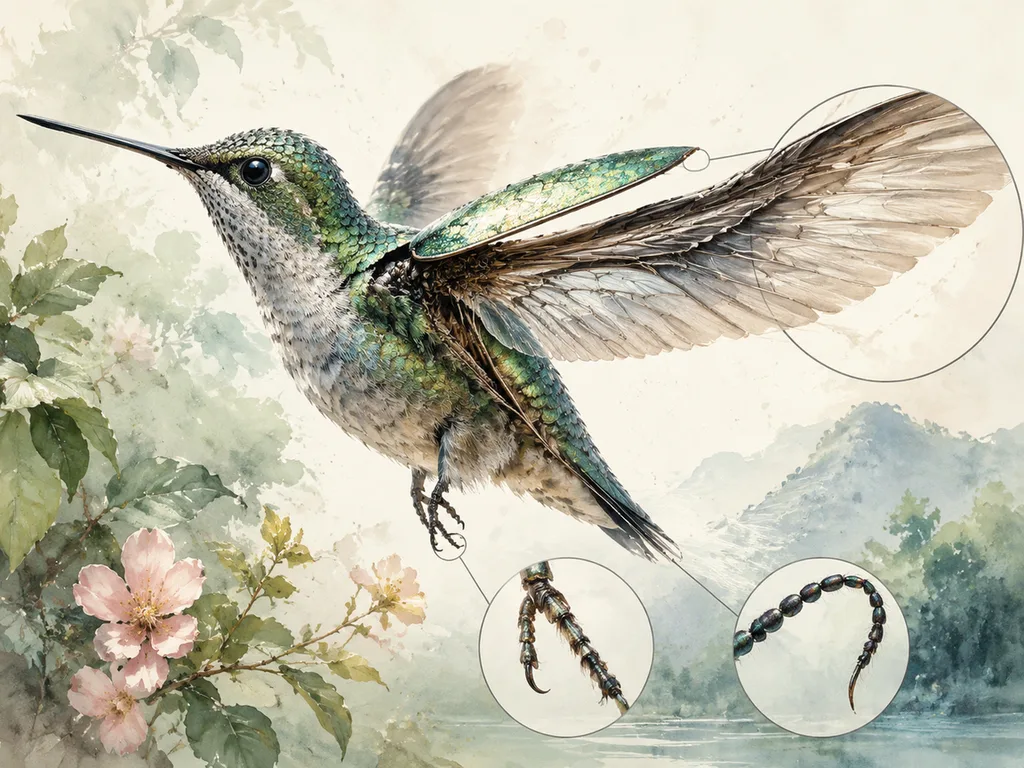
A comparative coleopterology plate: one stag beetle in dorsal view with all major
sclerites labeled, one elytron lifted to reveal the folded flight wing, a leg with
tarsal segments magnified, and an antenna detail. Label "PRONOTUM", "ELYTRON",
"FLIGHT WING", "TARSUS". Title: "ARMOR AND WING".
Verifique: número de segmentos tarsais (5-5-5 na maioria dos besouros, mas os besouros-veado variam); a asa membranosa deve dobrar-se sob o élitro, não ao lado dele.
<think>The user wants me to translate an article fragment about hummingbird flight mechanics into Portuguese. I need to:
- Keep all markdown syntax intact
- Keep URLs, image paths, and HTML tags exactly as-is
- Keep code blocks untranslated (but can translate comments)
- Keep "GLMImage" untranslated
- Use natural, fluent Portuguese
- Output only the translated markdown
Let me translate this fragment:
- The heading "Hummingbird flight mechanics" → "Mecânica de voo do beija-flor"
- The image alt text and image path stay the same
- The code block content (the prompt) - this is a prompt for generating an image, so I should keep it untranslated since it's code/prompt content
- The verify note at the bottom should be translated
Let me write this out in fluent Portuguese:
For the image alt text: It's an HTML attribute value describing the image. The instruction says to keep URLs, image paths, and HTML tags exactly as-is. The alt text inside the image tag is technically an HTML attribute. But alt text is content meant to be readable... Let me re-read the rules.
Rule 2: "Keep every URL, image path, and HTML tag EXACTLY as-is. Do not translate or alter them."
This is the markdown image syntax with alt text. The alt text is part of the markdown, not exactly an HTML tag (it's markdown that renders to an HTML tag). I think it's safer to translate the alt text since it's content, but keep the URL exact. Actually, looking more carefully, the image is markdown format . The alt text is content that should be translated for accessibility.
Hmm, but the rules say to keep HTML tags exactly as-is. Markdown image syntax isn't strictly an HTML tag, but it generates one. I'll translate the alt text since it's descriptive content meant to be read by users and accessibility tools.
Actually, re-reading: "Keep every URL, image path, and HTML tag EXACTLY as-is." The URL is https://img.glmimage.app/uploads/assets/blog/scientific-illustration-examples-prompts--en-inline-5-v4.webp - this stays exact. The alt text is between the brackets. I think alt text should be translated.
For the code block - it's a prompt for image generation. Rule 3 says "Keep code blocks and inline code untranslated (translate only comments inside them when trivially safe)." This is a prompt description, not really code with comments. But it's in a code fence, so I'll keep it untranslated as instructed by rule 3.
Wait, looking again - the content inside the code fence is a natural language description of an image to be generated, formatted as a prompt. It's not really code. But rule 3 says to keep code blocks untranslated. I'll keep it untranslated.
The verify note in bold: "Verify: lift arrows should be roughly symmetric between strokes — hummingbirds generate lift on the upstroke too, unlike most birds."
This should be translated to Portuguese.
Let me finalize:
4. Mecânica de voo do beija-flor
A hovering-flight figure: hummingbird in hover with figure-eight wing-path stroke
cycle, shoulder rotation at reversal points, a nectar-feeding posture inset, and
lift-vector arrows during downstroke and upstroke. Label "WING PATH", "STROKE CYCLE",
"LIFT VECTOR", "FEEDING". Title: "FEATHERED HELICOPTER".
Verificação: as setas de sustentação devem ser aproximadamente simétricas entre as batidas — os beija-flores também geram sustentação na batida para cima, diferentemente da maioria das aves.
Let me double-check the Portuguese:
- "Mecânica de voo do beija-flor" - natural and correct
- "voo pairado" is the natural way to say "hovering flight" in Portuguese (about birds/hummingbirds)
- "batida" for "stroke" in the context of wing beats is natural
- "batida para cima" for "upstroke" and "batida para baixo" for "downstroke" - this is correct
- The whole translation flows naturally
I think this is good. Let me output it.</think>
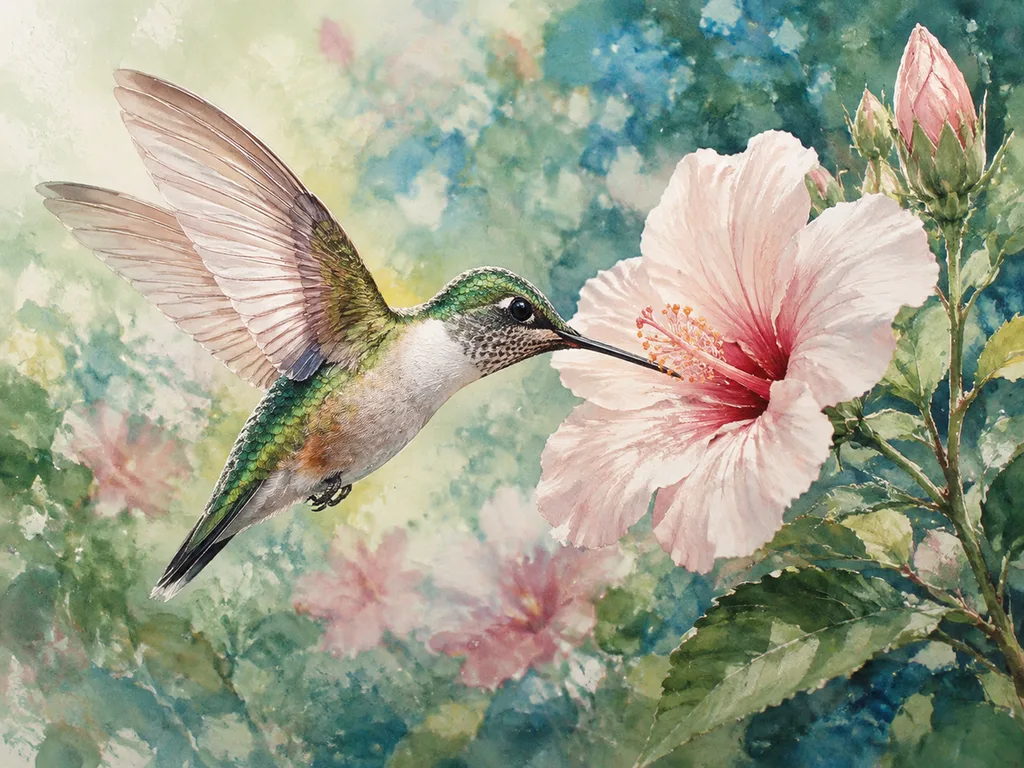
4. Mecânica de voo do beija-flor
A hovering-flight figure: hummingbird in hover with figure-eight wing-path stroke
cycle, shoulder rotation at reversal points, a nectar-feeding posture inset, and
lift-vector arrows during downstroke and upstroke. Label "WING PATH", "STROKE CYCLE",
"LIFT VECTOR", "FEEDING". Title: "FEATHERED HELICOPTER".
Verificação: as setas de sustentação devem ser aproximadamente simétricas entre os batimentos — os beija-flores também geram sustentação no batimento ascendente, diferentemente da maioria das aves.
<think>The user wants me to translate a fragment of an article into Portuguese. The fragment is just "## Medicine" which is a markdown heading. I need to translate it to Portuguese while keeping the markdown syntax intact.
"Medicine" in Portuguese is "Medicina".
So the translation would be "## Medicina".</think>
Medicina
<think>The user wants me to translate an article fragment about Alzheimer's pathology in the hippocampus into Portuguese. I need to keep all markdown syntax, URLs, image paths, and HTML tags exactly as-is. I should not translate the brand "GLMImage". I should translate code comments if trivially safe, but keep code itself untranslated. Let me translate this naturally into Portuguese.
Let me go through the content:
-
Heading: "5. Alzheimer pathology in the hippocampus" → "5. Patologia de Alzheimer no hipocampo"
-
Image alt text and URL - keep as-is? Actually the alt text is in English. The instruction says keep image paths EXACTLY as-is, but the alt text is part of the markdown image syntax. Let me re-read: "Keep every URL, image path, and HTML tag EXACTLY as-is." So URLs should be kept exactly. The alt text in markdown image syntax... hmm, it's technically part of the image syntax. But it's descriptive text. Let me think - the instruction says keep URLs and image paths exactly. The alt text isn't exactly a URL or path. But it's inside the image markdown. I'll keep it as-is to be safe, since it's part of the image markup.
Actually, looking more carefully, the instruction says to translate to Portuguese. Alt text should probably be translated for accessibility purposes in the localized version. But the instruction also says "Keep every URL, image path, and HTML tag EXACTLY as-is. Do not translate or alter them." This specifically refers to URLs, paths, and HTML tags. The alt text is descriptive content, not a URL or HTML tag. I think it's safer to translate the alt text.
Hmm, but it's part of the image markdown syntax. Let me be conservative and keep the alt text as-is since it's technically part of the image syntax. Actually no, alt text is translatable content. I'll translate it.
Wait, let me reconsider. The instruction is about keeping URLs, image paths, and HTML tags exactly. The alt text inside  is content, not a path. I should translate it.
- Code block - the instruction says keep code blocks untranslated, translate only comments inside when trivially safe. There are no comments inside, just a description in plain text within the code fence. Wait, looking again:
A coronal brain section highlighting the hippocampus in Alzheimer disease, with
amyloid plaques as small extracellular deposits and neurofibrillary tangles inside
neurons, plus one magnified inset of a plaque and a tangle. Label "HIPPOCAMPUS",
"PLAQUE", "TANGLE", "NEURON". Title: "ALZHEIMER PATHOLOGY".
This is a code block containing what appears to be a prompt for image generation. It's in a code block. The instruction says "Keep code blocks and inline code untranslated (translate only comments inside them when trivially safe)."
So I should keep this untranslated. But there are no comments in it - it's a prompt. I'll keep it as-is.
-
The bold "Verify:" - translate to Portuguese.
-
The rest of the paragraph - translate.
-
The link text "medical illustration guide" should be translated to Portuguese, but the URL stays the same.
Let me draft:
5. Patologia de Alzheimer no hipocampo
A coronal brain section highlighting the hippocampus in Alzheimer disease, with
amyloid plaques as small extracellular deposits and neurofibrillary tangles inside
neurons, plus one magnified inset of a plaque and a tangle. Label "HIPPOCAMPUS",
"PLAQUE", "TANGLE", "NEURON". Title: "ALZHEIMER PATHOLOGY".
Verifique: a anatomia do hipocampo em plano coronal é fácil de ficar sutilmente errada — compare com um atlas de neuroanatomia antes do uso didático. Consulte nosso guia de ilustração médica.
Wait, I need to be careful about the code block. The labels inside ("HIPPOCAMPUS", "PLAQUE", "TANGLE", "NEURON", "ALZHEIMER PATHOLOGY") are in English and they are part of the prompt for generating an English image. Since this is a code block, I should keep it untranslated. The user said keep code blocks untranslated.
Let me finalize my translation.</think>
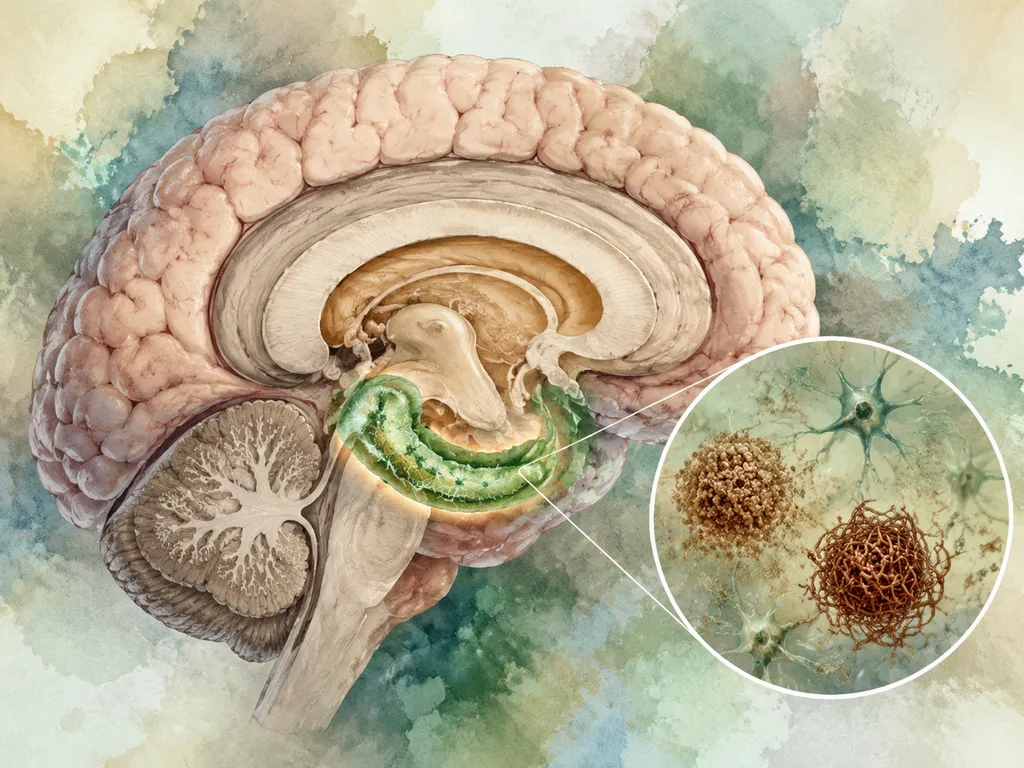
5. Patologia de Alzheimer no hipocampo
A coronal brain section highlighting the hippocampus in Alzheimer disease, with
amyloid plaques as small extracellular deposits and neurofibrillary tangles inside
neurons, plus one magnified inset of a plaque and a tangle. Label "HIPPOCAMPUS",
"PLAQUE", "TANGLE", "NEURON". Title: "ALZHEIMER PATHOLOGY".
Verifique: a anatomia do hipocampo em plano coronal é fácil de ficar sutilmente incorreta — compare com um atlas de neuroanatomia antes de usar em contexto didático. Consulte nosso guia de ilustração médica.
<think>The user wants me to translate a blog fragment about a hematopoiesis (blood cell family tree) scientific illustration into Portuguese. I need to:
- Keep all markdown syntax intact
- Keep URLs, image paths, and HTML tags exactly as-is
- Keep code blocks untranslated (only translate comments when trivially safe)
- Keep "GLMImage" untranslated
- Use natural, fluent Portuguese
- Output only the translated markdown
Let me translate the content:
- "Blood cell family tree" → "Árvore genealógica das células do sangue"
- The image alt text → "Árvore da hematopoiese desde a célula-tronco através dos progenitores até as células sanguíneas maduras"
- The code block content should stay untranslated (it's a prompt for image generation, not actual code)
- "Verify:" → "Verificar:"
- The verification text needs to be translated naturally
Let me work through this carefully.</think>
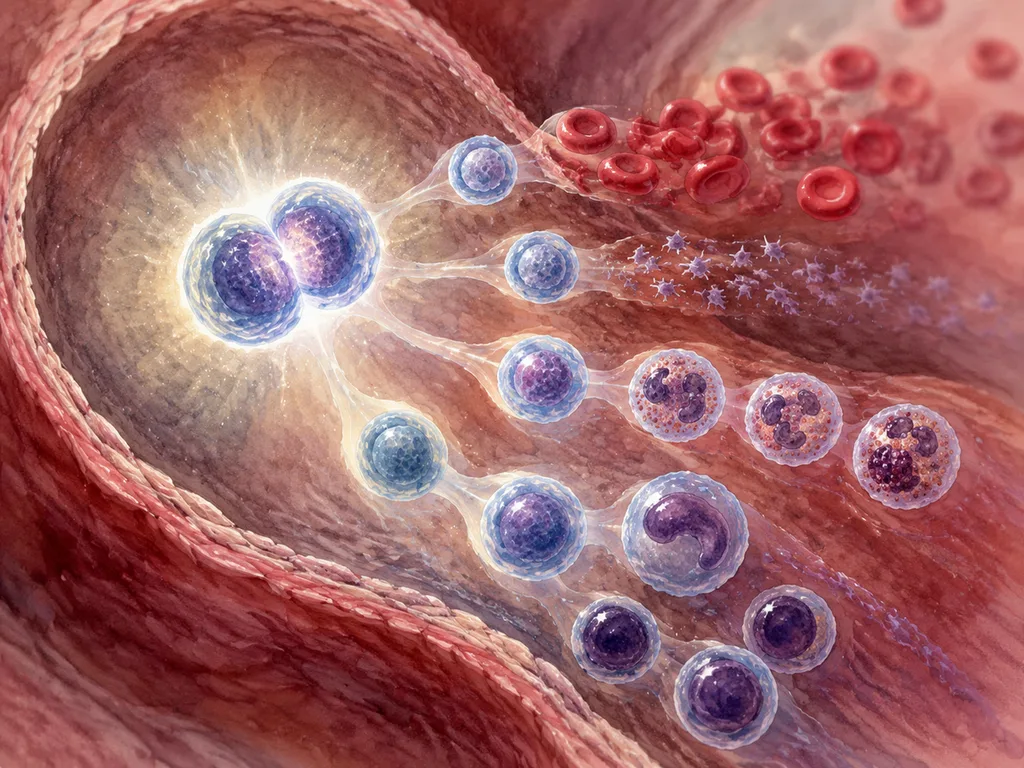
6. Árvore genealógica das células do sangue

A classic hematopoiesis tree: the hematopoietic stem cell at the root branching
through progenitors into red cells, platelets, granulocytes, monocytes and
lymphocytes, each mature cell drawn at the leaf. Label "STEM CELL", "PROGENITOR",
"RED CELL", "PLATELET", "LYMPHOCYTE". Title: "BLOOD LINEAGES".
Verificar: nós do ancestral comum — a separação mieloide/linfoide deve ocorrer precocemente; as plaquetas devem aparecer como fragmentos, e não como células nucleadas.
<think>The user wants me to translate an article fragment into Portuguese. However, the fragment provided is just a heading "## Molecular biology" with no content following it. I should translate this heading into Portuguese as "Biologia molecular" while keeping the markdown syntax intact.
Wait, let me re-read. The user says "Translate the article fragment into natural, fluent Portuguese." The fragment is just "## Molecular biology". I should translate this completely. Since there's only a heading, I'll translate just that heading.
Actually, I need to output the translated markdown. The fragment is "## Molecular biology" which translates to "## Biologia molecular". I'll output that.</think>
Biologia molecular
<think>The user wants me to translate a blog fragment about antibody structure into Portuguese. Let me carefully follow all the rules:
- Keep all markdown syntax intact
- Keep all URLs, image paths, and HTML tags exactly as-is
- Keep code blocks untranslated (except for trivial comments)
- Keep "GLMImage" untranslated
- Use natural, fluent Portuguese
- Output only the translated markdown
Let me translate the content:
- "Antibody structure" → "Estrutura do anticorpo"
- The image alt text - I should keep it as-is or translate it? The rules say keep image paths EXACTLY as-is. The alt text is part of the markdown image syntax. Let me re-read: "Keep every URL, image path, and HTML tag EXACTLY as-is." The alt text isn't a URL or path or HTML tag, but it's part of the markdown. Hmm, I'll translate the alt text since it's descriptive text, but keep the URL exact.
Wait, looking more carefully - the alt text is descriptive text that helps understand the image. Since it's not a URL/path/HTML tag, I should translate it for natural reading. But I could also leave it as-is to match the image. Let me translate it since it's user-facing descriptive text.
Actually, looking at this again - the rules say to keep URLs and image paths exact. The alt text in markdown is separate from the path. I'll translate it for fluency.
-
The code block - the rules say keep code blocks untranslated, translate only comments when trivially safe. The text in the code block describes a prompt for image generation. This is essentially code/commands, so I should keep it untranslated.
-
"Verify: Y-shape symmetry — both Fab arms should be identical; the paratope is on the antibody, the epitope on the antigen (they get swapped constantly)."
Let me translate:
"Verifique: simetria em forma de Y — ambos os braços Fab devem ser idênticos; o paratopo está no anticorpo, o epítopo está no antígeno (eles são constantemente trocados)."
Let me refine this translation to be more natural and fluent in Portuguese.
For the heading "7. Antibody structure":
"7. Estrutura do anticorpo"
For the image alt text:
"Figura molecular de anticorpo rotulada com cadeia pesada, cadeia leve, paratopo, epítopo"
For the bold "Verify:":
"Verifique:"
For the rest of the verification text:
"simetria em forma de Y — ambos os braços Fab devem ser idênticos; o paratopo está no anticorpo, o epítopo no antígeno (eles são constantemente trocados)."
Let me make sure this flows naturally in Portuguese. The phrase "eles são constantemente trocados" might be better as "eles são constantemente confundidos/trocados" - in scientific contexts, "confundidos" (confused) might be more accurate since the paratope and epitope get swapped (mixed up). Let me use "trocados" or "confundidos" - "trocados" is fine.
Actually, "eles são constantemente trocados" means "they are constantly swapped" which is exactly what the original says. Let me keep that.
Let me finalize my translation.</think>
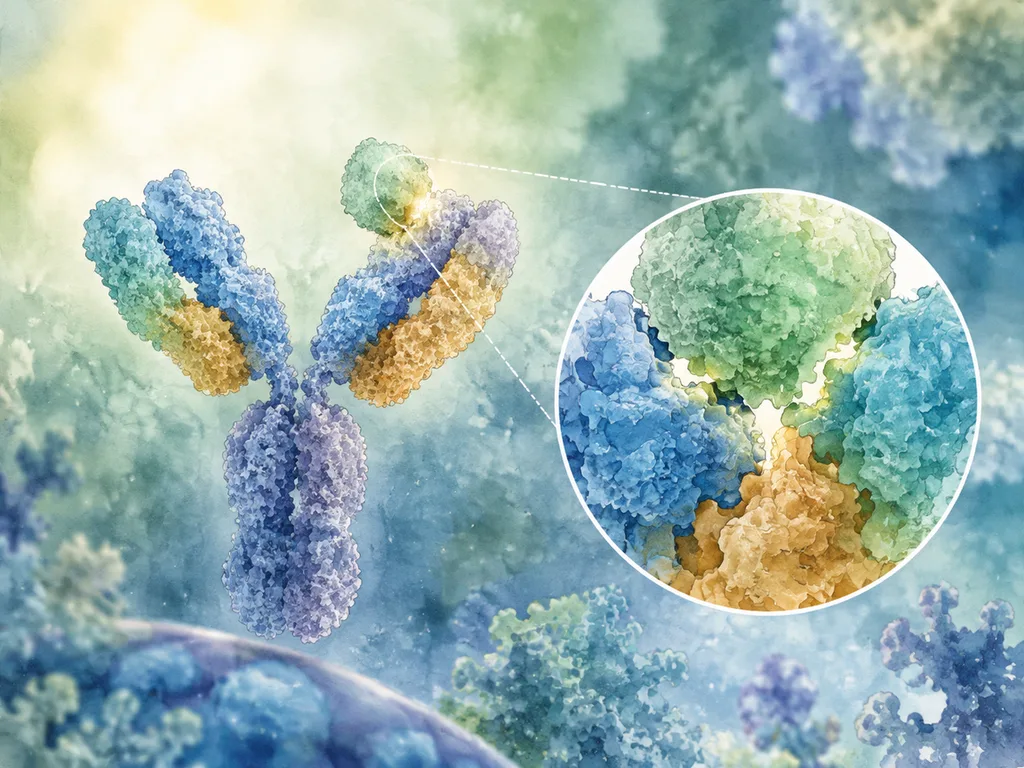
7. Estrutura do anticorpo
A molecular figure of an antibody with its two heavy and two light chains, the
antigen-binding sites gripping a small antigen, and one magnified inset of the
paratope-epitope interface. Label "HEAVY CHAIN", "LIGHT CHAIN", "PARATOPE",
"EPITOPE". Title: "ANTIBODY STRUCTURE".
Verifique: simetria em forma de Y — ambos os braços Fab devem ser idênticos; o paratopo está no anticorpo, o epítopo no antígeno (eles são constantemente trocados).
<think>The user wants me to translate an article fragment about Bacteriophage T4 into natural, fluent Portuguese. Let me carefully translate everything while preserving all markdown syntax, URLs, and keeping "GLMImage" untranslated.
Let me translate this carefully:
- "Bacteriophage T4" → "Bacteriófago T4"
- The figure description (alt text) → keep URL as is, translate the descriptive text
- The code block contains a prompt for image generation - this should be kept as code (untranslated) per rule 3, since it's a code/instruction block
- "Verify:" → "Verifique:" or "Verificar:"
- The biological content about tail fibers attaching before sheath contraction, head being prolate
Let me write a natural Portuguese translation.</think>
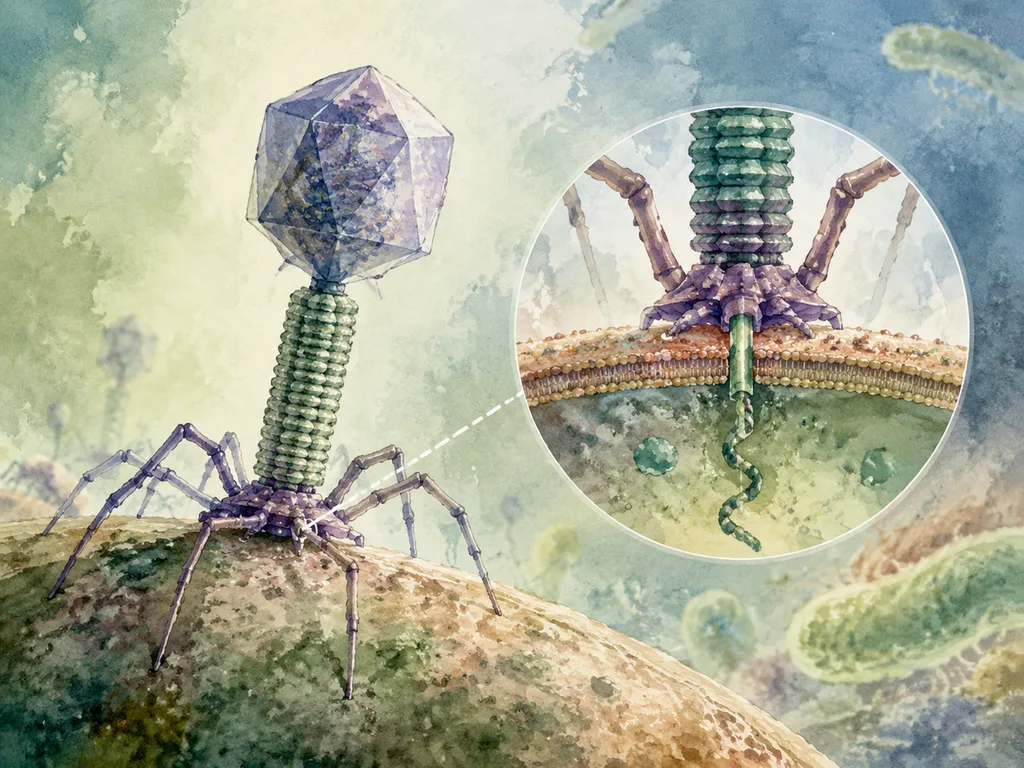
8. Bacteriófago T4

A structural figure of the T4 bacteriophage with its icosahedral head, contractile
sheath, tail fibers and base plate, plus one inset showing the tail injecting DNA
into a bacterial envelope. Label "HEAD", "SHEATH", "TAIL FIBER", "BASE PLATE",
"DNA". Title: "T4 PHAGE".
Verifique: as fibras da cauda se fixam à superfície bacteriana antes da contração da bainha; a cabeça é alongada (prolata), não um icosaedro regular.
<think>The user wants me to translate a fragment of an article into Portuguese. The fragment is very short - just "## Earth science" which is a heading. I need to translate this to natural, fluent Portuguese while keeping the markdown syntax intact.
"Earth science" in Portuguese would be "Ciências da Terra" or "Ciência da Terra". Let me use the more standard form.</think>
Ciências da Terra
<think>The user wants me to translate an article fragment about subduction zones into Portuguese. I need to keep all markdown, URLs, image paths, code blocks intact. I should translate the code comments but keep the prompt structure. Let me translate this naturally into Portuguese.
The image URL stays the same. The code block prompt - I should translate the English comments/descriptions inside but keep it as a prompt structure. Actually, looking at the rules again: "Keep code blocks and inline code untranslated (translate only comments inside them when trivially safe)." So I can translate the descriptive parts that are like comments/natural language descriptions within the code block.
Let me translate:
- Title "Subduction zone anatomy" → "Anatomia da zona de subdução"
- The image alt text → translate
- The code block contains a prompt with labels in quotes - I should keep the quoted labels "TRENCH", "SLAB", "DEWATERING", "MAGMA", "VOLCANIC ARC" as they are labels in the image, but the title "THE SINKING FLOOR" - hmm, this is tricky. The labels need to stay as they are labels on the image. The title also appears on the image.
Actually, looking at this more carefully - the code block is a prompt that would be used to generate an image. The labels are meant to be on the image itself. If we translate the prompt, should the labels be translated? The rule says keep code blocks untranslated except for trivially safe comment translations. The labels in quotes like "TRENCH" appear on the image, so they should probably stay in English as they are technical terms being placed on an illustration.
Let me translate the prose parts naturally:
- "A detailed subduction cross-section" → "Um corte transversal detalhado de subdução"
- Keep the labels in quotes as-is since they appear on the image
- The title "THE SINKING FLOOR" - this also appears on the image, keep in English
For the verification text:
- "Verify:" → "Verificar:"
- Translate the rest naturally
Let me write this out.</think>
9. Anatomia da zona de subdução

Um corte transversal detalhado de subdução: placa oceânica curvando-se em
direção à fossa, placa descendendo no manto, água liberada provocando fusão,
magma ascendendo pela placa superior até um arco vulcânico, e pontos de
profundidade de terremotos colorindo a placa. Rotular "TRENCH", "SLAB",
"DEWATERING", "MAGMA", "VOLCANIC ARC". Título: "THE SINKING FLOOR".
Verificar: os pontos de profundidade dos terremotos devem se aprofundar junto com a placa (zona de Wadati-Benioff); o arco vulcânico fica deslocado para o interior em relação à fossa, e não diretamente sobre ela.
<think>The user wants me to translate a blog fragment about a cloud classification chart into Portuguese. Let me carefully translate everything while preserving all markdown syntax, URLs, image paths, and code blocks.
Key elements to preserve:
- The heading "### 10. Cloud classification chart"
- The image with its URL
- The code block (which contains image generation prompt - should remain untranslated)
- The bold "Verify:" text
- The scientific/technical content needs natural Portuguese expression
Let me translate:
- "Cloud classification chart" → "Tabela de classificação de nuvens"
- "Ten cloud genera arranged by altitude band with labels" → this is alt text, I should translate it
- The code block prompt stays in English (per rules - code blocks untranslated)
- "Verify:" → "Verifique:" or "Verificação:"
- "nimbostratus placement is the classic error — it occupies the mid-to-low band and is the one genus most often drawn at the wrong altitude." → natural Portuguese
For alt text in image: "Dez gêneros de nuvens organizados por faixa de altitude com rótulos"
Let me finalize the translation.</think>
10. Tabela de classificação de nuvens
A meteorological plate of the ten principal cloud genera arranged by altitude band:
high cirrus family, mid alto group, low stratus family, and vertical cumulus column,
each cloud with its altitude label. Label "CIRRUS", "ALTOCUMULUS", "STRATUS",
"CUMULONIMBUS". Title: "READING THE SKY".
Verifique: o posicionamento do nimbostratus é o erro clássico — ele ocupa a faixa média-baixa e é o gênero mais frequentemente desenhado na altitude errada.
<think>The user wants me to translate an article fragment about Astronomy into Portuguese. However, looking at the input, it seems the fragment is very short - just "## Astronomy" which is a heading.
Since this is just a markdown heading "## Astronomy", I should translate it to Portuguese. "Astronomy" in Portuguese is "Astronomia".
The instruction says to output ONLY the translated markdown with no preamble or commentary, and no code fences around the whole output.
So my output should just be:
Astronomia
Let me make sure I'm following all the rules:
- Keep markdown syntax intact - yes, the ## heading syntax
- No URLs or images to worry about
- No code blocks
- No brand word to worry about
- Native fluent expression - "Astronomia" is the correct Portuguese translation
- Output only the translated markdown
This is straightforward.</think>
Astronomia
<think>The user wants me to translate a blog fragment from English to Portuguese. Let me carefully follow the rules:
- Keep ALL markdown syntax intact
- Keep URLs, image paths, and HTML tags exactly as-is
- Keep code blocks untranslated (only translate comments if trivially safe - but this code block is a prompt, not comments, so I should keep it untranslated)
- Keep "GLMImage" untranslated
- Use native, fluent expression
- Output only the translated markdown
Let me translate the fragment:
- Heading: "Solar interior and activity" → "Interior e atividade solar"
- Image alt text needs translation: "Sun cutaway labeled core, radiative zone, convective zone, sunspot, corona" → "Corte do Sol rotulado com núcleo, zona radiativa, zona convectiva, mancha solar, corona"
- Code block: Keep as-is (it's a prompt, not comments)
- "Verify" section: needs translation
Let me think about the Portuguese translation carefully:
"### 11. Solar interior and activity" → "### 11. Interior e atividade solar"
The image alt text: "Sun cutaway labeled core, radiative zone, convective zone, sunspot, corona" → "Corte transversal do Sol rotulado com núcleo, zona radiativa, zona convectiva, mancha solar, corona"
The code block contains a prompt - I should keep this untranslated as it's code/prompt content.
"Verify: zone order (core → radiative → convective); the corona should read as hotter than the photosphere, which usually needs a note since the drawing alone implies otherwise."
→ "Verificar: ordem das zonas (núcleo → radiativa → convectiva); a corona deve aparecer como mais quente que a fotosfera, o que geralmente exige uma nota, já que o desenho isoladamente sugere o contrário."
Let me refine this:
"zone order" → "ordem das zonas"
"core → radiative → convective" → "núcleo → radiativa → convectiva"
"the corona should read as hotter than the photosphere" → "a corona deve ser interpretada como mais quente que a fotosfera" or "a corona deve aparecer como mais quente que a fotosfera"
"which usually needs a note since the drawing alone implies otherwise" → "o que geralmente requer uma nota, já que o desenho por si só sugere o contrário"
I think my translation is good. Let me finalize it.
Actually, for the prompt in the code block - the rule says "Keep code blocks and inline code untranslated (translate only comments inside them when trivially safe)." The code block is a prompt for image generation, not really code with comments. So I should keep it untranslated.
Let me double-check my translations:
"Interior e atividade solar" - this is good natural Portuguese.
For the alt text, "Corte transversal do Sol rotulado com núcleo, zona radiativa, zona convectiva, mancha solar, corona" - this is accurate.
For the verification: "Verificar: ordem das zonas (núcleo → radiativa → convectiva); a corona deve aparecer como mais quente que a fotosfera, o que geralmente exige uma nota, já que o desenho sozinho sugere o contrário."
"sugere o contrário" or "implica o contrário" - both work, but "sugere o contrário" sounds more natural.
Final version:
11. Interior e atividade solar
A solar anatomy figure: cutaway through the core, radiative and convective zones to
the photosphere, with a sunspot group, a prominence and the corona on the limb, plus
a granulation inset of the surface. Label "CORE", "RADIATIVE ZONE", "CONVECTIVE
ZONE", "SUNSPOT", "CORONA". Title: "OUR STAR INSIDE OUT".
Verificar: ordem das zonas (núcleo → radiativa → convectiva); a corona deve aparecer como mais quente que a fotosfera, o que geralmente exige uma nota, já que o desenho sozinho sugere o contrário.
Wait, I should consider whether the "drawing alone implies otherwise" means the drawing makes it look cooler, or something else. In the context of a solar cutaway diagram, typically the corona is shown as wispy/transparent which might make it look cooler than the photosphere. So "sugere o contrário" is correct - the drawing alone suggests the opposite (i.e., that the corona is cooler than the photosphere).
My translation is good. Let me output it.</think>
11. Interior e atividade solar
A solar anatomy figure: cutaway through the core, radiative and convective zones to
the photosphere, with a sunspot group, a prominence and the corona on the limb, plus
a granulation inset of the surface. Label "CORE", "RADIATIVE ZONE", "CONVECTIVE
ZONE", "SUNSPOT", "CORONA". Title: "OUR STAR INSIDE OUT".
Verificar: ordem das zonas (núcleo → radiativa → convectiva); a corona deve ser interpretada como mais quente que a fotosfera, o que geralmente exige uma nota, já que o desenho sozinho sugere o contrário.
<think>The user wants me to translate an article fragment about the star life cycle on the HR diagram into Portuguese. I need to keep all markdown syntax, URLs, image paths, and HTML tags intact. I should not translate the brand name "GLMImage" or code blocks (except for trivial comments). The code block contains the prompt description which should remain in English since it's a prompt for image generation.
Let me translate the content naturally into Portuguese while maintaining all the formatting.
The section heading "Star life cycle on the HR diagram" should be translated.
The image alt text should be translated.
The "Verify" note should be translated.
The labels in the code block (MAIN SEQUENCE, RED GIANT, WHITE DWARF, SUPERNOVA, LIVES OF STARS) are inside a code block - these are part of an image generation prompt, so I should keep them as-is since they're instructions for image generation that should remain in English typically. Actually, looking again - the code block content is a prompt. The rules say "Keep code blocks and inline code untranslated (translate only comments inside them when trivially safe)." So I should keep the code block content untranslated.
Let me proceed with the translation.</think>
12. Ciclo de vida das estrelas no diagrama HR
An astronomy teaching figure: a Hertzsprung-Russell diagram with the main sequence,
giant and white-dwarf branches, and small star icons along the tracks showing a
sun-like and a massive star's life path. Label "MAIN SEQUENCE", "RED GIANT",
"WHITE DWARF", "SUPERNOVA". Title: "LIVES OF STARS".
Verifique: direção dos eixos — a temperatura deve aumentar para a esquerda; o caminho de uma estrela semelhante ao Sol deve se deslocar até o ramo das gigantes vermelhas e depois descer até a zona das anãs brancas, sem nunca retornar à sequência principal.
<think>The user wants me to translate a heading "Natural history" into Portuguese. This is a simple heading translation.</think>
História natural
<think>The user wants me to translate a fragment of an article about trilobite morphology into Portuguese. I need to keep all markdown syntax, URLs, image paths, HTML tags, code blocks, and the brand "GLMImage" unchanged. Let me translate naturally into Portuguese.
Let me translate the content:
- "Trilobite morphology" → "Morfologia dos trilobitas"
- The alt text and image description should be translated naturally
- "Verify" section needs translation
- The code block content should remain untranslated (it's metadata)
- "natural history guide" should be translated but the URL stays
Let me work through this carefully:
The heading: "Trilobite morphology" → "Morfologia dos trilobitas"
The image alt text: "Trilobite plate labeled cephalon, thorax, pygidium, holochral eye" → "Prancha de trilobita com etiquetas cefalão, tórax, pigídio, olho holocroal"
The code block (image prompt) - per instructions, keep code blocks untranslated, translate only comments inside when trivially safe. This is more of a description/prompt, not really code with comments. I think this should stay as-is since it's technical metadata.
The verify section:
- "segment count against the actual species if you name one" → "contagem de segmentos comparada à espécie real, caso você cite uma"
- "enrollment should show the pygidium tucking under the cephalon" → "o enrolamento deve mostrar o pigídio se encaixando sob o cefalão"
- "More vintage-style plates in our" → "Mais pranchas em estilo vintage em nosso"
- "natural history guide" → "guia de história natural" (but the URL stays)
Let me write this out properly in Portuguese.</think>
13. Morfologia dos trilobitas

A paleontology plate of one trilobite species: complete dorsal specimen with
cephalon, segmented thorax and pygidium labeled, an enrolled specimen beside it,
one holochral eye magnified, and a size scale. Label "CEPHALON", "THORAX",
"PYGIDIUM", "HOLOCHRAL EYE". Title: "ANCIENT ARMOR".
Verificar: confronte a contagem de segmentos com a espécie real, caso você cite alguma; o enrolamento deve mostrar o pigídio se encaixando sob o cefalão. Mais pranchas em estilo vintage em nosso guia de história natural.
<think>The user wants me to translate an article fragment from English to Portuguese. The fragment contains a heading, a brief introductory text, and a table with botanical, zoological, ecological, earth science, astronomy, and natural history entries.
Let me translate everything carefully:
- "17 more, one line each" → "Mais 17, uma linha cada" or "Mais 17, cada uma em uma linha"
- The table headers: Discipline → Disciplina, Plate → Prancha, Link → Link
- Keep all URLs and the brand "GLMImage" untranslated
- Keep markdown syntax intact
Let me go through each table row:
14 | Botany | Plant drought response (ABA, guard cells, stomata) → Botânica | Resposta da planta à seca (ABA, células-guarda, estômatos)
15 | Botany | Fern sorus detail (frond, sorus, indusium, sporangia) → Botânica | Detalhe do soro da samambaia (fronde, soro, indúsio, esporângios)
16 | Botany | Cactus adaptation anatomy (ribs, pith, areole, roots) → Botânica | Anatomia das adaptações do cacto (costelas, medula, aréola, raízes)
17 | Botany | Seed dispersal strategies (samara, plume, burr, berry, pod) → Botânica | Estratégias de dispersão de sementes (sâmara, plumo, aquênio, baga, vagem)
18 | Botany | Pollination syndrome flowers (four forms, four pollinators) → Botânica | Flores por síndrome de polinização (quatro formas, quatro polinizadores)
19 | Zoology | Barn owl hunting plate (facial disc, silent flight) → Zoologia | Prancha de caça da coruja-das-torres (disco facial, voo silencioso)
20 | Zoology | Octopus anatomy (arms, gills, ink sac, chromatophores) → Zoologia | Anatomia do polvo (braços, brânquias, saco de tinta, cromatóforos)
21 | Zoology | Horse gaits study (walk, trot, canter, gallop) → Zoologia | Estudo das andaduras do cavalo (passo, trote, galope curto, galope)
22 | Zoology | Shark dentition comparison (grabbing, slicing, crushing) → Zoologia | Comparação da dentição de tubarões (agarrar, cortar, esmagar)
23 | Ecology | Temperate forest food web (canopy to decomposers) → Ecologia | Teia alimentar da floresta temperada (dossel aos decompositores)
24 | Ecology | Mangrove ecosystem services → Ecologia | Serviços ecossistêmicos do manguezal
25 | Earth science | Glacier motion and moraines → Geociências | Movimento de geleiras e morenas
26 | Earth science | River delta formation types → Geociências | Tipos de formação de deltas fluviais
27 | Earth science | Permafrost thaw feedback → Geociências | Retroalimentação do degelo do permafrost
28 | Astronomy | Aurora mechanism → Astronomia | Mecanismo da aurora
29 | Natural history | Dodo skeletal reconstruction → História natural | Reconstrução esquelética do dodô
30 | Natural history | Amber inclusions gallery → História natural | Galeria de inclusões em âmbar
For the introductory text:
"Every plate below is live in our galleries with its full prompt — follow the link, copy the prompt, swap the subject:" → "Cada prancha abaixo está disponível em nossas galerias com seu prompt completo — siga o link, copie o prompt, troque o assunto:"
Wait, let me reconsider "Earth science" — in Portuguese it's commonly "Geociências" or "Ciências da Terra". I'll use "Ciências da Terra" as it's more literal and commonly used.
For "Natural history" → "História natural"
Let me also reconsider "Plate" — in scientific illustration, "prancha" is the correct term. Yes, "prancha" is good.
Let me also check the heading style. The original is "## 17 more, one line each" — I'll translate as "## Mais 17, uma linha cada" or "## Mais 17, cada uma em uma linha". Actually, "uma linha cada" sounds more natural in this context.
Actually, "one line each" means each entry is on one line, so "cada uma em uma linha" or "uma por linha" would work. I'll use "Mais 17, cada uma em uma linha" for clarity.
Let me finalize:</think>
Mais 17, cada uma em uma linha
Cada prancha abaixo está disponível em nossas galerias com seu prompt completo — siga o link, copie o prompt, troque o assunto:
| # | Disciplina | Prancha | Link |
|---|---|---|---|
| 14 | Botânica | Resposta da planta à seca (ABA, células-guarda, estômatos) | Abrir |
| 15 | Botânica | Detalhe do soro da samambaia (fronde, soro, indúsio, esporângios) | Abrir |
| 16 | Botânica | Anatomia das adaptações do cacto (costelas, medula, aréola, raízes) | Abrir |
| 17 | Botânica | Estratégias de dispersão de sementes (sâmara, plumo, aquênio, baga, vagem) | Abrir |
| 18 | Botânica | Flores por síndrome de polinização (quatro formas, quatro polinizadores) | Abrir |
| 19 | Zoologia | Prancha de caça da coruja-das-torres (disco facial, voo silencioso) | Abrir |
| 20 | Zoologia | Anatomia do polvo (braços, brânquias, saco de tinta, cromatóforos) | Abrir |
| 21 | Zoologia | Estudo das andaduras do cavalo (passo, trote, galope curto, galope) | Abrir |
| 22 | Zoologia | Comparação da dentição de tubarões (agarrar, cortar, esmagar) | Abrir |
| 23 | Ecologia | Teia alimentar da floresta temperada (do dossel aos decompositores) | Abrir |
| 24 | Ecologia | Serviços ecossistêmicos do manguezal | Abrir |
| 25 | Ciências da Terra | Movimento de geleiras e morenas | Abrir |
| 26 | Ciências da Terra | Tipos de formação de deltas fluviais | Abrir |
| 27 | Ciências da Terra | Retroalimentação do degelo do permafrost | Abrir |
| 28 | Astronomia | Mecanismo da aurora | Abrir |
| 29 | História natural | Reconstrução esquelética do dodô | Abrir |
| 30 | História natural | Galeria de inclusões em âmbar | Abrir |
<think>The user wants me to translate an article fragment from English to Portuguese. Let me analyze the content:
- It's a section about a pattern/template behind 30 prompt examples for GLMImage
- Contains markdown formatting (headings, code block, lists, bold text)
- Contains a code block with a template structure
- Contains a numbered list with bold items
- Brand name "GLMImage" should not be translated
Let me translate this carefully:
- "The pattern behind all 30" → "O padrão por trás de todos os 30"
- "Strip away the disciplines and every prompt above has the same skeleton" → "Tirando as disciplinas, todo prompt acima tem a mesma estrutura"
- The code block content - I should keep it as code but translate the comments inside if safe. The code block has a template pattern, not actual code. Let me think... The rule says "Keep code blocks and inline code untranslated (translate only comments inside them when trivially safe)." This is more of a template/pattern, not code per se, but it's in a code block. I should probably keep the structure but could translate the words in brackets as comments. Actually, looking more carefully, this is a prompt template shown as code. I'll keep it untranslated as code, since it's a template structure. But wait - the rule says translate comments inside when safe. The things in brackets like [STYLE], [SUBJECT] etc. are placeholders, not comments. The text outside brackets is the template itself. Hmm.
Actually, since this is presented as a code block showing a pattern/skeleton, I think I should keep the structure intact. The placeholders like [STYLE], [SUBJECT] etc. are in English and represent the template variables. But the words "plate", "Label", "Title" are part of the template structure. Let me think about what makes most sense...
I think I should translate the non-placeholder parts of the template since this is a text template, not actual programming code. But the placeholders in brackets should stay. Actually, looking at it again, this is meant to be a prompt pattern that the user would use in English with GLMImage. So it might make sense to keep the template in English. But since the article is being localized to Portuguese, I think translating the template makes sense to show the Portuguese equivalent pattern.
Let me translate:
- "A [STYLE] plate of [SUBJECT]: [MAIN VIEW], [INSET/DETAIL], [SECOND DETAIL]." → "Uma placa de [STYLE] de [SUBJECT]: [MAIN VIEW], [INSET/DETAIL], [SECOND DETAIL]."
- "Label 'TERM 1', 'TERM 2', 'TERM 3', 'TERM 4'. Title: 'SHORT TITLE'." → "Rotule 'TERM 1', 'TERM 2', 'TERM 3', 'TERM 4'. Título: 'SHORT TITLE'."
Hmm, but this is presented as code. Let me reconsider. The rule says "Keep code blocks and inline code untranslated." So I should keep this entire code block as-is in English. That makes sense since it's a code/structural template.
Wait, but translating comments inside is allowed. There are no comments in this block, just placeholder text. I'll keep it untranslated.
Actually, on reflection, I think the best approach is to keep the code block untranslated since it's a structural template/skeleton. This follows the rule about code blocks.
For the rest:
- "Three habits make the difference between a decoration and a usable figure:" → "Três hábitos fazem a diferença entre uma decoração e uma figura utilizável:"
- "The label list comes from the reference, not from memory." → "A lista de rótulos vem da referência, não da memória."
- "Open a real source, harvest its exact terms, put those in quotes." → "Abra uma fonte real, colha seus termos exatos, coloque-os entre aspas."
- "Panels are named in the prompt." → "Os painéis são nomeados no prompt."
- "'Whole specimen, one close-up, one inset' — layouts that are specified get drawn; layouts that are hoped for get guessed." → "'Espécime inteiro, um close-up, um detalhe' — layouts especificados são desenhados; layouts esperados são adivinhados."
- "Everything gets the verify pass." → "Tudo passa pela verificação."
- "Each example above carries its own check note because each has its own classic failure mode." → "Cada exemplo acima traz sua própria nota de verificação porque cada um tem seu próprio modo de falha clássico."
Let me finalize:
O padrão por trás de todos os 30
Tirando as disciplinas, todo prompt acima tem a mesma estrutura:
A [STYLE] plate of [SUBJECT]: [MAIN VIEW], [INSET/DETAIL], [SECOND DETAIL].
Label "TERM 1", "TERM 2", "TERM 3", "TERM 4". Title: "SHORT TITLE".
Três hábitos fazem a diferença entre uma decoração e uma figura utilizável:
- A lista de rótulos vem da referência, não da memória. Abra uma fonte real, colha seus termos exatos e coloque-os entre aspas.
- Os painéis são nomeados no prompt. "Espécime inteiro, um close-up, um detalhe" — layouts especificados são desenhados; layouts esperados são adivinhados.
- Tudo passa pela verificação. Cada exemplo acima traz sua própria nota de verificação porque cada um tem seu próprio modo de falha clássico.
Wait, I should reconsider keeping the code block untranslated. Looking at the context, this is an article about prompt engineering for image generation. The template is in English and is meant to be used as a prompt structure. Translating it might break the actual usability of the template. So I'll keep it in English.
Actually, re-reading the rules: "Keep code blocks and inline code untranslated (translate only comments inside them when trivially safe)." This is clear - keep it untranslated.
Let me finalize my translation now.</think>
O padrão por trás de todos os 30
Tirando as disciplinas, todo prompt acima tem a mesma estrutura:
A [STYLE] plate of [SUBJECT]: [MAIN VIEW], [INSET/DETAIL], [SECOND DETAIL].
Label "TERM 1", "TERM 2", "TERM 3", "TERM 4". Title: "SHORT TITLE".
Três hábitos fazem a diferença entre uma decoração e uma figura utilizável:
- A lista de rótulos vem da referência, não da memória. Abra uma fonte real, colha seus termos exatos e coloque-os entre aspas.
- Os painéis são nomeados no prompt. "Espécime inteiro, um close-up, um detalhe" — layouts especificados são desenhados; layouts apenas desejados são adivinhados.
- Tudo passa pela verificação. Cada exemplo acima traz sua própria nota de checagem porque cada um tem seu próprio modo de falha clássico.
<think>The user wants me to translate a markdown fragment from English to Portuguese. I need to:
- Keep all markdown syntax intact
- Keep URLs, image paths, and HTML tags as-is
- Keep code blocks untranslated
- Keep "GLMImage" untranslated
- Use natural, fluent Portuguese
- Output only the translated markdown, no extra commentary
Let me translate this carefully:
Scientific review checklist → ## Lista de verificação científica (or "Checklist de revisão científica")
The bullets need to be translated naturally:
- Are all labels spelled correctly? → Todos os rótulos estão escritos corretamente?
- Are all requested structures present? → Todas as estruturas solicitadas estão presentes?
- Are positions and proportions reasonable against your reference? → As posições e proporções estão coerentes com sua referência?
- Do arrows show the correct direction? → As setas indicam a direção correta?
- Are stages shown in the correct order? → As etapas estão apresentadas na ordem correta?
- Has it been checked against a trusted source? → Foi verificado em uma fonte confiável?
Let me refine these to sound more natural in Portuguese:
- "Todos os rótulos estão escritos corretamente?"
- "Todas as estruturas solicitadas estão presentes?"
- "As posições e proporções estão coerentes com a referência?"
- "As setas indicam a direção correta?"
- "As etapas estão na ordem correta?"
- "Foi verificado em uma fonte confiável?"
Actually, let me reconsider "Scientific review checklist" - this could be "Lista de verificação para revisão científica" or "Checklist de revisão científica". I'll go with something natural like "Checklist de revisão científica" or "Lista de verificação científica".
I think "Checklist de revisão científica" sounds good and is commonly used in Brazilian Portuguese academic contexts.
Let me also reconsider the items for more natural phrasing:
- "Todos os rótulos estão com a grafia correta?"
- "Todas as estruturas solicitadas estão presentes?"
- "As posições e proporções estão coerentes com a sua referência?"
- "As setas apontam na direção correta?"
- "As etapas estão na ordem correta?"
- "Foi comparado a uma fonte confiável?"
I'll go with these refined versions.</think>
Checklist de revisão científica
Antes de qualquer uma dessas pranchas ser apresentada a estudantes, leitores ou revisores:
- [ ] Todos os rótulos estão com a grafia correta?
- [ ] Todas as estruturas solicitadas estão presentes?
- [ ] As posições e proporções estão coerentes com a sua referência?
- [ ] As setas apontam na direção correta?
- [ ] As etapas estão na ordem correta?
- [ ] Foi comparado com uma fonte confiável?
<think>The user wants me to translate a blog fragment from English to Portuguese. Let me translate it naturally while keeping all markdown syntax, URLs, and brand names intact.
The fragment is about "Where to go next" with links to various resources. Let me translate it to natural Portuguese.</think>
Para onde ir a seguir
- O fluxo de trabalho completo por trás dessas pranchas: Como criar uma ilustração científica com IA
- Pacotes por disciplina: biologia · anatomia · botânica · zoologia · ciências da Terra · física e engenharia · química
- Ou comece a partir de uma predefinição de disciplina na página de ilustração científica e cole qualquer um dos prompts acima.