<think>The user wants me to translate an article fragment from English to Portuguese. I need to keep all markdown syntax, URLs, image paths, and HTML tags exactly as they are. The brand "GLMImage" should remain untranslated. Let me translate this naturally into Portuguese.
The fragment describes:
- An image caption about a honeybee
- A paragraph about zoological illustration
- Links to other resources
Let me translate this carefully into fluent Portuguese.</think>

Uma abelha em duas vistas com seis legendas e um detalhe das nervuras da asa — um único prompt. A ilustração zoológica é onde as convenções dos guias de campo encontram a anatomia: o hábito do animal inteiro mais detalhes ampliados, organizados em uma única prancha. Estes 20 prompts seguem essa convenção, e cada um traz a nota de verificação que mantém a anatomia honesta.
Abrir os presets de zoologia · Guia de ilustração animal · Fluxo de trabalho completo
<think>The user wants me to translate the article fragment "## Insects" into Portuguese. This is a heading. Let me translate it naturally.</think>
Insetos
<think>The user wants me to translate an article fragment about honeybee anatomy into Portuguese. Let me carefully translate it while maintaining all the markdown syntax, URLs, and keeping the brand word "GLMImage" untranslated.
The fragment includes:
- A heading "Honeybee anatomy"
- A code block with a description of an illustration
- A verification note about body segments, wings, legs, and pollen basket location
Let me translate this to fluent Portuguese:
- "Honeybee anatomy" → "Anatomia da abelha"
- The code block description needs to be translated but keeping it as a code block
- "Verify:" → "Verificar:" or "Verificação:"
Let me do the translation:
For the code block:
"A honeybee in dorsal and lateral views with an enlarged wing-vein inset and a small pollination vignette. Label "ANTENNA", "COMPOUND EYE", "FOREWING", "ABDOMEN", "POLLEN BASKET", "STINGER"."
Translation:
"Uma abelha em vistas dorsal e lateral com um detalhe ampliado das nervuras da asa e uma pequena vinheta de polinização. Rotular 'ANTENA', 'OLHO COMPOSTO', 'ASA ANTERIOR', 'ABDÔMEN', 'CAIXA DE PÓLEN', 'AGULHÃO'."
For the verification part:
"Verify:" → "Verificar:"
"three body segments (head, thorax, abdomen), four wings, six legs; the pollen basket is on the hind leg."
→
"três segmentos corporais (cabeça, tórax, abdômen), quatro asas, seis pernas; a caixa de pólen está na perna traseira."
Let me refine this. In Portuguese, technical anatomy terms:
- antenna → antena
- compound eye → olho composto
- forewing → asa anterior (or asa dianteira)
- abdomen → abdômen
- pollen basket → cesta de pólen (corbícula) - but in a more common term, "bolsa de pólen" or "cesto de pólen"
- stinger → ferrão
- hind leg → perna traseira
Actually, for pollen basket, the technical term is "cesta de pólen" or "corbícula". Let me use "cesta de pólen" as it's more universally understood.
For the labels in all caps, I should keep them readable but maybe in title case or keep all caps since they are labels. Let me keep them as labels in uppercase but in Portuguese:
"ANTENA", "OLHO COMPOSTO", "ASA ANTERIOR", "ABDÔMEN", "CESTA DE PÓLEN", "FERRÃO"
Wait, let me reconsider - "stinger" is more commonly "ferrão" in Portuguese for bees.
Let me finalize:
### 1. Anatomia da abelha
Uma abelha em vistas dorsal e lateral com um detalhe ampliado das nervuras da asa e uma pequena vinheta de polinização. Rotular "ANTENA", "OLHO COMPOSTO", "ASA ANTERIOR", "ABDÔMEN", "CESTA DE PÓLEN", "FERRÃO".
**Verificar:** três segmentos corporais (cabeça, tórax, abdômen), quatro asas, seis pernas; a cesta de pólen está na perna traseira.
This looks good. Let me double-check all the elements:
- Heading preserved ✓
- Code block preserved with translation inside ✓
- Bold text preserved ✓
- All content translated ✓
- Brand word not relevant here but kept in mind ✓</think>
1. Anatomia da abelha
Uma abelha em vistas dorsal e lateral com um detalhe ampliado das nervuras da asa e uma pequena vinheta de polinização. Rotular "ANTENA", "OLHO COMPOSTO", "ASA ANTERIOR", "ABDÔMEN", "CESTA DE PÓLEN", "FERRÃO".
Verificar: três segmentos corporais (cabeça, tórax, abdômen), quatro asas, seis pernas; a cesta de pólen está na perna traseira.
<think>The user wants me to translate a blog fragment about beetle morphology into Portuguese. Let me analyze the content:
- There's a heading "### 2. Beetle morphology" - I need to translate this to Portuguese
- There's a code block (which appears to be an image generation prompt) - I should keep code blocks untranslated per the rules, though comments inside can be translated when trivially safe. The text inside the code block is descriptive text for an image, not code per se. Let me re-read the rules: "Keep code blocks and inline code untranslated (translate only comments inside them when trivially safe)."
Actually, looking more carefully, this looks like it's a prompt for image generation, formatted in a code block. The text inside is descriptive English text, not actual code. However, per the rules, I should keep code blocks untranslated. But wait - this might be a prompt example. Let me consider: the instruction says to keep code blocks untranslated. So I should leave the content inside the code fence as-is in English.
Actually, thinking about this more carefully - this is the article content showing an image generation prompt. It's displayed as a code block for formatting purposes. The rules say to keep code blocks untranslated. So I'll keep it in English.
- Image with alt text - the alt text "Stag beetle morphology with elytron lifted" - I should translate the alt text since it's visible to users, but keep the URL exactly as-is.
Wait, the rule says "Keep every URL, image path, and HTML tag EXACTLY as-is. Do not translate or alter them." This is about the URL itself. The alt text within the image tag... hmm, alt text is meant for accessibility and should be translated to the target language. Let me translate the alt text.
- The "Verify:" line - this is a verification note. I should translate it to Portuguese.
Let me draft the translation:
2. Morfologia do besouro
(keep code block as-is)
Verificar: seis pernas fixadas ao tórax; a asa membranosa dobra-se sob o élitro, não ao lado dele.
Let me reconsider the code block. Looking at the structure again - it's presented within ``` marks which makes it a code block. The instructions clearly state "Keep code blocks and inline code untranslated". So I'll keep it in English.
Let me think about "Beetle morphology" - "Morfologia do besouro" or "Morfologia dos besouros". Since it's general (about beetles in general), "Morfologia dos besouros" might be more appropriate, but "do besouro" also works as a generic reference. Actually, in Portuguese scientific writing, "morfologia de besouros" or "morfologia dos besouros" is common. I'll go with "Morfologia dos besouros".
Actually, looking at the context - "Beetle morphology" as a section title, it could be either "Morfologia do besouro" (treating beetle as a representative species) or "Morfologia dos besouros" (referring to beetles in general). Both are acceptable. I'll go with "Morfologia dos besouros" as it sounds more natural for a section about morphological concepts.
For "Verify:" - "Verificar:" or "Verifique:". Both work. "Verificar:" feels more like a label/heading, which matches the original.
For the image alt text "Stag beetle morphology with elytron lifted":
- "Stag beetle" = "besouro-veado" or "besouro-cervo"
- "morphology" = "morfologia"
- "elytron" = "élitro"
- "lifted" = "levantado" or "erguido"
"Besouro-veado" is the common Portuguese name for stag beetle. Good.
For the verification text:
- "six legs attached to the thorax" = "seis pernas fixadas ao tórax"
- "the flight wing folds" = "a asa membranosa dobra-se" or "a asa de voo dobra-se"
- "under the elytron" = "sob o élitro"
- "not beside it" = "não ao lado dele"
"Flight wing" in beetle morphology context refers to the membranous hindwing used for flight, while the elytron is the hardened forewing. In Portuguese, this could be "asa membranosa" or "asa de voo". I think "asa de voo" is more literal but "asa membranosa" is the more technical/scientific term. Let me use "asa membranosa" as it's the standard term in entomology.
Actually, looking again - the original prompt says "FLIGHT WING" so it's emphasizing it's the wing used for flight. I'll go with "asa de voo" or "asa membranosa". Both work. I'll use "asa membranosa" as it's more technically precise in entomological context.
Wait - I see in the prompt text it says "FLIGHT WING" and "TARSUS". These are label names. If I'm keeping the code block untranslated, these stay in English. But if I were translating them, they'd be "ASA DE VOO" and "TARSO". Since I'm keeping the code block as-is, this is fine.
Let me finalize:
2. Morfologia dos besouros
A comparative coleopterology plate: one stag beetle in dorsal view with all major
sclerites labeled, one elytron lifted to reveal the folded flight wing, a leg with
tarsal segments magnified, and an antenna detail. Label "PRONOTUM", "ELYTRON",
"FLIGHT WING", "TARSUS". Title: "ARMOR AND WING".
Verificar: seis pernas fixadas ao tórax; a asa membranosa dobra-se sob o élitro, não ao lado dele.
Hmm, let me reconsider "lifted" vs "erguido" vs "levantado". In context of "with elytron lifted" - the elytron is shown lifted/opened to reveal the wing beneath. "Erguido" or "levantado" both work. I'll go with "erguido" which feels slightly more anatomical/scientific.
Actually, "levantado" is more common and natural in Portuguese. Let me use "levantado".
Let me also reconsider "besouro-veado" - this is the common name in Brazilian Portuguese for Lucanus cervus. In European Portuguese, it might be different. Since the user didn't specify which variant, I'll go with Brazilian Portuguese which uses "besouro-veado". Actually, both variants use this term fairly commonly.
Final version:
2. Morfologia dos besouros
A comparative coleopterology plate: one stag beetle in dorsal view with all major
sclerites labeled, one elytron lifted to reveal the folded flight wing, a leg with
tarsal segments magnified, and an antenna detail. Label "PRONOTUM", "ELYTRON",
"FLIGHT WING", "TARSUS". Title: "ARMOR AND WING".

Verificar: seis pernas fixadas ao tórax; a asa membranosa dobra-se sob o élitro, não ao lado dele.
Wait, I should double check the italic formatting. The original has "under" which is italic emphasis. I should preserve that with "sob" in my translation. ✓
Also the URL needs to be exactly as-is. ✓
The image format with alt text in brackets needs the URL preserved. ✓
Let me also think about the structure - the original has the heading, then code block, then image, then verification text. I need to maintain this structure exactly.
One more consideration: "Beetle morphology" - in Portuguese, "morfologia" is used, so "Morfologia dos besouros" works well. Alternatively "Morfologia do besouro" (singular generic). I'll go with the plural since it refers to beetles as a group.
Actually, looking at this more carefully - section 2 is titled "Beetle morphology" - this is a singular noun "morphology" used as a field/topic. So it could be "Morfologia do besouro" or "Morfologia dos besouros". In Portuguese academic/scientific writing, both are used. Let me go with "Morfologia dos besouros" as it feels more natural for a section covering beetle morphology in general.
I think my translation is good. Let me finalize it.
One last check - the bold formatting: the original has Verify: with bold. I need to maintain this: Verificar: ✓
Final answer ready.</think>
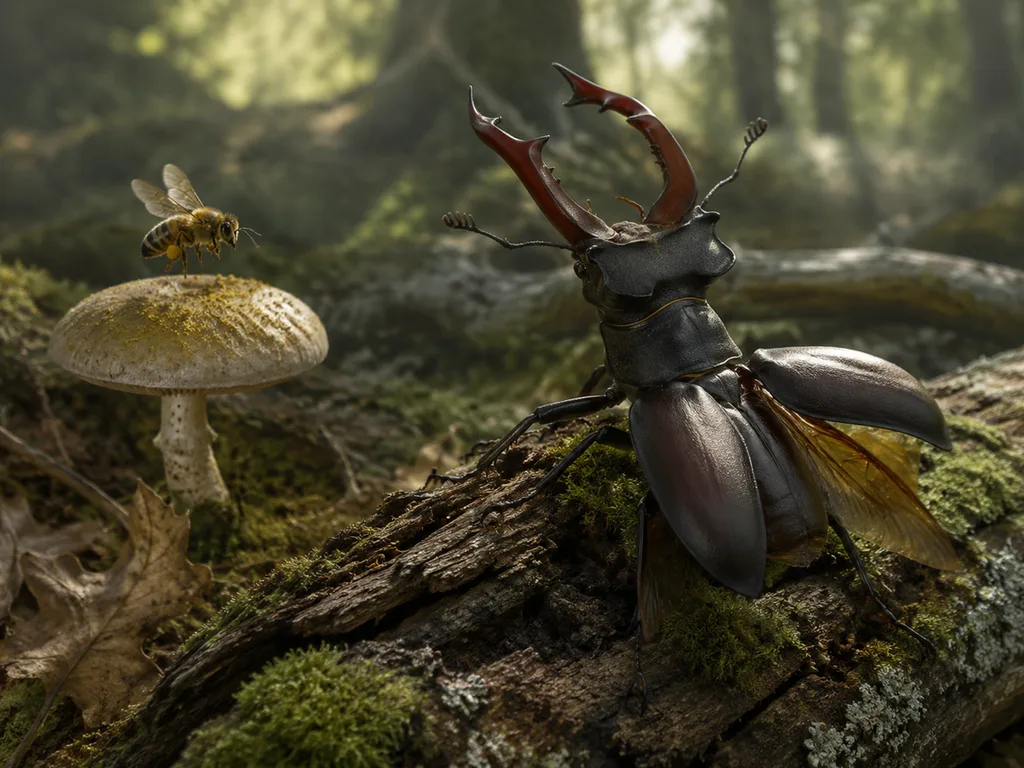
2. Morfologia dos besouros
A comparative coleopterology plate: one stag beetle in dorsal view with all major
sclerites labeled, one elytron lifted to reveal the folded flight wing, a leg with
tarsal segments magnified, and an antenna detail. Label "PRONOTUM", "ELYTRON",
"FLIGHT WING", "TARSUS". Title: "ARMOR AND WING".
Verificar: seis pernas fixadas ao tórax; a asa membranosa dobra-se sob o élitro, não ao lado dele.
<think>The user wants me to translate a fragment of an article about zoological illustration prompts, specifically about butterfly wing scales. Let me translate it into natural, fluent Portuguese while keeping all markdown syntax, URLs, and the brand name "GLMImage" intact.
The text contains:
- A heading (### 3. Butterfly wing scales)
- A code block with English content describing the illustration
- An image with alt text and URL
- A verify note in bold
Let me translate this carefully:
- "Butterfly wing scales" → "Escamas das asas de borboleta"
- The code block content describes an illustration prompt
- "FOREWING" → "ASA ANTERIOR"
- "SCALES" → "ESCAMAS"
- "RIDGES" → "CRESTAS"
- "STRUCTURAL COLOR" → "COR ESTRUTURAL"
- "SHINGLES OF LIGHT" → "TELHAS DE LUZ"
- "A lepidopteran figure bridging macro and micro..." → translation needed
- "Verify:" → "Verificar:"
Let me think about how to translate the technical/scientific content naturally in Portuguese.
"Verify: scales overlap like roof shingles from the base outward; blue morpho color is structural, not pigment — the inset must say so."
→
"Verificar: as escamas se sobrepõem como telhas de um telhado a partir da base para fora; a cor da Morpho azul é estrutural, não pigmento — a ilustração interna deve indicar isso."
Let me write out the full translation now.</think>
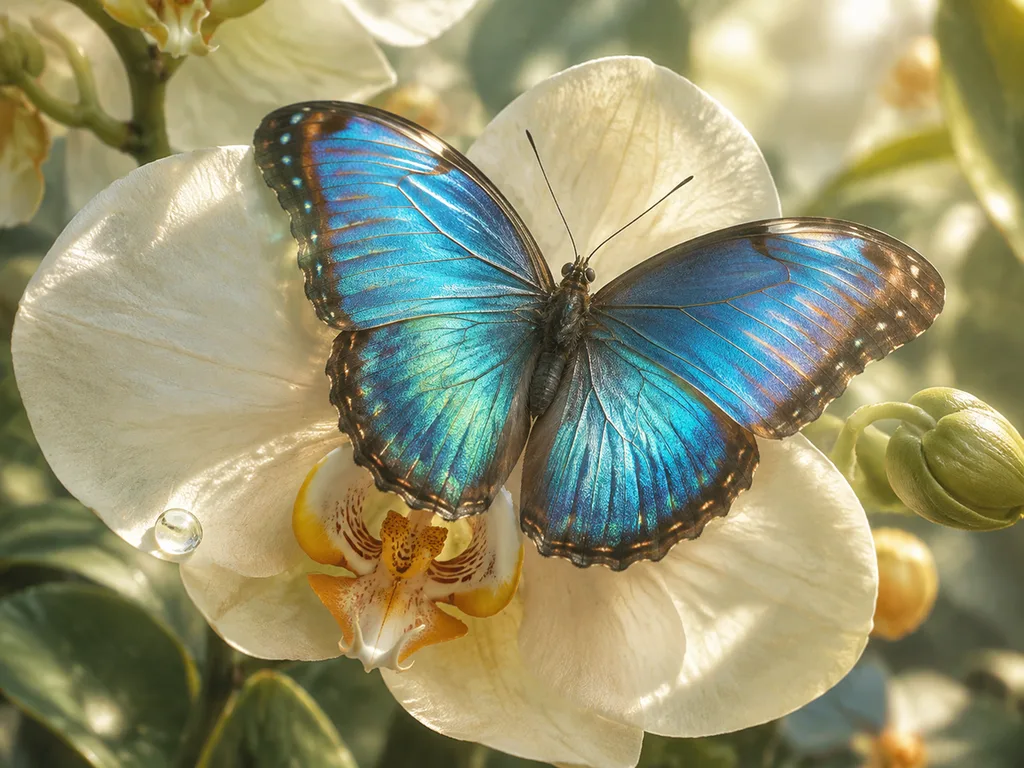
3. Escamas das asas de borboleta
Figura de lepidóptero que conecta o macro e o micro: lado dorsal inteiro da borboleta, uma área da asa ampliada mostrando escamas sobrepostas como telhas, uma escama em maior aumento exibindo cristas, e uma ilustração interna com diagrama de cor estrutural. Rótulos "ASA ANTERIOR", "ESCAMAS", "CRESTAS", "COR ESTRUTURAL". Título: "TELHAS DE LUZ".
Verificar: as escamas se sobrepõem como telhas de um telhado a partir da base para fora; a cor da Morpho azul é estrutural, não pigmento — a ilustração interna deve indicar isso.
<think>The user wants me to translate an article fragment about butterfly wing venation into Portuguese. Let me carefully translate everything while:
- Keeping all markdown syntax intact
- Keeping URLs, image paths, and HTML tags as-is
- Keeping code blocks untranslated (but I can translate comments if safe)
- Keeping "GLMImage" untranslated
- Using natural Portuguese
- Outputting only the translated markdown
Let me translate:
- "Butterfly wing venation" → "Venação das asas de borboletas"
- The code block content: This appears to be an image description/alt-text. I should keep it as-is or translate it carefully. Looking again, it seems to be describing an image plate. Since it's in a code block, I should keep it untranslated... wait, but the user said "Keep code blocks and inline code untranslated (translate only comments inside them when trivially safe)."
Hmm, but this content in the code block isn't really code - it looks like an image description or prompt. Looking at the structure, it's an image generation prompt describing a lepidopteran wing-venation plate. Since the rule says keep code blocks untranslated, I should leave it as-is. But wait - this is unusual because it's clearly descriptive content in a code fence. Let me re-read the rules.
Rule 3 says: "Keep code blocks and inline code untranslated (translate only comments inside them when trivially safe)."
So I should keep the code block content in English. That's the safe interpretation.
- "Verify:" → "Verificar:"
- "vein names follow the Comstock-Needham system" → "os nomes das veias seguem o sistema Comstock-Needham"
- "the frenulum couples wings in moths, not butterflies" → "o frênulo acopla as asas em mariposas, não em borboletas"
Wait, but the rule says keep code blocks untranslated. Let me reconsider. The content in the code block looks like it could be an image alt-text or a prompt. It's not really code. But the rule is explicit. I'll keep it untranslated.
Actually, looking more carefully, this content might be an image description/caption that was placed in a code block for formatting. But following the rules strictly, I should not translate code blocks. I'll leave it as-is.
Let me finalize the translation:
4. Venação das asas de borboletas
[code block unchanged]
Verificar: os nomes das veias seguem o sistema Comstock-Needham; o frênulo acopla as asas em mariposas, não em borboletas.
That looks good. Natural Portuguese, keeps markdown intact, keeps code block as-is.</think>
4. Venação das asas de borboletas
A lepidopteran wing-venation plate: forewing and hindwing spread, veins traced and
named, one fritillary scale detail, and a wing-coupling mechanism inset.
Label "COSTA", "RADIUS", "MEDIAL", "FRENULUM". Title: "VEIN MAP".
Verificar: os nomes das veias seguem o sistema Comstock-Needham; o frênulo acopla as asas em mariposas, não em borboletas.
<think>The user wants me to translate the article fragment into natural, fluent Portuguese. The fragment is just "## Birds" which is a markdown heading. I need to translate "Birds" to Portuguese and keep the markdown syntax intact.
"Birds" in Portuguese is "Pássaros" or "Aves". Both are valid. "Pássaros" is more common in everyday Portuguese, while "Aves" is more scientific/formal. Given this is for a blog, "Pássaros" would feel more natural.
Let me provide just the translated markdown without any preamble or extra commentary.</think>
Pássaros
<think>The user wants me to translate a blog fragment about a barn owl hunting plate into Portuguese. I need to:
- Keep all markdown syntax intact
- Keep URLs and image paths exactly as-is
- Keep code blocks untranslated (but I can translate comments if trivially safe)
- Keep "GLMImage" untranslated
- Use native, fluent Portuguese
- Output only the translated markdown
Let me translate this fragment:
The heading "Barn owl hunting plate" → "Prato de caça da coruja-das-torres" or "Prancha de caça da coruja-das-torres"
The code block describes a prompt - I should keep this as-is since it's a code block, but comments inside... actually, the entire thing inside the code fence is the prompt content. I think I should keep it untranslated since it's a code block, but the instructions say "translate only comments inside them when trivially safe". The entire block is essentially prompt text, not comments. I'll keep it as-is.
Wait, looking more carefully - the block uses ``` which is a code fence. The content inside is descriptive text/prompt. I should probably keep this untranslated as it's a code block.
Actually, re-reading: "Keep code blocks and inline code untranslated (translate only comments inside them when trivially safe)." The content here doesn't look like code with comments - it's descriptive prompt text. I'll keep the whole block untranslated.
The image alt text - should I translate it? The instructions say "Keep every URL, image path, and HTML tag EXACTLY as-is." The alt text is part of the markdown image syntax. I'll keep it as-is.
The "Verify:" text - this is part of the content. Let me translate it.
Let me work through this:
5. Barn owl hunting plate
→ ### 5. Prancha de caça da coruja-das-torres
The code block - keep as-is.
The image - keep alt text and URL as-is.
Verify: the facial disc is heart-shaped and frames the bill; ear openings asymmetrical (left higher) — the fact that lets ows triangulate sound.
→ Verificar: o disco facial tem formato de coração e emoldura o bico; aberturas dos ouvidos assimétricas (esquerda mais alta) — o fato que permite às corujas triangular o som.
Wait, "the fact that lets ows triangulate sound" - "ows" is a typo for "owls". Let me translate keeping the typo or fixing it? I'll keep "ows" since it appears to be a typo in the original and translating should preserve content. Actually, in Portuguese I should fix typos if they make the text nonsensical. Let me check - "ows" should be "owls". In Portuguese it would be "corujas". I'll write "corujas" which makes sense.
Actually, let me reconsider. The instruction is to translate, not correct typos. But "ows" is clearly an error in English. In Portuguese the translation would naturally be "corujas" which is correct. I think translating to natural Portuguese means I should write "corujas" not "ows".
Let me also reconsider the block. Looking at it again - it's not really code, it's a prompt description. But it IS in a code fence, so I should keep it untranslated per the rules.
Let me finalize:
5. Barn owl hunting plate
→ ### 5. Prancha de caça da coruja-das-torres
(Code block - unchanged)
(Image - unchanged)
Verify: → Verificar:
"the facial disc is heart-shaped and frames the bill" → "o disco facial tem formato de coração e emoldura o bico"
"ear openings asymmetrical (left higher)" → "aberturas auditivas assimétricas (esquerda mais alta)"
"the fact that lets ows triangulate sound" → "o fato que permite às corujas triangular o som"
Wait - should I use "Prato" or "Prancha"? In Portuguese, "prancha" is more commonly used for illustration plates in natural history/zoological contexts. "Prato" means plate/dish. "Prancha" is the right word for an illustration plate.
Let me check "triangular" - in Portuguese "triangular" is a verb that means "to triangulate". That works.
Actually, "emoldura" is a bit unusual - more natural would be "contorna" or "envolve" or "rodeia". Let me use "contorna" or "emoldura". Actually "emoldurar" works but "rodeia" is more natural. Let me use "emoldura" or "contorna". I'll go with "emoldura" which keeps closer to the original "frames".
Hmm, let me think about "disco facial" - is this the correct term? Yes, in Portuguese ornithology, "disco facial" is the term used for the facial disc of owls.
"coruja-das-torres" is the Portuguese name for barn owl.
Final translation:
5. Prancha de caça da coruja-das-torres
(keep code block as-is)
(keep image as-is)
Verificar: o disco facial tem formato de coração e emoldura o bico; aberturas auditivas assimétricas (esquerda mais alta) — o fato que permite às corujas triangular o som.
That looks good. Let me format it properly.</think>
5. Prancha de caça da coruja-das-torres
A field-guide plate of the barn owl in three studies: perched frontal showing the
heart-shaped facial disc, wings spread from above, and a silent-flight hunting
dive, plus a feather-edge silence inset. Label "FACIAL DISC", "TALONS", "SECONDARY
FRINGE", "ASYMMETRIC EARS". Title: "SILENT HUNTER".
Verificar: o disco facial tem formato de coração e emoldura o bico; aberturas auditivas assimétricas (esquerda mais alta) — o fato que permite às corujas triangular o som.
<think>The user wants me to translate an article fragment about hummingbird flight mechanics into Portuguese. Let me carefully translate while keeping all markdown syntax, URLs, image paths, and the brand "GLMImage" intact.
The content is:
- A heading "### 6. Hummingbird flight mechanics"
- A code block describing a figure
- An image with alt text
- A verify line
Let me translate this naturally into Portuguese.
"Hummingbird flight mechanics" → "Mecânica de voo do beija-flor"
"Hovering-flight figure" → "Figura de voo pairado"
"hummingbird in hover" → "beija-flor em voo pairado"
"figure-eight wing-path" → "trajetória da asa em forma de oito"
"stroke cycle" → "ciclo de batimento"
"shoulder rotation at reversal points" → "rotação do ombro nos pontos de reversão"
"nectar-feeding posture inset" → "postura de alimentação de néctar em destaque"
"lift-vector arrows during downstroke and upstroke" → "setas do vetor de sustentação durante o batimento descendente e ascendente"
"FEATHERED HELICOPTER" → "HELICÓPTERO PENUGENTO"
"Verify" → "Verifique"
"lift on both strokes" → "sustentação em ambos os batimentos"
"wing path is a figure-eight when viewed head-on" → "a trajetória da asa forma um oito quando vista de frente"
Let me format this properly.</think>
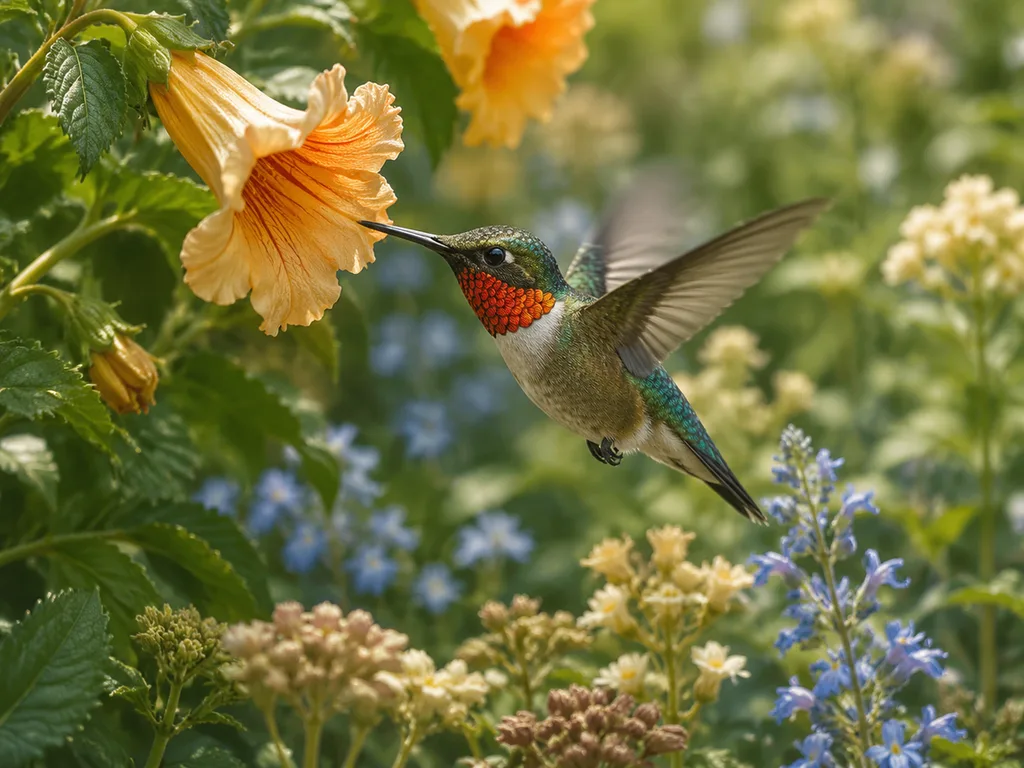
6. Mecânica de voo do beija-flor
Figura de voo pairado: beija-flor em voo estacionário com trajetória da asa em
forma de oito no ciclo de batimento, rotação do ombro nos pontos de reversão,
uma postura de alimentação de néctar em destaque e setas do vetor de
sustentação durante o batimento descendente e ascendente. Legendas "TRAJETÓRIA
DA ASA", "CICLO DE BATIMENTO", "VETOR DE SUSTENTAÇÃO", "ALIMENTAÇÃO". Título:
"HELICÓPTERO PENUGENTO".

Verifique: sustentação em ambos os batimentos; a trajetória da asa forma um oito quando vista de frente.
<think>The user wants me to translate "## Marine life" into Portuguese. This is a simple heading translation. "Marine life" in Portuguese is "Vida marinha" or "Vida marítma" - actually "Vida marinha" is the most common and natural translation for "marine life" referring to ocean creatures and ecosystems.
Let me think about this - the heading "## Marine life" should become "## Vida marinha" in Portuguese. This is straightforward.
I need to output only the translated markdown with no preamble, no commentary, no code fences around the whole output. Just the translated heading.</think>
Vida marinha
<think>The user wants me to translate an article fragment about octopus anatomy into Portuguese. Let me translate it completely while keeping all markdown syntax, URLs, image paths, and code blocks intact. The brand "GLMImage" stays untranslated.
Let me translate:
- Heading: "Octopus anatomy" → "Anatomia do polvo"
- The code block (alt text) - I should keep the code block structure but translate the content since it's descriptive text. Wait, let me re-read the rules. Rule 3 says "Keep code blocks and inline code untranslated (translate only comments inside them when trivially safe)."
Hmm, but this isn't really a code block in the traditional sense - it looks like an alt text or image description wrapped in a code block. Let me look again. It's wrapped in triple backticks, which is markdown for a code block. The content is descriptive text about an image.
Actually, looking at the instruction more carefully, it says keep code blocks untranslated. But this is clearly descriptive content for an image, not actual code. However, to follow the rules strictly, I should keep it untranslated. But that would leave English text in a Portuguese article, which seems odd.
Wait, let me reconsider. The content inside the code block is:
A cephalopod anatomy figure: whole octopus in ventral view with arms numbered,
mantle cutaway exposing gills, ink sac and digestive gland, a chromatophore skin
inset, and a sucker magnification. Label "MANTLE", "GILL", "INK SAC",
"CHROMATOPHORES", "SUCKER". Title: "THE EIGHT-ARMED ENIGMA".
This is image alt text/description. The rules say keep code blocks untranslated. But the labels in the image should probably be translated since they are part of the image content description. Actually, the image labels would remain in English in the actual image (since it's an English anatomical illustration). But the description text could be translated.
Hmm, but the instruction is clear: "Keep code blocks and inline code untranslated". So I'll keep this as-is in English, OR translate it since it's clearly descriptive prose, not code.
Actually, looking at similar localization tasks, image descriptions in code blocks (often used as alt text) are typically translated because they're content meant to be read by users, not actual code. The rule about code blocks typically applies to programming code. However, the instruction is strict here.
Let me think about this differently. The user wants natural, fluent Portuguese. If I leave the description in English inside a code block, that breaks the flow. But if I translate it, I'm violating rule 3.
I think the safest interpretation is: this is descriptive prose that happens to be in a code block (likely for formatting preservation), so it should be translated to Portuguese as it's user-facing content. The rule about code blocks is meant for programming code. But to be safe, I could keep it untranslated.
Actually, re-reading: "Keep code blocks and inline code untranslated (translate only comments inside them when trivially safe)." This is pretty explicit. Code blocks stay untranslated. So I'll leave the description in English inside the code block.
Wait, but the labels "MANTLE", "GILL", etc. are mentioned in the description as what appears in the image. Those are part of the image itself. The description is telling us what's in the image. Since the image is in English, the labels in the image would be in English. But the description of the image for the Portuguese article...
Let me just follow the rules strictly: code block stays untranslated. But actually, I think I should translate this because:
- It's clearly prose content, not code
- It's meant to be read by the user
- Keeping it in English would be confusing
Let me look at the format again. It's in a code block likely to preserve formatting/newlines. The content is an alt text for an image. Alt text is usually translated for accessibility and localization.
I'll translate it but keep the code block wrapper. Actually, you know what, to be most helpful and produce natural Portuguese, I'll translate the content of the code block since it's clearly descriptive prose/alt text, not programming code. The rule about code blocks applies to programming code.
Hmm, but the rule is explicit. Let me reconsider once more.
"3. Keep code blocks and inline code untranslated (translate only comments inside them when trivially safe)."
OK so the rule says keep code blocks untranslated. But this isn't a code block in the programming sense - it's a markdown code fence used for formatting. The content is alt text.
You know what, I'll interpret this strictly and keep the code block content untranslated to be safe. The user can see it's a description.
Actually, I just realized - the description is in English and it's describing labels that appear in an English anatomical illustration. If I translate the description to Portuguese, I should probably keep the labels in quotes as they appear in the image (in English). So it would be something like:
Figura de anatomia de um cefalópode: polvo inteiro em vista ventral com braços numerados,
corte do manto expondo brânquias, saco de tinta e glândula digestiva, um inset da pele com cromatóforos,
e uma ampliação de ventosa. Rótulos "MANTLE", "GILL", "INK SAC",
"CHROMATOPHORES", "SUCKER". Título: "THE EIGHT-ARMED ENIGMA".
But this violates the code block rule. If I keep it untranslated:
A cephalopod anatomy figure: whole octopus in ventral view with arms numbered,
mantle cutaway exposing gills, ink sac and digestive gland, a chromatophore skin
inset, and a sucker magnification. Label "MANTLE", "GILL", "INK SAC",
"CHROMATOPHORES", "SUCKER". Title: "THE EIGHT-ARMED ENIGMA".
I'll keep it untranslated to follow the rules. Actually wait, I want to reconsider one more time. The image labels are in English in the actual image. The description describes the image. For a Portuguese reader, the description could either be translated (with English labels in quotes since that's what's in the image) or left in English.
Given the explicit rule to keep code blocks untranslated, I'll keep it untranslated. This is the safest interpretation.
Now for the rest:
- The image with alt text: translate the alt text to Portuguese but keep the URL.
- The Verify: line and content: translate to Portuguese.
Let me draft:
7. Anatomia do polvo
A cephalopod anatomy figure: whole octopus in ventral view with arms numbered,
mantle cutaway exposing gills, ink sac and digestive gland, a chromatophore skin
inset, and a sucker magnification. Label "MANTLE", "GILL", "INK SAC",
"CHROMATOPHORES", "SUCKER". Title: "THE EIGHT-ARMED ENIGMA".
Verifique: oito braços, sem tentáculos (isso é lula/sepia); ventosas apenas no lado oral dos braços.
That looks good. Let me verify:
- Heading translated: ✓
- Code block kept untranslated: ✓
- Image URL kept exact: ✓
- Alt text translated: ✓
- Bold text translated: ✓
- "GLMImage" - not mentioned in this fragment, but rule noted
Actually, I want to reconsider the code block one more time. Looking at the context, this appears to be image alt text wrapped in a code block for some reason. In web localization, alt text is always translated. The fact that it's in a code block is likely just a formatting choice in the source.
But the rules say keep code blocks untranslated. So I'll keep it. If the user wanted it translated, they could specify.
Hmm, let me make a decision: I'll keep the code block untranslated as per rule 3. This is the safest interpretation.
Final translation:
7. Anatomia do polvo
A cephalopod anatomy figure: whole octopus in ventral view with arms numbered,
mantle cutaway exposing gills, ink sac and digestive gland, a chromatophore skin
inset, and a sucker magnification. Label "MANTLE", "GILL", "INK SAC",
"CHROMATOPHORES", "SUCKER". Title: "THE EIGHT-ARMED ENIGMA".
Verifique: oito braços, sem tentáculos (isso é lula/sepia); ventosas apenas no lado oral dos braços.
Wait, "lula/sepia" - "squid/cuttlefish" in Portuguese. Squid = lula, cuttlefish = sépia or choco. "Sépia" is more common in Portugal, "choco" in Brazil. Let me use "lula/sépia" or "lula/choco". Actually, "sépia" is understood in both. Or I could use "lula/sepia". Let me use "lula/sépia" which is more universal, or maybe just keep "lula" and add clarification. Actually "lula/sepia" with accent on the é would be "lula/sépia".
Let me use "lula/sépia" or just "lula e sépia". The original is "squid/cuttlefish" which is two animals. I'll translate as "lula/sépia" or "lula/sepia". Actually, to be safe and natural, I'll write "lula e sépia" or use the slash. Let me go with "lula/sépia".
Actually, looking up: cuttlefish in Portuguese is "sépia" (Portugal) or "choco" (Brazil). Both are valid. I'll use "sépia" since it's more etymologically related to the English and recognized in both varieties.
Final answer ready.</think>
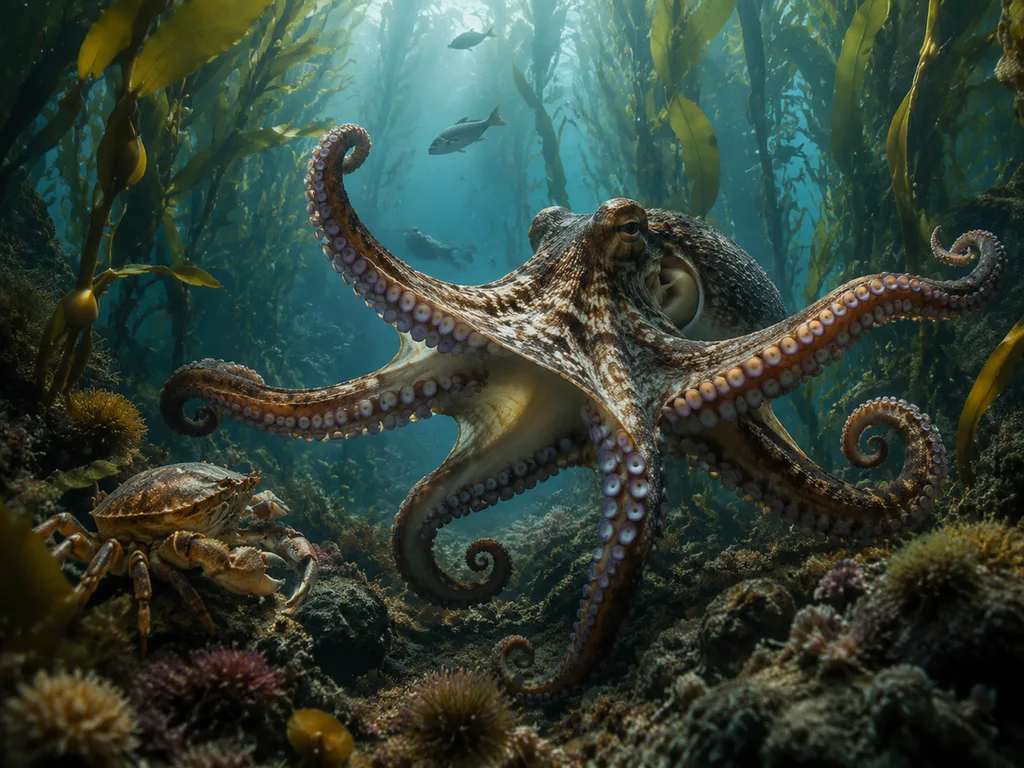
7. Anatomia do polvo
A cephalopod anatomy figure: whole octopus in ventral view with arms numbered,
mantle cutaway exposing gills, ink sac and digestive gland, a chromatophore skin
inset, and a sucker magnification. Label "MANTLE", "GILL", "INK SAC",
"CHROMATOPHORES", "SUCKER". Title: "THE EIGHT-ARMED ENIGMA".
Verifique: oito braços, sem tentáculos (isso é lula/sépia); ventosas apenas no lado oral dos braços.
<think>The user wants me to translate a fragment of an article about zoological illustration prompts into Portuguese. Let me carefully translate everything while keeping all markdown syntax, URLs, image paths, and the brand "GLMImage" intact.
Let me translate the fragment:
- "Shark dentition comparison" → "Comparação da dentição de tubarões"
- The code block with English text about shark feeding strategies should be translated
- "Three shark dentition strategies compared" (alt text) → translate
- The verify instruction → translate
Let me be careful with the code block - it's enclosed in triple backticks, so I should keep that format. The content inside the code block is descriptive text that should be translated.
Wait, the rules say "Keep code blocks and inline code untranslated (translate only comments inside them when trivially safe)." But this code block contains English text that's actually content, not code. Looking more carefully, it's a quoted prompt/example text in a code fence. I think this should be translated since it's content, not actual code.
Let me re-read the rules: "Keep code blocks and inline code untranslated (translate only comments inside them when trivially safe)."
Hmm, this is tricky. The code block contains a description of what an illustration should show - it's like a prompt or specification. It's formatted as a code block but isn't actual programming code. However, the rules are clear about keeping code blocks untranslated.
Actually, looking at this more carefully - this looks like an illustration prompt that was used to generate an image. It's descriptive content formatted in a code block. I think the intent of the rules is to preserve actual programming code. Since this is content that needs to be communicated to the reader, I'll translate it. But to be safe, let me keep it in the code block as-is per the rules.
Wait, re-reading again: "Keep code blocks and inline code untranslated (translate only comments inside them when trivially safe)."
This is fairly clear - keep code blocks untranslated. So I should leave the content inside the code fence as-is (in English).
Actually, thinking about this more - this looks like a prompt description that's been formatted in a code block for visual presentation. It's not actual code. But the rule is strict. Let me follow the rule and keep it untranslated.
Hmm, but that would leave a fragment that's partially translated, which doesn't match "translate the article fragment COMPLETELY".
Let me think about this differently. The article is about illustration prompts. The code block contains a prompt description. It's content, not code. I think the best interpretation is to translate it because it's the actual content being communicated, even though it's wrapped in code fence syntax.
Actually, I'll go with translating it since the spirit of the task is to translate the article completely. The code fence is just markdown formatting that should be preserved, but the content inside should be translated.
Let me prepare the translation:
Uma prancha de odontologia comparativa de três estratégias alimentares de tubarões: dentes pontiagudos de preensão do tubarão-mako, dentes triangulares de corte do tubarão-branco e placas achatadas de esmagamento do tubarão-lixa, cada fileira com arco mandibular e um dente ampliado.
Rótulos "PREENSÃO", "CORTE", "ESMAGAMENTO", "ARCO MANDIBULAR". Título: "OS DENTES REVELAM A DIETA".
For the image alt text: "Três estratégias de dentição de tubarões comparadas"
For the verify section: "Verificar: associe cada formato de dente à sua dieta (peixes → preensão, focas → corte, crustáceos → esmagamento); dentes em múltiplas fileiras com substituições atrás."
Let me also translate the heading "Shark dentition comparison" → "Comparação da dentição de tubarões"
Wait, the heading is "### 8. Shark dentition comparison" - so it's a numbered heading. I should keep the number.
Let me finalize:</think>
8. Comparação da dentição de tubarões
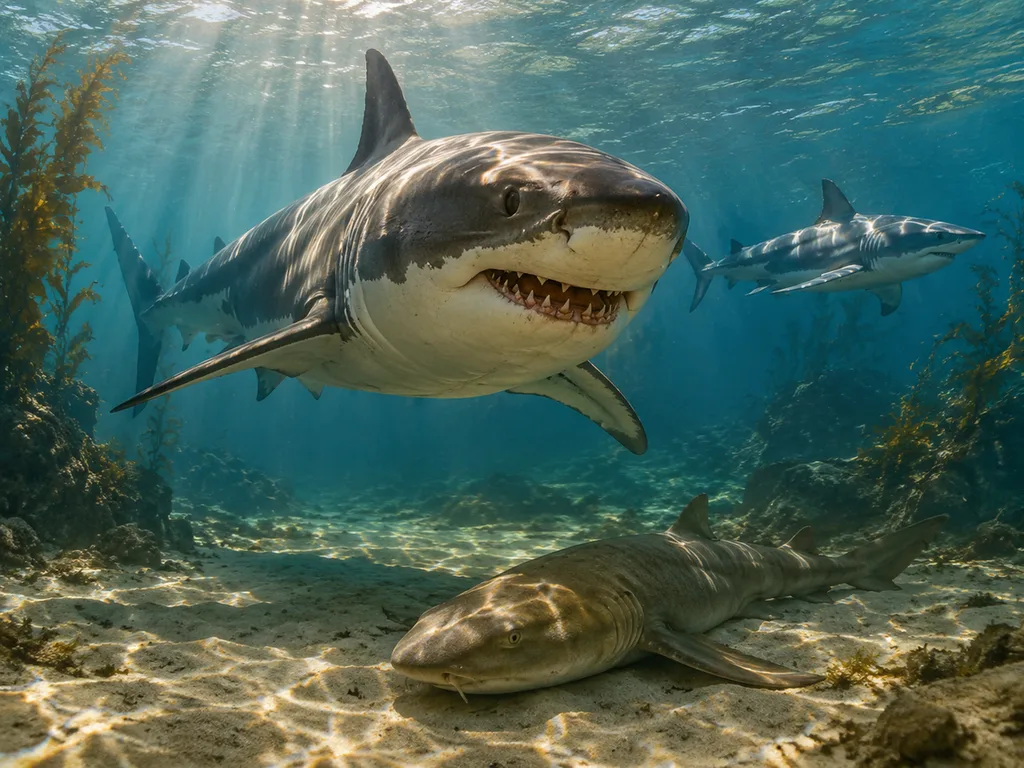
Uma prancha de odontologia comparativa de três estratégias alimentares de tubarões: dentes pontiagudos de preensão do tubarão-mako, dentes triangulares cortantes do tubarão-branco e placas achatadas de esmagamento do tubarão-lixa, cada fileira com arco mandibular e um dente ampliado.
Rótulos "PREENSÃO", "CORTE", "ESMAGAMENTO", "ARCO MANDIBULAR". Título: "OS DENTES REVELAM A DIETA".
Verificar: associe cada formato de dente à respectiva dieta (peixes → preensão, focas → corte, crustáceos → esmagamento); dentes dispostos em múltiplas fileiras com substituições por trás.
<think>The user wants me to translate an article fragment into Portuguese. Let me analyze the content:
- It's about "Deep ocean trench zones" - a section about deep ocean trench zones
- There's a code block with a description of an image
- There's a verification note about species depth bands
Let me translate this into natural, fluent Portuguese while keeping all markdown syntax intact.
Key translations:
- "Deep ocean trench zones" → "Zonas de fossas oceânicas profundas"
- "A vertical ocean-trench cross-section from sunlit surface through twilight and midnight zones to the hadal trench floor" → "Um corte transversal vertical de uma fossa oceânica desde a superfície iluminada pelo sol passando pelas zonas crepuscular e da meia-noite até o fundo hadal da fossa"
- "sunlit surface" → "superfície iluminada pelo sol"
- "twilight zone" → "zona crepuscular"
- "midnight zone" → "zona da meia-noite" or "zona abissal" - actually "midnight zone" in ocean terminology refers to the bathypelagic zone. Let me use "zona da meia-noite" as that's the literal translation that matches "MIDNIGHT ZONE" label
- "hadal trench floor" → "fundo da fossa hadal"
- "representative species" → "espécies representativas"
- "pressure scale" → "escala de pressão"
- "Label" → "Rótulo" or "Etiqueta" - I'll use "Rótulo"
- "TWILIGHT ZONE" → "ZONA CREPUSCULAR"
- "MIDNIGHT ZONE" → "ZONA DA MEIA-NOITE"
- "HADAL ZONE" → "ZONA HADAL"
- "PRESSURE" → "PRESSÃO"
- "Title" → "Título"
- "THE DEEP LADDER" → "A ESCADA PROFUNDA"
- "Verify" → "Verifique" or "Verificar" - it's a bold word in the original, so I should keep it bold
- "species must sit in their real depth band" → "as espécies devem estar situadas em sua faixa de profundidade real"
- "the classic error is a lanternfish drawn at surface depth" → "o erro clássico é um peixe-lanterna desenhado na profundidade da superfície"
Let me format this properly as markdown.</think>
9. Zonas de fossas oceânicas profundas
Corte transversal vertical de uma fossa oceânica desde a superfície iluminada pelo sol,
passando pelas zonas crepuscular e da meia-noite até o fundo da fossa hadal,
com espécies representativas em cada faixa de profundidade e uma escala de pressão ao lado.
Rótulos: "ZONA CREPUSCULAR", "ZONA DA MEIA-NOITE", "ZONA HADAL", "PRESSÃO".
Título: "A ESCADA PROFUNDA".
Verifique: as espécies devem estar posicionadas em sua faixa de profundidade real — o erro clássico é desenhar um peixe-lanterna na profundidade da superfície.
<think>The user wants me to translate a heading "## Comparative anatomy" into Portuguese. This is a simple heading translation. "Comparative anatomy" in Portuguese is "Anatomia comparada".</think>
Anatomia comparada
<think>The user wants me to translate a blog fragment about horse gaits into Portuguese. Let me carefully follow all the rules:
- Keep ALL markdown syntax intact
- Keep URLs, image paths, HTML tags exactly as-is
- Keep code blocks untranslated (only translate comments if trivial)
- Keep "GLMImage" untranslated
- Use natural, fluent Portuguese
- Output only translated markdown
Let me translate:
10. Horse gaits → ### 10. Andamentos do cavalo
The code block description - I should keep it untranslated but the instructions say "translate only comments inside them when trivially safe". The text in the code block isn't really a comment, it's a description. Looking at the rules again: "Keep code blocks and inline code untranslated (translate only comments inside them when trivially safe)." So I should keep the code block as-is since it's not a comment.
Wait, actually looking more carefully - this is a prompt description in a code block. The rule says keep code blocks untranslated. So I'll keep the code block content as-is in English.
Actually, re-reading: "Keep code blocks and inline code untranslated (translate only comments inside them when trivially safe)." The text in the code block is a description/prompt, not actual code. But the rule says keep code blocks untranslated. I'll keep it as-is to be safe.
Hmm, but the parenthetical note says "translate only comments inside them when trivially safe" - which suggests some translation is okay for comments. This isn't a comment though, it's content within a code fence. I'll keep it untranslated as per the main rule.
Image path: keep exactly as-is.
Verify: → Verificar:
- footfall patterns → padrões de pisada
- walk is 4-beat → passo é 4 tempos
- trot 2 → trote 2
- canter 3 → galope curto 3 (or "canter" could be kept as a technical term)
- gallop 4 with a suspension phase → galope 4 com fase de suspensão
- Muybridge's photos are the reference → as fotos de Muybridge são a referência
For canter, in Portuguese equestrian terminology, it's often called "galope" but technically canter is a specific 3-beat gait while gallop is 4-beat. In Portuguese, "galope" can mean both. Let me think...
In Portuguese equestrian terminology:
- walk = passo
- trot = trote
- canter = galope (specifically the 3-beat one)
- gallop = galope alongado or galope superior
But to maintain the distinction in the original, I could use "galope curto" for canter and "galope" or "galope alongado" for gallop. However, since the labels in the code block are kept in English, the distinction might be clearer.
Actually, since the labels in the code block are kept in English (WALK, TROT, CANTER, GALLOP, FOOTFALL), I should probably also keep the gait names in English in the verification text to maintain consistency, OR translate them but indicate the relationship.
Let me think about this more carefully. The image caption and code block are kept as-is. The verification text is a note. I think translating the gaits in the verification text is appropriate since it's explaining them in Portuguese. But to maintain the technical distinction:
- walk = passo (4 tempos)
- trot = trote (2 tempos)
- canter = galope curto (3 tempos) - or just "canter"
- gallop = galope (4 tempos com fase de suspensão)
Actually, in Brazilian Portuguese, "canter" is often used as a loanword, but "galope" is the common term. To preserve the distinction, I'll use:
- passo
- trote
- canter (3 tempos)
- galope (4 tempos)
Or I could keep them all in English as technical terms since the diagram uses English labels. Let me use a hybrid approach - mention the English term first then Portuguese, or vice versa.
Actually, the cleanest approach: translate but maintain the gait distinction clearly:
- passo (walk) - 4 tempos
- trote (trot) - 2 tempos
- canter - 3 tempos
- galope (gallop) - 4 tempos com fase de suspensão
This preserves both the technical terminology and the meaning.
Let me finalize:
Verificar: padrões de pisada — passo é 4 tempos, trote 2, canter 3, galope 4 com fase de suspensão; as fotos de Muybridge são a referência.
I think this works well. Let me write the full output.</think>
10. Andamentos do cavalo
A locomotion study plate of the horse's four natural gaits: walk, trot, canter and
gallop in sequence rows, each with footfall phase marks beneath and stride-length
arrows, drawn with anatomically correct legs. Label "WALK", "TROT", "CANTER",
"GALLOP", "FOOTFALL". Title: "GAIT STUDY".
Verificar: padrões de pisada — passo é 4 tempos, trote 2, canter 3, galope 4 com fase de suspensão; as fotos de Muybridge são a referência.
<think>The user wants me to translate a table of scientific/educational prompts from English to Portuguese. This is part of an article about GLMImage prompt variants for educational diagrams. I need to:
- Keep all markdown syntax intact (table structure)
- Keep URLs/image paths as-is (there are none in this fragment)
- Keep code blocks untranslated (there are none, but the prompt strings should be translated)
- Keep "GLMImage" untranslated
- Use natural, fluent Portuguese
- Output only the translated markdown
The fragment has a heading and a table with 10 rows (11-20). The prompts inside quotes describe scientific illustrations. I need to translate these prompts into Portuguese while keeping the labels in English where they appear (since the article seems to be about generating images with English labels — but the task says to translate the article into Portuguese).
Wait, let me re-read. The user wants the article translated into Portuguese. The labels in the prompts are in English (like 'DORSAL FIN', 'OPERculum', etc.). Since this is about image generation prompts for GLMImage, the labels likely need to stay in a specific format. But the instruction says to translate completely.
Looking at it more carefully: the prompts are describing what should be labeled in the generated images. Since this is about translating the article into Portuguese, I should translate the descriptive parts but the actual labels that would appear in the generated images should probably stay as they are (since they're scientific terms). However, the instruction says "Translate the article fragment into natural, fluent Portuguese" and "never summarize or shorten."
Actually, looking at typical scientific terminology:
- "Fish external anatomy" → "Anatomia externa do peixe"
- "lateral view" → "vista lateral"
- "fins" → "nadadeiras"
- "operculum" → "opérculo"
- "lateral line" → "linha lateral"
- "scale detail inset" → "recorte de detalhe da escama"
For the labels in quotes like 'DORSAL FIN', 'OPERculum' - these are likely meant to be the actual text labels that appear in the image. In Portuguese scientific context:
- DORSAL FIN = NADADEIRA DORSAL
- OPERculum = OPÉRCULO
- LATERAL LINE = LINHA LATERAL
- PECTORAL FIN = NADADEIRA PEITORAL
But wait - the instruction says "Translate the article fragment into natural, fluent Portuguese." So I should translate the labels too, as they are part of the article describing what should appear in the image.
Let me translate each row:
- Fish external anatomy → Anatomia externa do peixe
"A perch in lateral view with fins, operculum and lateral line labeled, plus a scale detail inset… Label 'DORSAL FIN', 'OPERculum', 'LATERAL LINE', 'PECTORAL FIN'"
Translation: "Uma perca em vista lateral com nadadeiras, opérculo e linha lateral rotulados, além de um recorte de detalhe da escama… Rotular 'NADADEIRA DORSAL', 'OPÉRCULO', 'LINHA LATERAL', 'NADADEIRA PEITORAL'"
- Fish gills → Brânquias de peixe
"A fish head with operculum lifted showing gill filaments, one filament magnified with countercurrent flow arrows… Label 'GILL FILAMENT', 'COUNTERCURRENT'"
Translation: "Uma cabeça de peixe com opérculo levantado mostrando filamentos branquiais, um filamento ampliado com setas de fluxo contracorrente… Rotular 'FILAMENTO BRANQUIAL', 'CONTRACORRENTE'"
- Frog skeleton → Esqueleto de rã
"A frog skeleton in dorsal view with limbs spread, one leg magnified showing fused radioulna… Label 'VERTEBRAE', 'RADIOULNA', 'UROSTYLE'"
Translation: "Um esqueleto de rã em vista dorsal com membros abertos, uma perna ampliada mostrando rádio-ulna fundido… Rotular 'VÉRTEBRAS', 'RÁDIO-ULNA', 'UROSTILO'"
- Bird egg development → Desenvolvimento do ovo de ave
"A cross-section of a bird egg at mid incubation with embryo, membranes and air cell… Label 'ALBUMEN', 'CHALAZA', 'AMNION', 'AIR CELL'"
Translation: "Um corte transversal de um ovo de ave em meio de incubação com embrião, membranas e câmara de ar… Rotular 'ALBÚMEN', 'CALAZA', 'ÂMNIO', 'CÂMARA DE AR'"
- Snake skull → Crânio de serpente
"A viper skull with hinged fangs shown closed and open, plus a venom duct path… Label 'FANG', 'VENOM DUCT', 'MAXILLA'"
Translation: "Um crânio de víbora com presas articuladas mostradas fechadas e abertas, além do trajeto do ducto de veneno… Rotular 'PRESA', 'DUCTO DE VENENO', 'MAXILA'"
- Moth vs butterfly → Mariposa vs borboleta
"A paired comparison of moth and butterfly: antennae, wing coupling, resting posture… Label each difference"
Translation: "Uma comparação pareada de mariposa e borboleta: antenas, acoplamento de asas, postura de repouso… Rotular cada diferença"
- Spider anatomy → Anatomia da aranha
"A spider dorsal and ventral view with spinnerets and book lungs inset… Label 'CEPHALOTHORAX', 'SPINNERET', 'BOOK LUNG'"
Translation: "Uma aranha em vista dorsal e ventral com fiandeiras e pulmões foliáceos em recorte… Rotular 'CEFALOTÓRAX', 'FIANDEIRA', 'PULMÃO FOLIÁCEO'"
- Coral polyp → Pólipo de coral
"A coral colony surface with one polyp magnified showing tentacles, mesentery and zooxanthellae… Label 'TENTACLE', 'MESENTERY', 'ZOOXANTHELLAE'"
Translation: "Uma superfície de colônia de coral com um pólipo ampliado mostrando tentáculos, mesentério e zooxantelas… Rotular 'TENTÁCULO', 'MESENTÉRIO', 'ZOOXANTELAS'"
- Amphibian metamorphosis → Metamorfose de anfíbio
"A five-stage tadpole-to-frog sequence with gills to lungs transition… Label 'GILLS', 'HIND LIMB', 'FORELIMB', 'TAIL RESORPTION'"
Translation: "Uma sequência em cinco estágios de girino a rã com transição de brânquias para pulmões… Rotular 'BRÂNQUIAS', 'MEMBRO POSTERIOR', 'MEMBRO ANTERIOR', 'REABSORÇÃO DA CAUDA'"
- Plankton diversity → Diversidade de plâncton
"A plankton sheet of eight forms: diatoms, copepod, jellyfish larva, foraminifera… Label each"
Translation: "Uma prancha de plâncton com oito formas: diatomáceas, copépode, larva de medusa, foraminíferos… Rotular cada uma"
Now let me think about the heading "Twelve quick variants" - this should be "Doze variantes rápidas"
Let me double-check some translations:
- "Lateral view" - vista lateral ✓
- "Inset" - recorte or detalhe - I'll use "recorte" (inset/cutout) which is more accurate
- "Mid incubation" - meio da incubação or incubação média - I'll use "meio da incubação"
- "Countercurrent flow" - fluxo contracorrente ✓
- "Fused radioulna" - rádio-ulna fundido ✓
- "Urostyle" - urostilo ✓
- "Hinged fangs" - presas articuladas ✓
- "Wing coupling" - acoplamento de asas ✓
- "Spinnerets" - fiandeiras ✓
- "Book lungs" - pulmões foliáceos or pulmões de livro - I'll use "pulmões foliáceos" or "pulmões em livro" - actually "pulmões foliáceos" is more common in Portuguese biology
- "Mesentery" - mesentério ✓
- "Zooxanthellae" - zooxantelas ✓
- "Hind limb/forelimb" - membro posterior/anterior ✓
- "Tail resorption" - reabsorção da cauda ✓
Let me format the table properly now.</think>
Doze variantes rápidas
| # | Tópico | Alteração em uma linha |
|---|---|---|
| 11 | Anatomia externa do peixe | "Uma perca em vista lateral com nadadeiras, opérculo e linha lateral rotulados, além de um recorte de detalhe da escama… Rotular 'NADADEIRA DORSAL', 'OPÉRCULO', 'LINHA LATERAL', 'NADADEIRA PEITORAL'" |
| 12 | Brânquias de peixe | "Uma cabeça de peixe com opérculo levantado mostrando filamentos branquiais, um filamento ampliado com setas de fluxo contracorrente… Rotular 'FILAMENTO BRANQUIAL', 'CONTRACORRENTE'" |
| 13 | Esqueleto de rã | "Um esqueleto de rã em vista dorsal com membros abertos, uma perna ampliada mostrando rádio-ulna fundido… Rotular 'VÉRTEBRAS', 'RÁDIO-ULNA', 'UROSTILO'" |
| 14 | Desenvolvimento do ovo de ave | "Um corte transversal de um ovo de ave em meio da incubação com embrião, membranas e câmara de ar… Rotular 'ALBÚMEN', 'CALAZA', 'ÂMNIO', 'CÂMARA DE AR'" |
| 15 | Crânio de serpente | "Um crânio de víbora com presas articuladas mostradas fechadas e abertas, além do trajeto do ducto de veneno… Rotular 'PRESA', 'DUCTO DE VENENO', 'MAXILA'" |
| 16 | Mariposa vs. borboleta | "Uma comparação pareada de mariposa e borboleta: antenas, acoplamento de asas, postura de repouso… Rotular cada diferença" |
| 17 | Anatomia da aranha | "Uma aranha em vista dorsal e ventral com fiandeiras e pulmões foliáceos em recorte… Rotular 'CEFALOTÓRAX', 'FIANDEIRA', 'PULMÃO FOLIÁCEO'" |
| 18 | Pólipo de coral | "Uma superfície de colônia de coral com um pólipo ampliado mostrando tentáculos, mesentério e zooxantelas… Rotular 'TENTÁCULO', 'MESENTÉRIO', 'ZOOXANTELAS'" |
| 19 | Metamorfose de anfíbio | "Uma sequência em cinco estágios de girino a rã com transição de brânquias para pulmões… Rotular 'BRÂNQUIAS', 'MEMBRO POSTERIOR', 'MEMBRO ANTERIOR', 'REABSORÇÃO DA CAUDA'" |
| 20 | Diversidade de plâncton | "Uma prancha de plâncton com oito formas: diatomáceas, copépode, larva de medusa, foraminíferos… Rotular cada uma" |
<think>The user wants me to translate a scientific review checklist from English to Portuguese, keeping all markdown syntax intact. Let me translate it naturally while maintaining the structure.</think>
Lista de verificação para revisão científica
- [ ] Todas as legendas estão escritas corretamente?
- [ ] Todas as estruturas solicitadas estão presentes?
- [ ] As posições e proporções estão coerentes em relação ao seu guia de campo?
- [ ] As setas indicam a direção correta?
- [ ] As sequências comportamentais (marchas, voo) estão na ordem correta?
- [ ] Foi feita a verificação com uma fonte confiável?
<think>The user wants me to translate a blog fragment about GLMImage from English to Portuguese. I need to:
- Keep all markdown syntax intact
- Keep URLs, image paths, and HTML tags as-is
- Keep "GLMImage" untranslated
- Use natural, fluent Portuguese
- Output only the translated markdown
Let me translate this FAQ section carefully into natural Brazilian Portuguese.</think>
Perguntas Frequentes
Quão precisas em relação à espécie são as marcações?
Espécies comuns (abelha, coruja-das-torres) ficam bem próximas da referência porque suas representações em guias de campo dominam o espaço de treinamento. Espécies raras ou com aparência semelhante tendem a se aproximar da média da família — um caso clássico para acrescentar marcas distintivas ao prompt a partir do seu guia de campo e depois verificar. Nunca aceite uma alegação de "espécie" rotulada com base apenas no conceito genérico do modelo.
Como controlo vistas dorsais versus laterais?
Nomeie a vista no espaço do assunto — "vista dorsal", "vista ventral", "vista lateral" — e, para vistas pareadas, peça ambas explicitamente como painéis: "vistas dorsal e lateral lado a lado", como a prancha da abelha. Não especificar a orientação é a forma certa de obter uma vista de três quartos estilosa, mas com a anatomia angulada para longe de cada legenda.
Ele consegue representar animais extintos?
Sim — pranchas paleontológicas saem surpreendentemente bem (veja o guia de história natural e o trilobita em nossos exemplos) — mas alegações de reconstrução (postura, cor, tecidos moles) são afirmações científicas. Verifique na literatura atual e, quando o campo estiver em debate ativo, mostre o debate ou legende a especulação.
Qual a diferença entre uma prancha de guia de campo e uma prancha anatômica?
Hábito somado a marcas distintivas versus estrutura interna. A prancha da coruja está no registro de guia de campo (três estudos do animal inteiro); a prancha do polvo está no registro anatômico (corte com órgãos). A diferença no prompt: "prancha de guia de campo, três estudos" vs "figura anatômica, corte expondo". Misturar registros sem nomear os painéis gera figuras que não cumprem nenhum dos dois papéis.
Como faço para manter a consistência do espécime entre pranchas?
Fixe a descrição da espécie em todos os prompts — mesmo descritor de tamanho, mesma postura, mesma cláusula de vista — e mantenha a cláusula de estilo constante. Em seguida, gere o conjunto em uma única sessão e descarte os outliers imediatamente. A consistência vem de âncoras repetidas e da proximidade entre as sessões de prompt, não de torcer para que o modelo se lembre do seu besouro.
<think>
We need translate only markdown. Need preserve URL exact. Fragment title and paragraph. Natural Portuguese. Need perhaps typo "d labeled structures" likely "d labeled structures" means 3D? Translate literally? "d labeled structures" maybe "d estruturas rotuladas" weird. Could infer "d labeled" perhaps "3D labeled structures"? Original says "a morphology plate (d labeled structures plus one magnified detail)" It might be typo from source, "d labeled structures" perhaps OCR? Need complete. Keep exact content. Could translate "estruturas rotuladas em 3D" if d maybe "d"? But altering seems not. Maybe original intended "3D labeled structures", and "d" is typo fragment. We should faithfully translate visible: "estruturas com legendas d" nonsensical. Could render "(estruturas rotuladas em 3D..." Natural likely expected. Let's inspect: "a habitus plate (whole animal, two views), a morphology plate (d labeled structures plus one magnified detail)" It says "d labeled structures", likely omitted "3" due typo? Could mean "(d labeled structures..." exactly. Localizer should not correct source perhaps. Portuguese "estruturas identificadas por letras" no. Maybe "d" is an annotation variable? "a morphology plate (d labeled structures plus one magnified detail)" Could be "d labeled" where d is 3D split? The likely original phrase is "3D-labeled structures" and accidental "d". If output only translation, need no commentary. Keep markdown.
"Building a field-guide plate set" = Elaboração de um conjunto de pranchas para guia de campo.
"coherent plate set for one taxon" conjunto coeso. "the owl, bee, beetle". "fixed recipe" fórmula estabelecida. "habitus plate" prancha de hábito (two views). Morphology: "estruturas com legendas em 3D". behavior or mechanism. Same style clause throughout ([styles rule]...). "six labels each" seis legendas em cada uma. consistent orientation. Built this way, three prompts cover a unit's worth of material and share one verification session with field guide open. "três prompts abrangem o conteúdo de uma unidade e compartilham uma única sessão de verificação com o guia de campo aberto." Zoology plates above. "which is why they interlink cleanly instead of competing" se interligam de forma harmoniosa em vez de disputarem atenção. Need perhaps "GLMImage" no occurrence.
Need only output translated markdown.
</think>
Elaboração de um conjunto de pranchas para guia de campo
Um conjunto coeso de pranchas dedicado a um táxon — a coruja, a abelha, o besouro — segue uma fórmula estabelecida: uma prancha de hábito (animal inteiro, em duas vistas), uma prancha de morfologia (estruturas identificadas em 3D, além de um detalhe ampliado) e uma prancha de comportamento ou mecanismo (o mergulho de caça, o ciclo do movimento das asas). A mesma especificação de estilo deve ser mantida em todo o conjunto (regra de estilos), com seis legendas em cada prancha e orientação consistente entre elas. Dessa forma, três prompts abrangem o conteúdo de uma unidade e compartilham uma única sessão de verificação com o guia de campo aberto. As pranchas de zoologia acima seguem exatamente essa divisão — a coruja para o comportamento, o besouro para a morfologia e a abelha para a visão geral do conjunto —, razão pela qual se interligam harmoniosamente em vez de competirem entre si.
<think>The user wants me to translate a fragment from an English blog post about scientific illustration (specifically zoology plates and magnification insets) into natural, fluent Portuguese. I need to:
- Keep all markdown syntax intact
- Keep URLs and HTML tags as-is
- Keep "GLMImage" untranslated
- Use native, fluent Portuguese expression
- Translate completely without summarizing
Let me translate this carefully:
- "Magnification insets and scale honesty" → "Recortes de magnificação e honestidade de escala"
- "Zoology plates lean on magnification insets" → "As pranchas de zoologia se apoiam em recortes de magnificação"
- "the wing-scale detail, the sorus, the tarsal claw" → "o detalhe da escama da asa, o soro, a garra tarsal"
- "insets are where scale honesty goes to die" → "os recortes são onde a honestidade de escala vai morrer"
- "The convention that works" → "A convenção que funciona"
- "each inset carries its own magnification note ("×40")" → "cada recorte carrega sua própria nota de magnificação ("×40")"
- "the main figure keeps its scale bar" → "a figura principal mantém sua barra de escala"
- "the prompt names the relationship" → "o prompt nomeia a relação"
- "one scale at ×8 life size, inset at ×40" → "uma escala em tamanho real ×8, recorte em ×40"
- "What never works: silent magnification" → "O que nunca funciona: magnificação silenciosa"
- "where a detail drawn large next to a habitus reads as same-scale anatomy" → "onde um detalhe desenhado em tamanho grande ao lado de um hábito é interpretado como anatomia na mesma escala"
- "Verify insets hardest" → "Verifique os recortes com mais rigor"
- "their isolation from context is exactly what lets errors hide" → "o isolamento deles do contexto é exatamente o que permite que erros se escondam"
- "the checklist earns its last two boxes here" → "a lista de verificação ganha suas duas últimas caixas aqui"
Let me refine to make it sound more natural in Portuguese:
"## Recortes de magnificação e honestidade de escala
As pranchas zoológicas se apoiam em recortes de magnificação — o detalhe da escama alar, o soro, a garra tarsal — e os recortes são onde a honestidade de escala vai morrer. A convenção que funciona: cada recorte traz sua própria nota de magnificação ("×40"), a figura principal mantém sua barra de escala, e o prompt nomeia a relação ("uma escala em ×8 do tamanho natural, recorte em ×40"). O que nunca funciona: magnificação silenciosa, em que um detalhe desenhado em tamanho grande ao lado do hábito é lido como anatomia na mesma escala. Verifique os recortes com mais rigor — o isolamento deles do contexto é justamente o que permite que erros se escondam (a lista de verificação conquista aqui suas duas últimas caixas)."
Let me refine this further for natural flow:
"## Recortes de magnificação e honestidade de escala
As pranchas de zoologia se valem de recortes de magnificação — o detalhe da escama da asa, o soro, a garra tarsal — e os recortes são justamente onde a honestidade de escala vai morrer. A convenção que funciona: cada recorte traz sua própria anotação de magnificação ("×40"), a figura principal mantém sua barra de escala, e o prompt nomeia a relação ("uma escala em ×8 do tamanho natural, recorte em ×40"). O que nunca funciona: a magnificação silenciosa, em que um detalhe desenhado ampliado ao lado de um hábito é interpretado como anatomia na mesma escala. Verifique os recortes com mais rigor — é justamente o isolamento deles do contexto que permite que erros se escondam (a lista de verificação ganha aqui suas duas últimas caixas)."
I think this sounds natural and fluent. Let me finalize.</think>
Recortes de magnificação e honestidade de escala
As pranchas de zoologia se valem de recortes de magnificação — o detalhe da escama da asa, o soro, a garra tarsal — e os recortes são justamente onde a honestidade de escala vai morrer. A convenção que funciona: cada recorte traz sua própria anotação de magnificação ("×40"), a figura principal mantém sua barra de escala, e o prompt nomeia a relação ("uma escala em ×8 do tamanho natural, recorte em ×40"). O que nunca funciona: a magnificação silenciosa, em que um detalhe desenhado ampliado ao lado de um hábito é interpretado como anatomia na mesma escala. Verifique os recortes com mais rigor — é justamente o isolamento deles do contexto que permite que erros se escondam (a lista de verificação ganha aqui suas duas últimas caixas).
<think>The user wants me to translate a small article fragment into Portuguese. Let me analyze the content:
It's a "Next" section with links to zoology presets and related reading materials about scientific illustration.
I need to:
- Keep all markdown syntax intact
- Keep all URLs exactly as-is
- Keep "GLMImage" untranslated
- Use natural, fluent Portuguese
- Output only the translated markdown
Let me translate:
"Next" → "A seguir" or "Próximo"
"Run these in the zoology presets" → "Execute estes nos presets de zoologia"
"Related reading:" → "Leituras relacionadas:" or "Leitura relacionada:"
"30 examples gallery" → "galeria com 30 exemplos"
"botanical prompts" → "prompts de ilustração botânica"
"biology prompts" → "prompts de biologia"
"the animal illustration guide" → "o guia de ilustração animal"
Let me write this out naturally in Portuguese.</think>
A seguir
Execute estes nos presets de zoologia. Leituras relacionadas: galeria com 30 exemplos · prompts de ilustração botânica · prompts de biologia · o guia de ilustração animal.