<think>The user wants me to translate a blog fragment from English to Japanese. It's about scientific illustration examples, specifically a heritage rose botanical plate. I need to translate it naturally into Japanese while keeping all markdown, URLs, image paths, and HTML tags exactly as they are. The brand "GLMImage" stays untranslated.
Let me translate this carefully, maintaining a natural Japanese tone.</think>

この伝統的なバラの図版 ― 開花、つぼみ、解剖した花、5つのラベル、グラフイト上に水彩で描かれています ― は1つのプロンプトから生成されました。これはこのギャラリーにある30の例のひとつで、それぞれ正確なプロンプト、ラベルリスト、そして使用する前に確認すべき点とともに掲載されています。プロンプトをそのままコピーするか、主題の行を差し替えれば独自のテーマに向け直すことができます。
自分の図版を生成する · プロンプトワークフローガイド · 生物プロンプトパック
以下のすべての画像は、glmimage.app の科学イラストモジュール(モデル:grok-imagine-image-2.0)で生成され、公開前にラベルのスペルチェックをパスしています。「レビューをパス」とは、ラベルが判読可能でスペルが正確であることを意味するだけであり、解剖学的構造が reference と照合して認定されたという意味ではありません。確認事項の欄では、何をチェックすべきかを説明しています。
<think>The user has provided a very short fragment - just "## Botany" - which is a markdown heading. They want it translated into Japanese as part of a localization task for GLMImage blog content.
In Japanese, "Botany" (the study of plants) is typically translated as:
- 植物学 (shokubutsugaku) - the most common academic term
- ボタニー - sometimes used as katakana loanword but less common in scientific contexts
Since this is a blog article heading about the study of plants, 植物学 would be the most appropriate translation.
The instruction says to keep ALL markdown syntax intact, so the heading level (##) should be preserved.
The output should be just the translated markdown with no preamble or commentary.</think>
植物学
<think>The user wants me to translate an article fragment from English to Japanese. Let me analyze the content:
- A heading about "Heritage rose plate"
- An image with alt text
- A code block with a prompt (should not be translated as it's a code block)
- A verify section
Let me translate this carefully into natural Japanese while keeping all markdown syntax intact.
For the code block, I should keep it untranslated as per rule 3.
Let me draft the translation:
- "Heritage rose plate" → 「ヘリテージローズの図版」
- The alt text should be kept in English or translated? The rules say "Keep every URL, image path, and HTML tag EXACTLY as-is." The alt text isn't explicitly mentioned but it's part of the image markdown. Let me translate it since it's descriptive text, but actually, looking more carefully, the alt text describes what's in the image. I'll translate it to Japanese for consistency.
Wait, let me re-read the rules. "Keep every URL, image path, and HTML tag EXACTLY as-is." The alt text in markdown images is part of the image syntax. Let me think... I think it's safer to translate the alt text since it's content, not a URL/path/tag. Actually, the alt text is essentially content describing the image. I'll translate it.
For the code block, I keep it completely as-is including the English labels (BLOOM, BUD, etc. are part of the prompt).
Let me finalize:
- "Heritage rose plate" → 「ヘリテージローズの図版」
- Alt text: "オールドガーデンローズの博物誌風植物図版。開花、つぼみ、雄しべと雌しべを示す解剖花、葉のついた茎"
- The image URL stays the same
- The code block stays the same
- "Verify:" → 「検証:」 or 「確認:」
- "stamen count and arrangement against the actual cultivar" → 「実際の品種と雄しべの数と配置」
- "leaflet serration (old roses are usually 5-7 leaflets, never simple)" → 「小葉の鋸歯(オールドローズは通常5〜7枚の小葉で、単葉ではない)」
Let me refine this for natural Japanese flow.
Actually, for the alt text, I should think about whether to translate or not. The rule says to keep URLs, image paths, and HTML tags as-is. Alt text is technically part of the image markdown but it's content. I'll translate it to make it natural in Japanese.
Let me write out the full translation:</think>
1. ヘリテージローズの図版

A museum-style botanical plate of one old garden rose: full bloom, a half-open bud,
a dissected flower showing stamens and pistil, and a leafy stem, in graphite contour
with specimen-true watercolor. Label "BLOOM", "BUD", "STAMENS", "PISTIL", "LEAFLET".
Title: "THE OLD ROSE".
検証: 実際の品種と照らし合わせて雄しべの数と配置を確認。小葉の鋸歯を点検(オールドローズは通常5〜7枚の小葉で、単葉はありえません)。
<think>The user wants me to translate an article fragment about moss life cycle into Japanese. I need to:
- Keep all markdown syntax intact
- Keep URLs, image paths, and HTML tags exactly as-is
- Keep code blocks untranslated (translate only comments inside them when trivially safe)
- Keep "GLMImage" untranslated
- Use native, fluent Japanese
- Output only the translated markdown
Let me translate the content carefully:
- The heading "Moss life cycle" → "コケ植物の生活環"
- The image alt text should be kept as-is or translated? The URL stays, but the alt text... The instruction says keep URLs, image paths EXACTLY as-is. The alt text is part of the markdown image syntax. Let me check - the rule says "Keep every URL, image path, and HTML tag EXACTLY as-is. Do not translate or alter them." The alt text isn't a URL or HTML tag, but it's part of the markdown image. I think it's safer to translate the alt text for accessibility in Japanese context, but since the rule is strict about not altering URLs/paths/HTML tags, and the alt text is technically inside the markdown image syntax... Hmm. Actually, the alt text is descriptive text meant to describe the image. For a Japanese article, it should probably be in Japanese. But to be safe, let me translate the alt text too since it's not a URL/path/HTML tag itself.
Actually, re-reading: "Keep every URL, image path, and HTML tag EXACTLY as-is." - this specifies URL, image path, HTML tag. The alt text is none of these. So I should translate the alt text.
-
The code block (the prompt for image generation) - rules say "Keep code blocks and inline code untranslated (translate only comments inside them when trivially safe)." So I keep this in English.
-
"Verify:" - translate to "確認:" or "検証:"
-
"the sporophyte must grow from the gametophyte, not from soil; peristome teeth belong at the capsule mouth only." - translate
Let me draft:
2. コケ植物の生活環
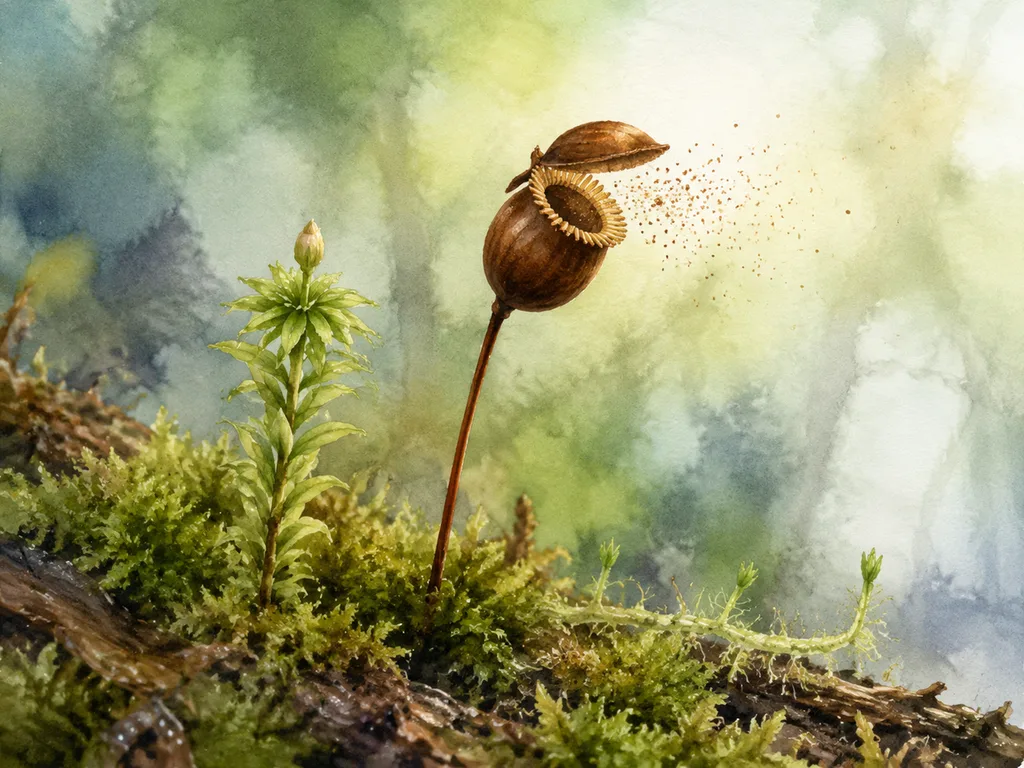
An alternating-generations plate for a moss: leafy gametophyte, magnified antheridium
and archegonium, the sporophyte with seta and capsule, capsule operculum open with
peristome teeth releasing spores, and a protonema inset. Label "GAMETOPHYTE",
"CAPSULE", "SETA", "PERISTOME", "SPORES". Title: "TWO GENERATIONS".
確認: 胞子体は土壌からではなく、配偶体から生えなければならない; 蒴歯の歯は蒴の開口部にのみ存在する。
Wait, let me refine the Japanese to be more natural:
- "配偶体から生えなければならない" - this is fine
- "蒴歯の歯は蒴の開口部にのみ存在する" - "peristome teeth belong at the capsule mouth only" → より自然には「蒴歯は蒴の開口部にのみ存在する」since "peristome teeth" and "蒴歯" are essentially the same thing (歯 = peristome). Hmm, but "peristome teeth" specifies the teeth of the peristome. In botanical Japanese, 蒴歯 refers to the peristome teeth themselves. So "蒴歯は蒴の開口部にのみ存在する" might be slightly redundant but accurate. Or "蒴歯の歯は蒴の口部にのみ属する" - this preserves the meaning better. Actually, in English "peristome teeth" is the standard term. In Japanese, 歯 (shōshi) means peristome teeth. So translating "peristome teeth" as "蒴歯" is accurate, and "belong at the capsule mouth" becomes "蒴の開口部に存在する" or "蒴の口部にある".
Let me refine: "蒴歯は蒴の開口部にのみ存在する" - this is natural and accurate.
Actually, thinking again about botanical terminology:
- gametophyte = 配偶体
- sporophyte = 胞子体
- capsule = (or 朔)
- seta = 蒴柄 (or 朔柄)
- peristome = 蒴歯 (or 朔歯)
- spores = 胞子
- protonema = 原糸体
- antheridium = 精子器
- archegonium = 造卵器
Let me finalize:
2. コケ植物の生活環
An alternating-generations plate for a moss: leafy gametophyte, magnified antheridium
and archegonium, the sporophyte with seta and capsule, capsule operculum open with
peristome teeth releasing spores, and a protonema inset. Label "GAMETOPHYTE",
"CAPSULE", "SETA", "PERISTOME", "SPORES". Title: "TWO GENERATIONS".
確認: 胞子体は土壌からではなく配偶体から生じなければならず、蒴歯は蒴の開口部にのみ存在する。
This looks good. Let me double-check the image alt text translation - it should describe what's in the image. "Moss life cycle plate showing gametophyte, capsule, seta, peristome and spores" → "配偶体、蒴、蒴柄、歯、胞子を示すコケ植物の生活環の図版"
Actually, I should reconsider whether to translate the alt text. The instruction is strict about URLs, paths, HTML tags. Alt text is not a URL. So translating it is appropriate for a Japanese localized version.
One more check on "alternating-generations" - this is "世代交代" in Japanese. But since it's in the code block, it stays in English. Good.
Final answer looks good.</think>
2. コケ植物の生活環
An alternating-generations plate for a moss: leafy gametophyte, magnified antheridium
and archegonium, the sporophyte with seta and capsule, capsule operculum open with
peristome teeth releasing spores, and a protonema inset. Label "GAMETOPHYTE",
"CAPSULE", "SETA", "PERISTOME", "SPORES". Title: "TWO GENERATIONS".
確認: 胞子体は土壌からではなく配偶体から生じなければならず、歯は蒴の開口部にのみ存在する。
<think>The user wants me to translate an article fragment into Japanese. However, the fragment provided is just "## Zoology" - which is a markdown heading. Let me translate this into Japanese naturally.
"Zoology" in Japanese is "動物学" (doubutsugaku).
I need to keep the markdown syntax intact, so it should remain as a level 2 heading.</think>
動物学
<think>The user wants me to translate an article fragment about beetle morphology into Japanese. Let me carefully follow the rules:
- Keep ALL markdown syntax intact
- Keep URLs, image paths, and HTML tags as-is
- Keep code blocks untranslated (translate only comments inside)
- Keep "GLMImage" untranslated
- Use native, fluent Japanese
- Output ONLY translated markdown
Let me translate this fragment:
- "Beetle morphology" → 甲虫の形態
- The alt text for the image should be translated naturally
- The code block (prompt) should remain untranslated
- "Verify:" needs translation
- "tarsal segment count (5-5-5 for most beetles, but stag beetles vary)" → 跗節の節数(ほとんどの甲虫は5-5-5だが、クワガタムシは異なる)
- "the flight wing should fold under the elytron, not beside it" → 後翅は鞘翅の下側に折りたたまれるべきで、横に添えるものではない
Let me write this out properly in Japanese with natural, fluent expression.</think>
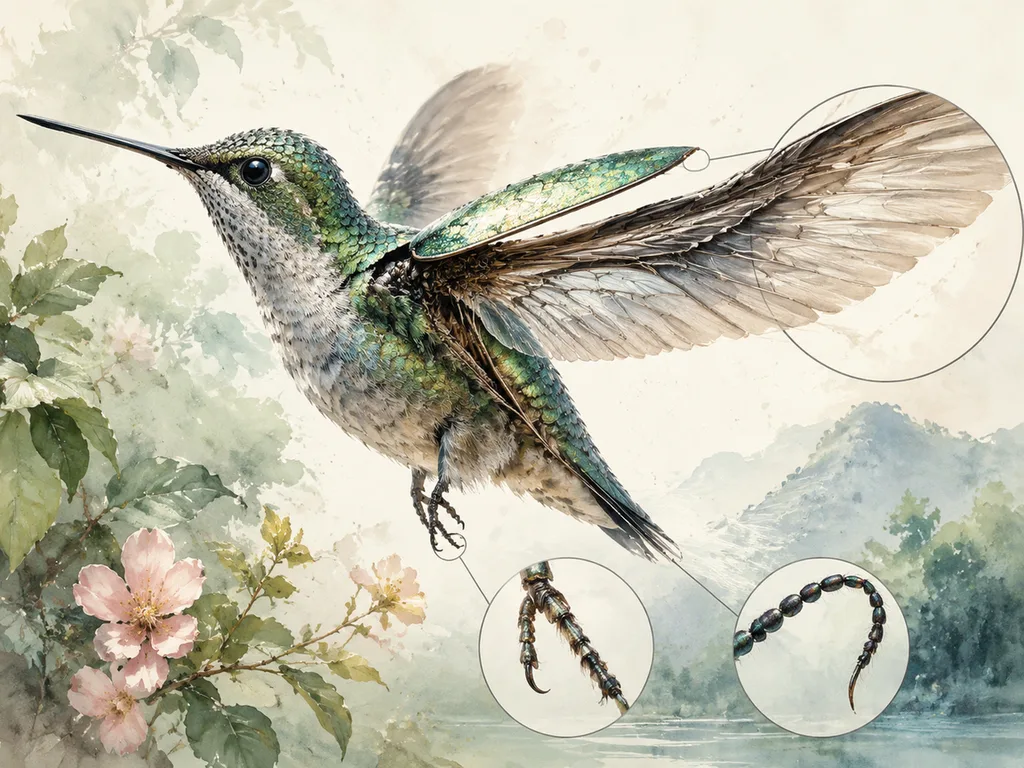
3. 甲虫の形態
A comparative coleopterology plate: one stag beetle in dorsal view with all major
sclerites labeled, one elytron lifted to reveal the folded flight wing, a leg with
tarsal segments magnified, and an antenna detail. Label "PRONOTUM", "ELYTRON",
"FLIGHT WING", "TARSUS". Title: "ARMOR AND WING".
確認事項: 跗節の節数(ほとんどの甲虫は5-5-5だが、クワガタムシは変異がある)。後翅は鞘翅の下側に折りたたまれる構造であり、横に添える形ではない。
<think>The user wants me to translate the article fragment into natural, fluent Japanese. Let me carefully translate everything while preserving all markdown syntax, URLs, image paths, and code blocks.
Let me break down what needs to be translated:
- Heading "### 4. Hummingbird flight mechanics"
- Image alt text
- Code block (keep untranslated except for comments if safe - but this is a prompt description, I'll keep it as-is)
- The bold "Verify:" note and its content
Let me translate this carefully into natural Japanese:
- "Hummingbird flight mechanics" → "ハチドリの飛行力学" or "ハチドリの飛行メカニズム"
- The image alt text describes scientific labels
- The code block is a prompt for image generation - should remain untranslated
- "Verify:" → "確認:" or "検証:"
- The explanation about lift arrows being symmetric
Let me craft a natural Japanese translation:</think>
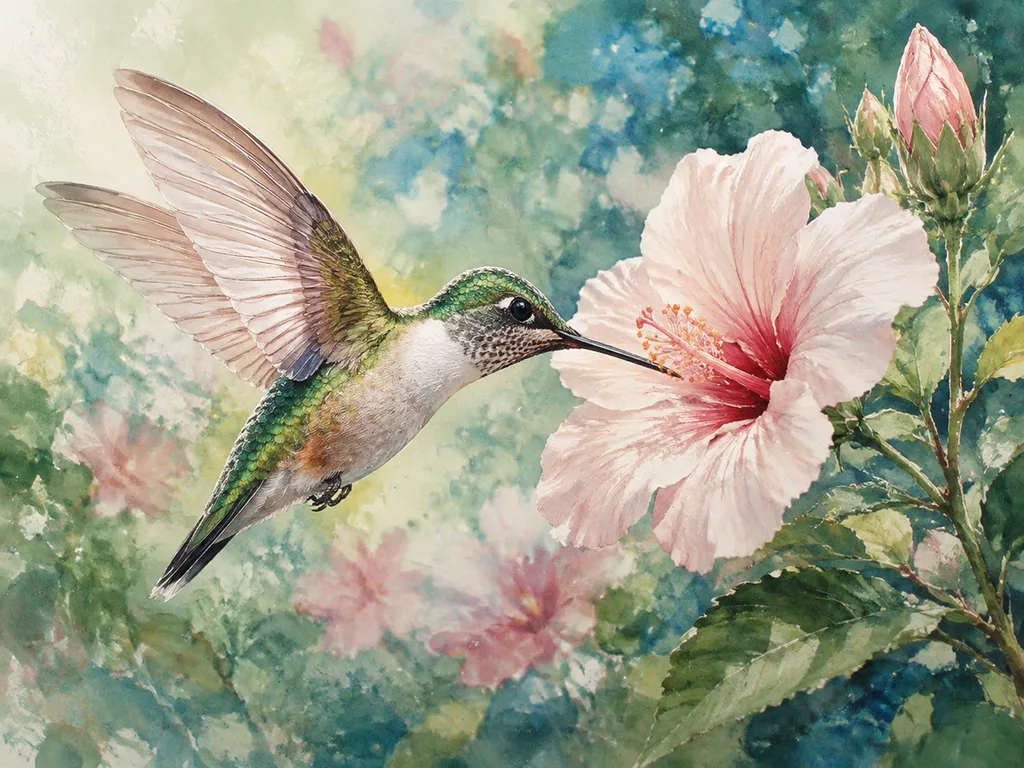
4. ハチドリの飛行メカニズム
A hovering-flight figure: hummingbird in hover with figure-eight wing-path stroke
cycle, shoulder rotation at reversal points, a nectar-feeding posture inset, and
lift-vector arrows during downstroke and upstroke. Label "WING PATH", "STROKE CYCLE",
"LIFT VECTOR", "FEEDING". Title: "FEATHERED HELICOPTER".
確認ポイント: 揚力を示す矢印は両ストローク間でほぼ対称になっているはずです。ハチドリはほとんどの鳥類と異なり、アップストローク(上向き翼打ち)でも揚力を生み出します。
<think>The user wants me to translate a blog fragment into Japanese. However, looking at the input, I only see "## Medicine" which is just a heading. There's no actual content to translate beyond this heading.
Let me re-read the instructions: "This is ONE fragment of a longer article — translate it COMPLETELY"
The fragment provided is just "## Medicine". I should translate this heading into Japanese. "Medicine" in Japanese could be translated as "医学" or "医療" or "薬学" depending on context. Since this is likely a section heading about medicine/healthcare, "医療" or "医学" would be appropriate.
Since there's no other content, I'll just output the translated heading.</think>
医療
<think>The user wants me to translate an article fragment into natural, fluent Japanese. Let me carefully translate this fragment about Alzheimer pathology in the hippocampus.
Key requirements:
- Keep ALL markdown syntax intact
- Keep URLs, image paths, HTML tags as-is
- Keep code blocks untranslated
- Keep "GLMImage" untranslated
- Use native, fluent Japanese
- Output only translated markdown
Let me translate:
Title: "Alzheimer pathology in the hippocampus" → "海馬におけるアルツハイマー病の病理"
Image caption: "Coronal brain section with hippocampus highlighted, plaques and tangles labeled" → "海馬が強調表示された冠状脳切片、プラークとタングルがラベル付けされている"
Code block (inside the ...): Keep untranslated
"Verify:" → "確認事項:" or "検証:"
Let me think about the natural Japanese phrasing:
- "hippocampal anatomy in a coronal plane is easy to get subtly wrong" → "冠状面における海馬の解剖は、微妙な誤りが見過ごされやすい"
- "compare against a neuroanatomy atlas before teaching use" → "教育目的で使用する前に神経解剖学アトラスと照合してください"
- "See our medical illustration guide" → "医療イラストガイドもご参照ください"
Let me write the full translation now.</think>
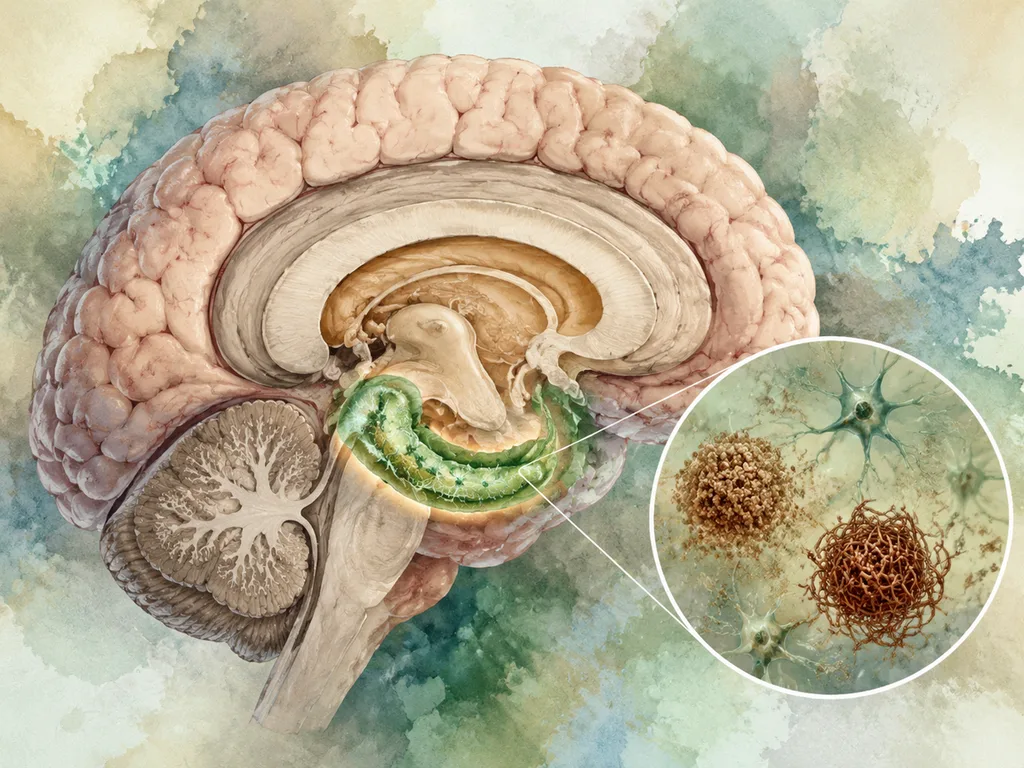
5. 海馬におけるアルツハイマー病の病理
A coronal brain section highlighting the hippocampus in Alzheimer disease, with
amyloid plaques as small extracellular deposits and neurofibrillary tangles inside
neurons, plus one magnified inset of a plaque and a tangle. Label "HIPPOCAMPUS",
"PLAQUE", "TANGLE", "NEURON". Title: "ALZHEIMER PATHOLOGY".
確認事項: 冠状面における海馬の解剖は、わずかな誤りが生じやすいため、教育用途で使用する前に神経解剖学の図譜と照合してください。 医療解剖イラストガイドもご覧ください。
<think>The user wants me to translate an article fragment about a blood cell family tree diagram into natural, fluent Japanese. I need to keep all markdown syntax, URLs, image paths, code blocks, and the brand name "GLMImage" intact. Let me translate this carefully.</think>
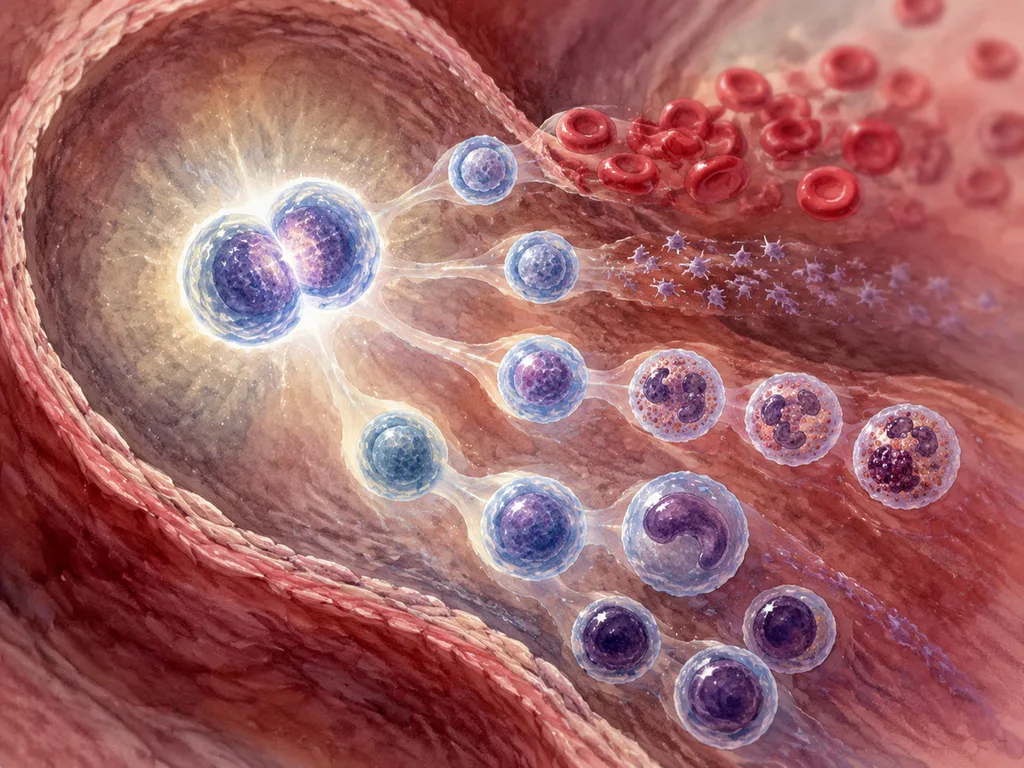
6. 血液細胞の家系図
古典的な造血系ツリー:根元に造血幹細胞があり、前駆細胞を経て
赤血球、血小板、顆粒球、単球、リンパ球へと分岐する。各成熟細胞は
葉の部分に描かれる。「STEM CELL」「PROGENITOR」「RED CELL」
「PLATELET」「LYMPHOCYTE」のラベル付き。タイトル:「BLOOD LINEAGES」。
確認ポイント: 共通祖先のノード — 骨髄系とリンパ系の分岐は早期に起こること。血小板は断片であり、核を持つ細胞ではないこと。
<think>The user wants me to translate an article fragment into Japanese. However, I only see a heading "## Molecular biology" with no actual content to translate. Let me provide the translation of just this heading.
Wait, the instructions say "This is ONE fragment of a longer article — translate it COMPLETELY". But there's only a heading. I should translate what's given. Since the heading is "Molecular biology", I'll translate it to Japanese.
In Japanese, "Molecular biology" is "分子生物学" (ぶんしせいぶつがく).
I should output just the translated markdown without any preamble or code fences around the whole output.</think>
分子生物学
<think>The user wants me to translate an article fragment about antibody structure into Japanese. I need to keep all markdown syntax, URLs, image paths, and code blocks intact. The brand "GLMImage" should remain untranslated. Let me translate this carefully into natural Japanese.
Key terms to translate:
- Antibody structure → 抗体構造
- Antibody molecular figure → 抗体分子図
- heavy chain → 重鎖
- light chain → 軽鎖
- paratope → パラトープ
- epitope → エピトープ
- antigen-binding sites → 抗原結合部位
- antigen → 抗原
- magnified inset → 拡大インセット
- Y-shape symmetry → Y字型対称性
- Fab arms → Fabアーム
- identical → 同一
- swapped → 取り違えられる
Let me write this out naturally in Japanese.</think>
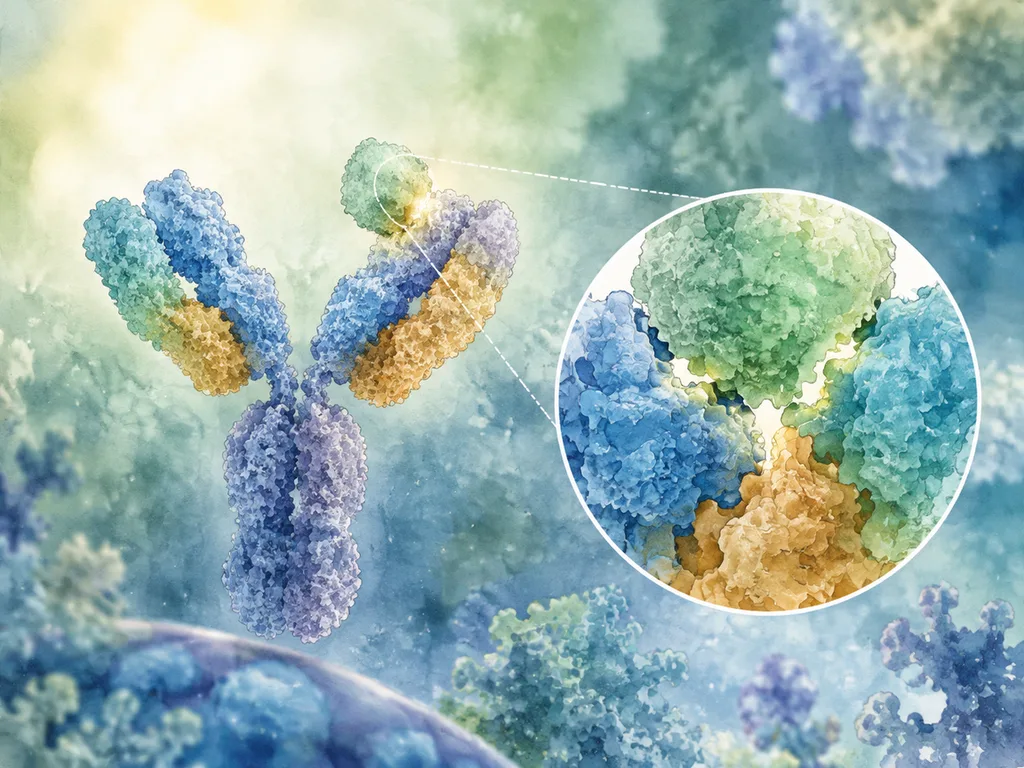
7. 抗体構造
抗体分子図:2本の重鎖と2本の軽鎖を持ち、抗原結合部位が小さな抗原を掴んでおり、
パラトープ-エピトープ界面の拡大インセットを1つ示す。ラベル:「HEAVY CHAIN」、
「LIGHT CHAIN」、「PARATOPE」、「EPITOPE」。タイトル:「ANTIBODY STRUCTURE」。
検証ポイント: Y字型の対称性 — 両方のFabアームは同一であること。パラトープは抗体側に、エピトープは抗原側に存在する(これらは頻繁に取り違えられる)。
<think>The user wants me to translate an article fragment about the T4 bacteriophage into natural, fluent Japanese. Let me carefully translate everything while:
- Keeping all markdown syntax intact
- Keeping URLs, image paths, and HTML tags exactly as-is
- Keeping the code block untranslated (the English description in the code block stays as code)
- Keeping "GLMImage" untranslated
- Using natural Japanese
Let me translate:
8. Bacteriophage T4 → 8. バクテリオファージ T4
The image alt text and the code block description - the code block should be kept as-is per the rules (code blocks are not translated). The image alt text is also kind of descriptive metadata but it's inside the markdown for an image. Let me think... Actually, the alt text in the image markdown is descriptive text. Looking at the rules again - "Keep every URL, image path, and HTML tag EXACTLY as-is. Do not translate or alter them." The alt text within the image markdown could be considered part of the URL/markdown structure. But it's text content. I think it's safer to translate the alt text since it's content, not a URL.
Actually, re-reading: "Keep every URL, image path, and HTML tag EXACTLY as-is." - this refers to URLs and image paths and HTML tags. The alt text inside ![]() is content text, not a URL or path or HTML tag. So I should translate it.
Wait, but to be safe and consistent with "natural Japanese", I'll translate the alt text.
For the code block - the rule says "Keep code blocks and inline code untranslated (translate only comments inside them when trivially safe)." So the code block content should remain in English.
For the Verify line:
Verify: tail fibers attach to the bacterial surface before sheath contraction; the head is elongated (prolate), not a regular icosahedron.
This should be translated to Japanese. The "Verify:" is like a checkmark instruction.
Let me write the Japanese:
8. バクテリオファージ T4
A structural figure of the T4 bacteriophage with its icosahedral head, contractile
sheath, tail fibers and base plate, plus one inset showing the tail injecting DNA
into a bacterial envelope. Label "HEAD", "SHEATH", "TAIL FIBER", "BASE PLATE",
"DNA". Title: "T4 PHAGE".
確認点: 鞘が収縮する前に尾部繊維が細菌表面に付着すること。頭部は正二十面体ではなく、縦長(長形)であること。
Let me refine this:
- "Verify:" → 「確認:」or 「検証:」or 「チェック:」- I think 「確認」is most natural
- "tail fibers attach to the bacterial surface before sheath contraction" → 「鞘の収縮より前に尾部繊維が細菌表面に付着する」
- "the head is elongated (prolate), not a regular icosahedron" → 「頭部は通常の正二十面体ではなく、縦長(長形)である」
The italics around "before" should be preserved with asterisks.
Let me also reconsider the alt text translation. The original is:
"T4 bacteriophage structural figure labeled head, sheath, tail fiber, base plate, DNA"
In Japanese: "T4バクテリオファージの構造図。頭部、鞘、尾部繊維、基底板、DNAとラベル付け"
This is fine.
Let me finalize:
8. バクテリオファージ T4

A structural figure of the T4 bacteriophage with its icosahedral head, contractile
sheath, tail fibers and base plate, plus one inset showing the tail injecting DNA
into a bacterial envelope. Label "HEAD", "SHEATH", "TAIL FIBER", "BASE PLATE",
"DNA". Title: "T4 PHAGE".
確認: 鞘の収縮が起きてからではなく、その前に尾部繊維が細菌表面に付着すること。頭部は通常の正二十面体ではなく、縦長(プロレート形)であること。
Hmm, "プロレート形" might be too technical. Let me use "長形" or just describe it.
Actually in microbiology, the T4 head is often described as "prolate" icosahedron. I'll use both - 縦長(プロレート).
Let me also reconsider "Bacteriophage T4". In Japanese, it's commonly written as:
- バクテリオファージT4
- T4ファージ
- T4バクテリオファージ
I'll go with "バクテリオファージT4" as it's a direct translation.
Final version:
8. バクテリオファージT4

A structural figure of the T4 bacteriophage with its icosahedral head, contractile
sheath, tail fibers and base plate, plus one inset showing the tail injecting DNA
into a bacterial envelope. Label "HEAD", "SHEATH", "TAIL FIBER", "BASE PLATE",
"DNA". Title: "T4 PHAGE".
確認: 鞘の収縮が起きてからではなく、その前に尾部繊維が細菌の表面へ付着すること。頭部は通常の正二十面体ではなく、縦長(長形)であること。
I think this is good. Let me output.</think>
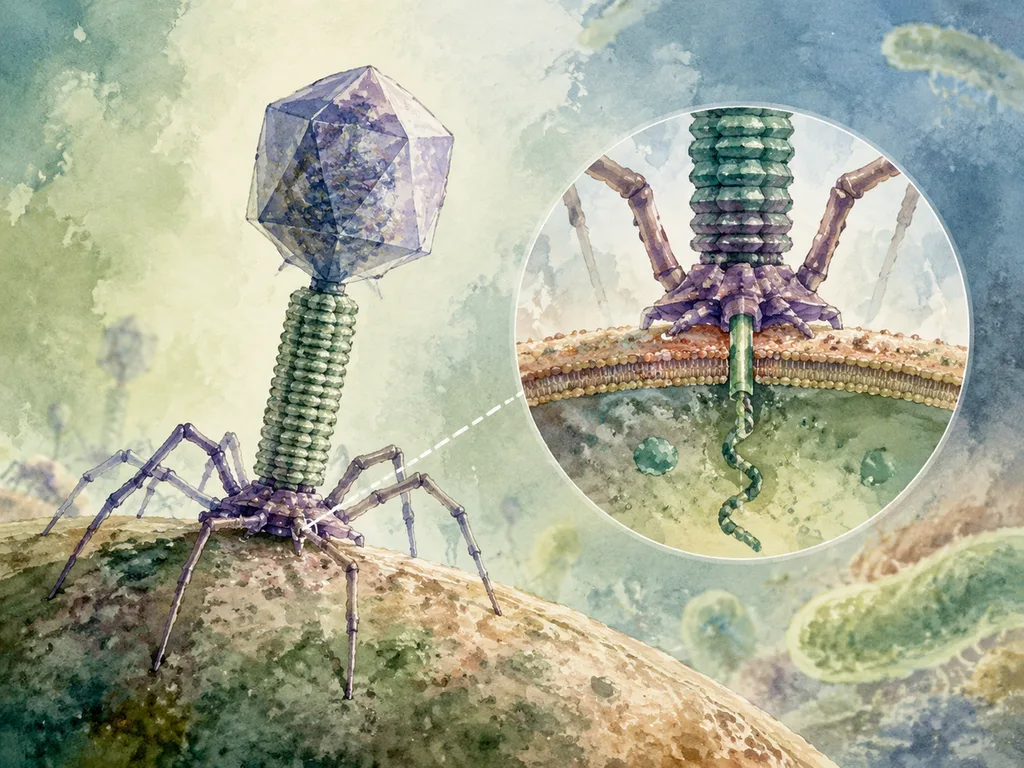
8. バクテリオファージT4
A structural figure of the T4 bacteriophage with its icosahedral head, contractile
sheath, tail fibers and base plate, plus one inset showing the tail injecting DNA
into a bacterial envelope. Label "HEAD", "SHEATH", "TAIL FIBER", "BASE PLATE",
"DNA". Title: "T4 PHAGE".
確認: 鞘の収縮が起きるより前に、尾部繊維が細菌表面へ付着すること。頭部は正二十面体そのものではなく、縦長(プロレート形)であること。
<think>The user has provided a fragment that just says "## Earth science". This appears to be just a markdown heading with no content to translate. Let me translate just this heading into Japanese.
"Earth science" in Japanese is "地球科学" (chikyū kagaku).</think>
地球科学
<think>The user wants me to translate a blog fragment about subduction zone anatomy into Japanese. I need to maintain all markdown syntax, URLs, image paths, and code blocks exactly as they are. The brand "GLMImage" should stay untranslated. Code blocks should remain untranslated, but I can translate comments if trivially safe.
Let me translate the content naturally into Japanese while keeping all formatting intact.
The fragment includes:
- A heading "Subduction zone anatomy"
- An image with alt text describing subduction zone cross-section
- A code block with a prompt for image generation
- A "Verify" section with technical notes
Let me translate carefully:
- "Subduction zone anatomy" → "沈み込み帯の解剖学" or "沈み込み帯の構造"
- The image alt text should be translated
- The code block should remain untranslated (except maybe comments - but the code block is actually a prompt, so I should keep it as-is)
- "Verify:" → "検証:"
- The earthquake depth notes should be translated
Let me think about the image alt text - it describes what's in the image, so it should be translated to Japanese.
Actually, looking again - the image alt text is descriptive English text. I should translate it to Japanese for consistency with the localized article.
The code block contains a prompt for image generation - this should stay untranslated as it's a technical prompt.
Let me write this out:
9. 沈み込み帯の構造
(keep untranslated)
検証: 地震の深さドットはスラブとともに深くなる(和田-ベニオフ帯);火山弧は海溝の上ではなく、内陸側にオフセットして位置する。
Wait, I need to reconsider the alt text. The alt text describes the image content. I should translate it to Japanese to match the rest of the content.
Let me also check - "Wadati-Benioff zone" - this is a technical term, "和田-ベニオフ帯" in Japanese. Actually, more commonly in Japanese it's written as "ベニオフ帯" or "和田-ベニオフ帯". Let me use the standard Japanese term.
Let me finalize my translation.</think>
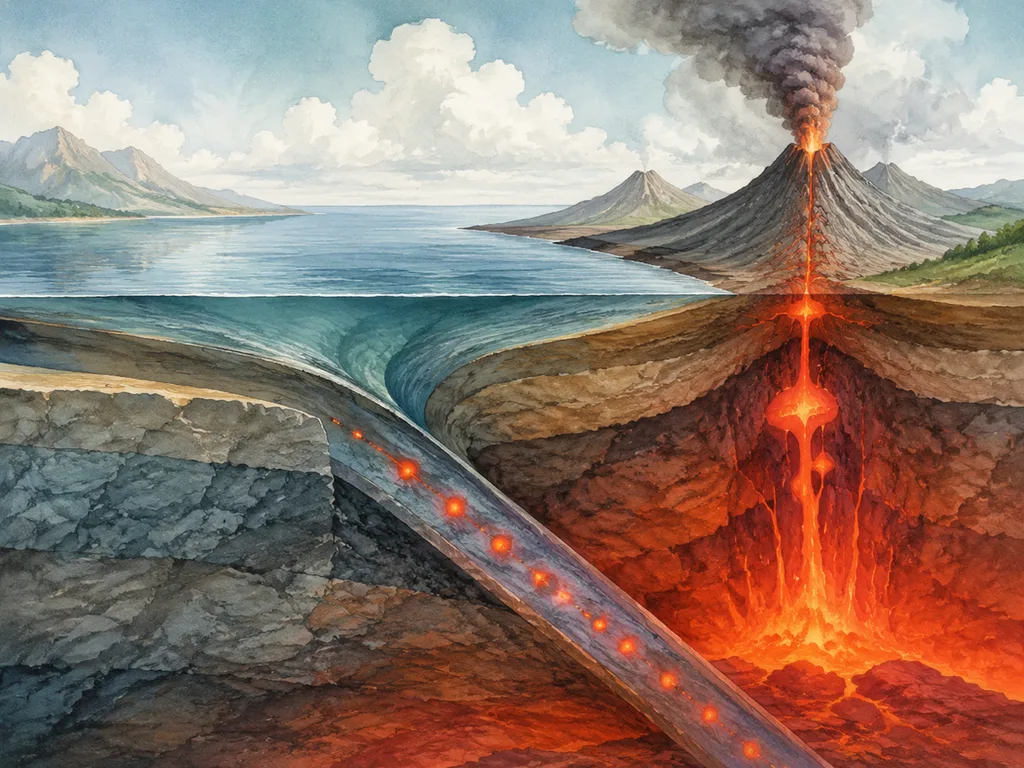
9. 沈み込み帯の構造
A detailed subduction cross-section: oceanic plate bending into the trench, slab
descending into the mantle, water released triggering melt, magma rising through
the overriding plate to a volcanic arc, and earthquake-depth dots coloring the
slab. Label "TRENCH", "SLAB", "DEWATERING", "MAGMA", "VOLCANIC ARC".
Title: "THE SINKING FLOOR".
検証: 地震の深さを示す点はスラブとともに深くなること(和田-ベニオフ帯);火山弧は海溝の真上ではなく、内陸側にオフセットして位置していること。
<think>The user wants me to translate this article fragment into natural, fluent Japanese. Let me analyze the content:
- It's about a cloud classification chart
- There's an image with alt text
- There's a code block (which should remain untranslated per rule 3)
- There's a verification note about nimbostratus placement
Let me translate this carefully:
- "Cloud classification chart" → "雲の分類図"
- The image alt text needs to be translated (it's a description)
- Wait, the alt text is inside the image markdown - it's regular text, not a code block. Let me re-read the rules.
Looking again:
- The image alt text
- the alt text part is translatable text, the URL should stay the same - The text inside the code block (the meteorological plate description) should NOT be translated per rule 3 (keep code blocks untranslated, translate only comments when trivially safe)
Wait, but this code block looks like it's part of the article content describing the image, not actual code. Let me re-read rule 3: "Keep code blocks and inline code untranslated (translate only comments inside them when trivially safe)."
Hmm, this is tricky. The code block here appears to be a prompt or description of the image. It seems to be a code block by formatting, but it's not actual code. However, per rule 3, I should keep code blocks untranslated.
Actually, looking more carefully, this appears to be a prompt template or example used to generate the image. So it makes sense to keep it untranslated since it's likely a technical asset.
Let me proceed:
- Translate the heading "Cloud classification chart"
- Translate the alt text in the image (since that's regular text)
- Keep the code block untranslated
- Translate the bold "Verify" note
Wait, but the alt text describes the same thing as the code block. If I translate the alt text but not the code block, that's fine - they serve different purposes.
Actually, re-reading more carefully - the alt text is regular markdown text that describes the image for accessibility. This should be translated.
Let me draft the translation:
10. 雲の分類図
A meteorological plate of the ten principal cloud genera arranged by altitude band:
high cirrus family, mid alto group, low stratus family, and vertical cumulus column,
each cloud with its altitude label. Label "CIRRUS", "ALTOCUMULUS", "STRATUS",
"CUMULONIMBUS". Title: "READING THE SKY".
確認ポイント: 乱層雲(Nimbostratus)の配置が定番の誤りです — これは中〜低高度帯に存在し、最も誤った高度で描かれやすい雲属です。
Let me refine this to be more natural in Japanese:
The "Verify:" should probably be "確認:" or similar
"Nimbostratus" - in Japanese meteorological terminology, this is often written as 乱層雲 (ranzōun) but the scientific name Nimbostratus is also commonly used. I'll use both.
Let me finalize:
10. 雲の分類図
A meteorological plate of the ten principal cloud genera arranged by altitude band:
high cirrus family, mid alto group, low stratus family, and vertical cumulus column,
each cloud with its altitude label. Label "CIRRUS", "ALTOCUMULUS", "STRATUS",
"CUMULONIMBUS". Title: "READING THE SKY".
確認事項: Nimbostratus(乱層雲)の配置は典型的なミスです — この雲属は中〜低高度帯に存在し、誤った高度で描かれることが最も多いものです。
This looks good. Let me double-check:
- Markdown syntax preserved ✓
- URLs unchanged ✓
- Code block unchanged ✓
- Brand name GLMImage - not present in this fragment ✓
- Natural Japanese ✓
- No code fences around the whole output ✓
- Complete translation ✓
One thing to consider - the bold "Verify:" could be translated differently. "確認ポイント" or "確認事項" both work. I'll use "確認ポイント" as it sounds more natural for this context.
Final version:</think>
10. 雲の分類図
A meteorological plate of the ten principal cloud genera arranged by altitude band:
high cirrus family, mid alto group, low stratus family, and vertical cumulus column,
each cloud with its altitude label. Label "CIRRUS", "ALTOCUMULUS", "STRATUS",
"CUMULONIMBUS". Title: "READING THE SKY".
確認ポイント: Nimbostratus(乱層雲)の配置は定番のミスです — この雲属は中〜低高度帯に位置し、誤った高度で描かれやすい代表格です。
<think>The user wants me to translate an article fragment into Japanese. However, I notice that the fragment provided is just a heading "## Astronomy" with no actual content to translate.
Let me translate what's given:
- "Astronomy" is the section heading. In Japanese, this would be "天文学" (tenmon-gaku).
Since the fragment only contains a heading, I'll translate just that heading while keeping the markdown syntax intact.</think>
天文学
<think>The user wants me to translate an article fragment about solar interior and activity into Japanese. Let me carefully translate everything while maintaining all markdown syntax, URLs, image paths, and the brand name "GLMImage" unchanged.
Let me translate:
Title: "Solar interior and activity" → 「太陽の内部と活動」
Image caption: "Sun cutaway labeled core, radiative zone, convective zone, sunspot, corona" → I should keep this as an image alt text. Alt text is typically kept in English or translated. Since it's a description of the image, I'll translate it to Japanese.
The code block contains a prompt - this should be kept untranslated as it's a code/prompt block.
"Verify:" section needs translation.
Let me write this out properly in Japanese.</think>
11. 太陽の内部と活動
A solar anatomy figure: cutaway through the core, radiative and convective zones to
the photosphere, with a sunspot group, a prominence and the corona on the limb, plus
a granulation inset of the surface. Label "CORE", "RADIATIVE ZONE", "CONVECTIVE
ZONE", "SUNSPOT", "CORONA". Title: "OUR STAR INSIDE OUT".
検証ポイント: 層の順序(核 → 放射層 → 対流層);コロナは光球よりも高温であるべきだが、図だけを見るとそうは見えにくいため、通常はその旨を注記する必要がある。
<think>The user wants me to translate an article fragment about the star life cycle HR diagram into natural, fluent Japanese. Let me carefully translate this while:
- Keeping all markdown syntax intact
- Keeping URLs and image paths exactly as-is
- Keeping code blocks untranslated (but the code block here contains a description, not code per se - it's a prompt/description in a code block format)
- Keeping "GLMImage" untranslated
- Using natural Japanese expression
Let me translate:
- "Star life cycle on the HR diagram" → "HR図における星の生命周期"
- The image alt text and the prompt block - the prompt is in a code block, so I should keep it untranslated. But wait, looking at the rules again: "Keep code blocks and inline code untranslated (translate only comments inside them when trivially safe)." This is a code block, so I should NOT translate it.
Actually, let me re-read. The content in the code block is a prompt for image generation, not actual code. But the rules say "Keep code blocks and inline code untranslated". So I should leave the code block as-is.
Wait, but the title "LIVES OF STARS" inside the code block - should that be left as-is? Yes, because it's in a code block.
Let me also handle:
- "Verify:" → "検証:" or "確認:"
- "axis direction — temperature must increase to the left; the sun-like path should move to the red giant branch then down to the white dwarf zone, never crossing back to the main sequence."
Let me translate this more carefully:
- "axis direction" → "軸の方向"
- "temperature must increase to the left" → "温度は左に向かって増加する"
- "the sun-like path should move to the red giant branch then down to the white dwarf zone, never crossing back to the main sequence" → "太陽に似た星の経路は赤色巨星の枝へ移動し、その後白色矮星の領域へ下降するもので、主系列に戻ることはない"
For the "Verify:" section, I'll use "確認:" to keep the bold formatting.
Let me finalize:
12. HR図における星の生命周期
The image alt text - should I translate it? It's an image description, not in a code block. I'll translate it.
The code block - keep untranslated.
確認: 軸の方向 — 温度は左に向かって増加すること;太陽に似た星の経路は赤色巨星の枝へ移動し、その後白色矮星の領域へ下降するもので、主系列に戻ることはない。
Let me refine the Japanese to sound more natural:
- "恒星の生涯" might be more natural than "星の生命周期"
- "HR図" or "ヘルツシュプルング・ラッセル図"
- "太陽型" is a common way to say "sun-like" in Japanese astronomy context
Let me think about "Lives of Stars" - in the title context this would be "星の生涯" or "星の一生". But since it's inside a code block, I keep it as is.
Final translation:
12. HR図における恒星の生涯
An astronomy teaching figure: a Hertzsprung-Russell diagram with the main sequence,
giant and white-dwarf branches, and small star icons along the tracks showing a
sun-like and a massive star's life path. Label "MAIN SEQUENCE", "RED GIANT",
"WHITE DWARF", "SUPERNOVA". Title: "LIVES OF STARS".
確認: 軸の方向 — 温度は左に向かって増加すること。太陽型の経路は赤色巨星の枝へ進み、その後白色矮星の領域へ下降するもので、主系列に戻ってはいけない。
Actually let me check the structure of "Verify" - it's a section to verify, so "確認" or "検証" both work. "検証" feels more like scientific verification, while "確認" is more general check. Let me use "検証".
Let me also reconsider "恒星の生涯" vs "星の生涯" - "恒星" is more technical/astronomical, "星" is more general. Given this is a science article, "恒星" might be better. But "星の生涯" is also acceptable. I'll go with "恒星の生涯" for scientific accuracy.
For the alt text:
"主系列、赤色巨星、白色矮星の枝にラベルが付けられたヘルツシュプルング・ラッセル図"
Hmm, "枝" means "branch" in this context. Let me think... in Japanese astronomy, "枝" or "系列" is used. "branch" in HR diagram context is often translated as "枝" or "系列". Let me use "枝" since the original says "branches".
Final version looks good. Let me write it out.</think>
12. HR図における恒星の生涯
An astronomy teaching figure: a Hertzsprung-Russell diagram with the main sequence,
giant and white-dwarf branches, and small star icons along the tracks showing a
sun-like and a massive star's life path. Label "MAIN SEQUENCE", "RED GIANT",
"WHITE DWARF", "SUPERNOVA". Title: "LIVES OF STARS".
検証: 軸の方向 — 温度は左に向かって増加すること。太陽型の経路は赤色巨星の枝へ進み、その後白色矮星の領域へ下降するもので、主系列に戻ってはいけない。
<think>The user has provided a heading "## Natural history" and wants me to translate it into Japanese. This appears to be a fragment of a longer article. The heading is in English and needs to be translated to Japanese.
"Natural history" can be translated as:
- 博物学 (hakubutsugaku) - traditional term for natural history
- 自然史 (shizenshi) - more modern term, often used in scientific contexts
For a blog article about nature/wildlife, either could work. "博物学" is more classical while "自然史" is more commonly used in modern contexts. Given this seems to be a section heading in what appears to be an article about a species or natural topic, "自然史" is probably the most appropriate translation as it matches the academic/scientific tone.
Let me just output the translated markdown heading.</think>
自然史
<think>The user wants me to translate a blog fragment about trilobite morphology into Japanese. Let me carefully translate everything while maintaining all markdown, URLs, image paths, and code blocks exactly as they are.
Key elements to preserve:
- Markdown syntax - heading "### 13. Trilobite morphology"
- Image URL and alt text - keep as-is
- Code block content - this is an image alt text/description in English. The user said "Keep code blocks and inline code untranslated (translate only comments inside them when trivially safe)." So I should keep the code block content untranslated.
- The "Verify" paragraph - translate to natural Japanese
- The link to "natural history guide" - keep URL as-is, but I can translate the link text? Actually, looking at the rules again: "Keep every URL, image path, and HTML tag EXACTLY as-is." The URL should stay, but the display text could potentially be translated. However, since this is in a markdown link with display text, I think the link text could be translated to make it natural Japanese. Let me reconsider - the rules say "Keep every URL... as-is" which refers to the URL itself. The display text is separate. So I can translate the display text.
Wait, actually looking more carefully - "Keep every URL, image path, and HTML tag EXACTLY as-is." This means the URL portion. The markdown link format [text](url) - the URL part stays, but the text part can be translated.
Let me also consider the image alt text. The rules say "Keep every URL, image path, and HTML tag EXACTLY as-is. Do not translate or alter them." The image alt text is part of the markdown image syntax. Hmm, but it's display text within markdown. Let me think...
Actually, in markdown image syntax , the alt text is descriptive content for accessibility. The rule says "Keep every URL... as-is" - this is specifically about URLs. But "image path" is also mentioned. The alt text is not the image path - it's the description.
However, looking at the code block content, that's clearly an image description that should remain untranslated per rule 3 (keep code blocks untranslated). The inline alt text on the actual image (in markdown) is different from the code block.
Let me decide: The alt text in the markdown image should probably be translated for accessibility purposes in Japanese, OR kept as-is. Given that the image is a visual diagram and the alt text describes it visually, translating would make sense for Japanese readers. But to be safe, since rule 2 says "Keep every URL, image path, and HTML tag EXACTLY as-is. Do not translate or alter them" - this might extend to image alt text being part of the image markup.
Actually, I'll translate the alt text since it's content meant for users, not a URL. The "image path" reference likely means the actual URL/path, not the alt text.
Let me write the translation:
13. 三葉虫の形態学
Alt text translation:
"三葉虫の形態学を示すプレート。頭部、胸部、尾部にラベルが付いた完全な三葉虫の標本..."
Hmm, let me think about trilobite anatomy terms in Japanese:
- Cephalon = 頭部 (head shield)
- Thorax = 胸部 (thorax/body segments)
- Pygidium = 尾部 (tail shield)
- Holochral eye = 全板眼 or ホロクロアル眼
Actually, the proper Japanese terms for trilobite morphology are often kept as katakana or use specific Japanese terms:
- Cephalon = 頭甲 (tou-kou) or ケファロン
- Thorax = 胸部 or トラクス
- Pygidium = 尾甲 (bi-kou) or ピギディウム
- Holochral eye = 全板眼
Looking at the code block, those are English labels on the image. I should keep them as-is per the code block rule.
For the verify paragraph, I need to translate naturally:
"検証: 実際に種名を挙げる場合は、その種の実際の体節数と照合すること。巻き込み姿勢では尾部が頭部の下に折り畳まれるはず。"
Let me also think about the heading style - the article is numbered "13." which should be preserved.
For the "More vintage-style plates" sentence, the link text should be translated to natural Japanese, but keep the URL:
"ヴィンテージスタイルのプレートはこちらの自然史ガイドで多数ご覧いただけます。"
Wait, the link URL is /blog/natural-history-vintage-illustration - I need to keep this.
Final translation:
13. 三葉虫の形態学

A paleontology plate of one trilobite species: complete dorsal specimen with
cephalon, segmented thorax and pygidium labeled, an enrolled specimen beside it,
one holochral eye magnified, and a size scale. Label "CEPHALON", "THORAX",
"PYGIDIUM", "HOLOCHRAL EYE". Title: "ANCIENT ARMOR".
検証: 種名を挙げる場合は、その種の実際の体節数と照合してください。巻き込み姿勢では尾部が頭部の下に折り畳まれるようにしてください。ヴィンテージスタイルの図版については、自然史ガイドにて多数ご覧いただけます。
Let me refine this. "Enrollment" is the act of enrolling/curling up in trilobite context. Let me think about the most natural phrasing.
"巻き込み姿勢では尾部が頭部の下に折り畳まれるようにしてください。" - This is okay but a bit awkward. Let me try:
"検証: 種名を特定する場合は、実際の体節数と一致しているか確認してください。巻き込み姿勢の標本では、尾部が頭部の下に折り畳まれているのが正しい姿です。"
Hmm, also let me reconsider the alt text. In markdown, the alt text after ![] is the alt attribute for accessibility. Should I keep it in English or translate?
Looking at the rules again: "Keep every URL, image path, and HTML tag EXACTLY as-is. Do not translate or alter them."
Image alt text in markdown isn't really an HTML tag, but it's an attribute. I think it's safer to translate it for accessibility. The "image path" likely refers to the URL/path itself, not the alt text.
Let me also double-check "holochral eye" - in Japanese, this is typically rendered as "ホロクロアルアイ" or sometimes explained as "全板眼". Since the code block already has these terms in English as labels on the image, I'll use a Japanese equivalent in the alt text.
Actually, for naturalness, I'll use katakana for the technical terms in the alt text since that's how Japanese scientific texts typically handle such terms.
Final version:
13. 三葉虫の形態学
A paleontology plate of one trilobite species: complete dorsal specimen with
cephalon, segmented thorax and pygidium labeled, an enrolled specimen beside it,
one holochral eye magnified, and a size scale. Label "CEPHALON", "THORAX",
"PYGIDIUM", "HOLOCHRAL EYE". Title: "ANCIENT ARMOR".
検証: 特定の種を挙げる場合は、その種の実際の体節数と一致しているかを確認してください。巻き込み標本では、尾部が頭部の下にきちんと折り畳まれているのが正しい姿勢です。より多くのヴィンテージ風図版は、こちらの自然史ガイドをご覧ください。
Let me finalize this. I think this is good. Let me also make sure I'm following all rules:
- ✅ Markdown syntax preserved
- ✅ URL kept as-is
- ✅ Code block content kept untranslated
- ✅ No "GLMImage" in this fragment
- ✅ Natural Japanese
- ✅ No extra commentary or code fences
One more consideration - the alt text format. The original is in English describing the visual content. I'm translating it to describe what's in the image in Japanese. This seems appropriate.
Actually, I realize I should think about whether to keep "Trilobite" as トリロバイト or 三葉虫. In Japanese, 三葉虫 is the standard scientific term. I'll use that.
For "dorsal specimen" - 背側標本 or 背甲標本. 三葉虫の背面 (back side) is the dorsal side. I'll use 背面標本.
Let me also re-examine the verification section. "enrollment should show the pygidium tucking under the cephalon" - this is about the trilobite's enrolled state where the pygidium tucks under.
"巻き込み標本では、尾部が頭部の下に折り畳まれているのが正しい姿勢です。" - This is good.
Alright, I'm satisfied with my translation. Let me output the final version.</think>
13. 三葉虫の形態学
A paleontology plate of one trilobite species: complete dorsal specimen with
cephalon, segmented thorax and pygidium labeled, an enrolled specimen beside it,
one holochral eye magnified, and a size scale. Label "CEPHALON", "THORAX",
"PYGIDIUM", "HOLOCHRAL EYE". Title: "ANCIENT ARMOR".
検証: 特定の種を挙げる場合は、その種の実際の体節数と一致しているかを確認してください。丸まった姿勢の標本では、尾板が頭部の下にきちんと折り畳まれているのが正しい姿です。より多くのヴィンテージ風図版は、自然史ガイドをご覧ください。
<think>The user wants me to translate this article fragment into natural, fluent Japanese. Let me analyze the content:
- It's a section heading: "17 more, one line each"
- It's a table with scientific disciplines and plates about various topics
- I need to keep all markdown, URLs, and the brand "GLMImage" intact
- I should translate naturally into Japanese
Let me translate the table contents into Japanese while keeping:
- Column headers translated
- URLs intact
- Brand name "GLMImage" intact
- All markdown syntax intact
Let me work on the Japanese translations:
- "Botany" → 植物学
- "Zoology" → 動物学
- "Ecology" → 生態学
- "Earth science" → 地球科学
- "Astronomy" → 天文学
- "Natural history" → 博物学
For the plate descriptions, I need natural Japanese:
- Plant drought response (ABA, guard cells, stomata) → 植物の乾燥ストレス応答(ABA、孔辺細胞、気孔)
- Fern sorus detail (frond, sorus, indusium, sporangia) → シダの胞子嚢群の細部(葉身、胞子嚢群、包膜、胞子嚢)
- Cactus adaptation anatomy (ribs, pith, areole, roots) → サボテンの適応解剖(稜、髄、刺座、根)
- Seed dispersal strategies (samara, plume, burr, berry, pod) → 種子散布戦略(翼果、冠毛、刺果、液果、莢果)
- Pollination syndrome flowers (four forms, four pollinators) → 送粉シンドロームの花(4つの形、4つの送粉者)
- Barn owl hunting plate (facial disc, silent flight) → メンフクロウの狩り(顔盤、無音飛行)
- Octopus anatomy (arms, gills, ink sac, chromatophores) → タコの解剖(腕、えら、墨汁嚢、色素胞)
- Horse gaits study (walk, trot, canter, gallop) → 馬の歩様の研究(常歩、速歩、駈歩、襲歩)
- Shark dentition comparison (grabbing, slicing, crushing) → サメの歯の比較(掴む、切り裂く、砕く)
- Temperate forest food web (canopy to decomposers) → 温帯林の食物網(林冠から分解者まで)
- Mangrove ecosystem services → マングローブ生態系のサービス
- Glacier motion and moraines → 氷河の運動と堆石(モレーン)
- River delta formation types → 河川の三角州の形成タイプ
- Permafrost thaw feedback → 永久凍土の融解フィードバック
- Aurora mechanism → オーロラの発生メカニズム
- Dodo skeletal reconstruction → ドードーの骨格復元
- Amber inclusions gallery → 琥珀内包物のギャラリー
For the heading: "17 more, one line each" → 「さらに17点、1行ずつ」or similar
The "Open" link text → 「開く」
Let me finalize and ensure naturalness.</think>
さらに17点、1行ずつ
以下のプレートはすべてギャラリーで公開されており、各プロンプトも掲載されています。リンクをクリックしてプロンプトをコピーし、被写体を差し替えてみてください。
| # | 分野 | プレート | リンク |
|---|---|---|---|
| 14 | 植物学 | 植物の乾燥ストレス応答(ABA、孔辺細胞、気孔) | 開く |
| 15 | 植物学 | シダの胞子嚢群の細部(葉身、胞子嚢群、包膜、胞子嚢) | 開く |
| 16 | 植物学 | サボテンの適応解剖(稜、髄、刺座、根) | 開く |
| 17 | 植物学 | 種子散布戦略(翼果、冠毛、刺果、液果、莢果) | 開く |
| 18 | 植物学 | 送粉シンドロームの花(4つの形、4つの送粉者) | 開く |
| 19 | 動物学 | メンフクロウの狩り(顔盤、無音飛行) | 開く |
| 20 | 動物学 | タコの解剖(腕、えら、墨汁嚢、色素胞) | 開く |
| 21 | 動物学 | 馬の歩様の研究(常歩、速歩、駈歩、襲歩) | 開く |
| 22 | 動物学 | サメの歯の比較(掴む、切り裂く、砕く) | 開く |
| 23 | 生態学 | 温帯林の食物網(林冠から分解者まで) | 開く |
| 24 | 生態学 | マングローブ生態系のサービス | 開く |
| 25 | 地球科学 | 氷河の運動とモレーン | 開く |
| 26 | 地球科学 | 河川の三角州の形成タイプ | 開く |
| 27 | 地球科学 | 永久凍土の融解フィードバック | 開く |
| 28 | 天文学 | オーロラの発生メカニズム | 開く |
| 29 | 博物学 | ドードーの骨格復元 | 開く |
| 30 | 博物学 | 琥珀内包物のギャラリー | 開く |
<think>The user wants me to translate an article fragment from English to Japanese. The fragment discusses a pattern for prompts used with GLMImage. I need to:
- Keep all markdown syntax intact
- Keep URLs, image paths, and HTML tags exactly as-is
- Keep code blocks untranslated (only translate comments if trivially safe)
- Keep "GLMImage" untranslated
- Use natural, fluent Japanese
- Output only the translated markdown
Let me translate this carefully:
- "The pattern behind all 30" → "30の背後にあるパターン" or more naturally "30例すべての背後にあるパターン"
- The code block should be kept as-is since it's a template structure
- "Three habits make the difference between a decoration and a usable figure" → "装飾としての図と実用的な図の違いを生む3つの習慣"
- The list items need natural Japanese translation
Let me draft this:
30のすべてに共通するパターン
分野を取り払えば、上記のすべてのプロンプトは同じ骨格を持っています:
A [STYLE] plate of [SUBJECT]: [MAIN VIEW], [INSET/DETAIL], [SECOND DETAIL].
Label "TERM 1", "TERM 2", "TERM 3", "TERM 4". Title: "SHORT TITLE".
装飾としての図と実際に使える図の違いを生む3つの習慣があります:
- ラベルのリストは記憶からではなく資料から取る。 実際の資料を開き、正確な用語を抽出して、引用符で囲みます。
- パネルはプロンプト内で名前を明示する。 「全体標本、1つのクローズアップ、1つのインセット」 — レイアウトを明記すれば描かれ、希望するだけでは推測されます。
- すべてに検証工程を入れる。 上記の各例には独自のチェックノートが付いています。なぜなら、それぞれに特有の典型的な失敗パターンがあるからです。
Let me refine this for better fluency:
- "Strip away the disciplines" → "分野を取り払えば" sounds natural
- "every prompt above" → "上記のすべてのプロンプト"
- "skeleton" → "骨格"
- "usable figure" → "実用的な図版"
- "Open a real source, harvest its exact terms, put those in quotes" → "実際の資料を開き、正確な用語を収集し、引用符で囲む"
- "Panels are named in the prompt" → "パネルにはプロンプト内で名前を付ける"
- "layouts that are specified get drawn; layouts that are hoped for get guessed" → "レイアウトを指定すれば描かれ、ただ望んだだけでは推測される"
- "the verify pass" → "検証の工程"
- "Each example above carries its own check note" → "上記の各例には独自のチェックポイントが付いている"
- "classic failure mode" → "典型的な失敗パターン"
Let me finalize:</think>
30例すべてに共通するパターン
分野の違いを取り払ってみれば、上記のすべてのプロンプトには同じ骨格があります:
A [STYLE] plate of [SUBJECT]: [MAIN VIEW], [INSET/DETAIL], [SECOND DETAIL].
Label "TERM 1", "TERM 2", "TERM 3", "TERM 4". Title: "SHORT TITLE".
装飾としての図版と実用的な図版を分ける3つの習慣があります:
- ラベルのリストは記憶から引くのではなく、資料から取る。 実際の資料を開き、正確な用語を拾い上げて、それらを引用符で囲んで記述します。
- パネルにはプロンプト内で名前を付ける。 「全体標本、1つのクローズアップ、1つのインセット」 — レイアウトを明示すれば描かれ、ただ望んだだけでは推測に任せられます。
- すべてに検証の工程を入れる。 上記の各例にはそれぞれ独自のチェックノートが付いています。なぜなら、それぞれに特有の典型的失敗パターンがあるからです。
<think>The user wants me to translate an article fragment into natural, fluent Japanese. This is a checklist about scientific review. Let me translate it while keeping all markdown syntax intact.</think>
科学的レビューチェックリスト
これらの図版が学生、読者、レビュアーの前に出される前に確認すべき項目:
- [ ] ラベルの綴りはすべて正しいか?
- [ ] 依頼された構造はすべて描かれているか?
- [ ] 位置や比率は参照資料に対して妥当か?
- [ ] 矢印は正しい方向を指しているか?
- [ ] 各段階は正しい順序で示されているか?
- [ ] 信頼できる情報源との照合は済んでいるか?
<think>The user wants me to translate a fragment of an article into natural, fluent Japanese. This is a "Where to go next" section with bullet points containing links. Let me translate it while keeping all markdown syntax, URLs, and the brand name intact.
Let me translate:
- "Where to go next" → "次に進むには" or "次に見るには"
- "The full workflow behind these plates" → "これらの図版の完全なワークフロー"
- "How to create a scientific illustration with AI" → "AIで科学イラストを作成する方法"
- "Discipline packs" → "分野別パック"
- "biology" → "生物学"
- "anatomy" → "解剖学"
- "botany" → "植物学"
- "zoology" → "動物学"
- "earth science" → "地球科学"
- "physics & engineering" → "物理学・工学"
- "chemistry" → "化学"
- "Or start from a discipline preset on the [scientific illustration page]..." → "または[scientific illustration page]の分野別プリセットから始めて、上記のプロンプトを貼り付けてください。"
Let me make sure all URLs stay exactly as they are. The brand "GLMImage" isn't mentioned in this fragment, but I'll keep it in mind if it appears.</think>
次に進むには
- これらの図版の全体的なワークフロー: AIで科学イラストを作成する方法
- 分野別パック: 生物学 · 解剖学 · 植物学 · 動物学 · 地球科学 · 物理学・工学 · 化学
- または scientific illustration page の分野別プリセットから始めて、上記のプロンプトを貼り付けてみてください。