An SN2 mechanism — nucleophile, leaving group, transition state, umbrella inversion, curved arrows — from one prompt. Chemistry sits between biology and engineering in AI-drafting terms: mechanisms and workflows draft beautifully; exact structures with subscripts and stereochemistry need verification or a real drawing tool. These 15 prompts stay on the draftable side, each with its verify note.
Open the chemistry presets · Full workflow · Biology prompts
The chemistry-specific rule: spell out formulas (CO2 not CO₂, H2O where possible) in label quotes — subscripts are where label rendering breaks. Structural formulas with precise bond geometry belong in ChemDraw; the mechanism as a story is what drafts well.
Reaction mechanisms
1. SN2 backside attack
An organic-chemistry mechanism figure: nucleophile approaching the stereocenter
from the side opposite the leaving group, the transition-state inset with dashed
bonds, umbrella-like inversion of configuration in the product, and a
curved-arrow notation panel. Label "NUCLEOPHILE", "LEAVING GROUP", "TRANSITION
STATE", "INVERSION". Title: "BACKSIDE ATTACK".
Verify: the nucleophile approaches opposite the leaving group (180°); inversion means the stereochemistry flips like an umbrella.
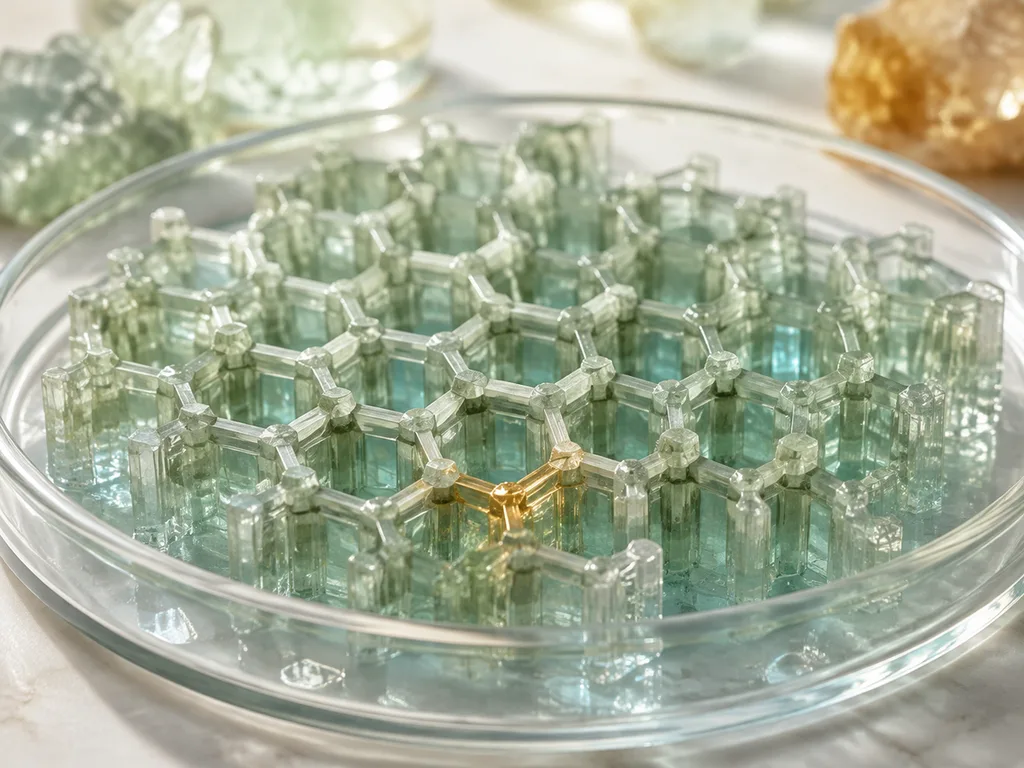
2. Covalent organic framework
A two-dimensional materials figure of a covalent organic framework: a periodic
honeycomb-like sheet of alternating organic linkers and vertex units, a magnified
inset of one vertex chemistry, and the stacked layers forming porous channels.
Label "LINKER", "VERTEX", "PORE", "STACKED LAYERS". Title: "COF SHEET".
3. Electrochemical CO2 reduction
An electrochemistry cell figure converting carbon dioxide: cathode with a copper
catalyst turning carbon dioxide into hydrocarbon products, anion-exchange
membrane in the middle, anode releasing oxygen, and a product palette listing
what exits each side. Label "CATHODE", "CATALYST", "MEMBRANE", "ANODE",
"PRODUCTS". Title: "CO2 TO FUEL".
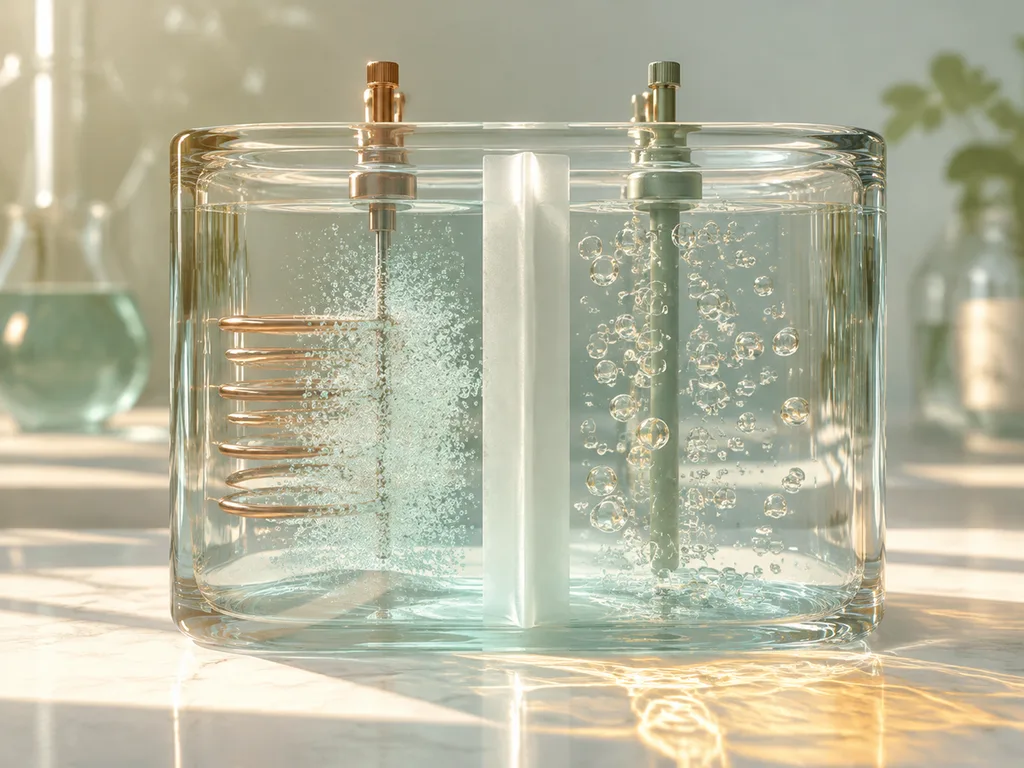
Verify: reduction at the cathode, oxidation at the anode — never reversed; CO2 enters the cathode side.
4. Drug delivery chemistry
An organ-targeted delivery figure: a nanoparticle with ligand keys on its
surface, circulating in a capillary, binding its receptor on the target organ's
cells, releasing its cargo inside, and one magnified inset of the ligand-receptor
docking. Label "NANOPARTICLE", "LIGAND", "RECEPTOR", "CARGO".
Title: "ADDRESSED DELIVERY".
Apparatus and workflows
5. Distillation setup
A classic simple-distillation apparatus: round-bottom flask with boiling liquid
on a heat source, thermometer at the side-arm head, condenser with water in at
the bottom and out at the top, and the receiver collecting distillate.
Label "FLASK", "THERMOMETER", "CONDENSER", "RECEIVER".
Title: "SIMPLE DISTILLATION".
Verify: condenser water flows counter to vapor (in at the bottom, out at the top); the thermometer bulb sits at the side-arm, not in the liquid.
6. 96-well plate layout
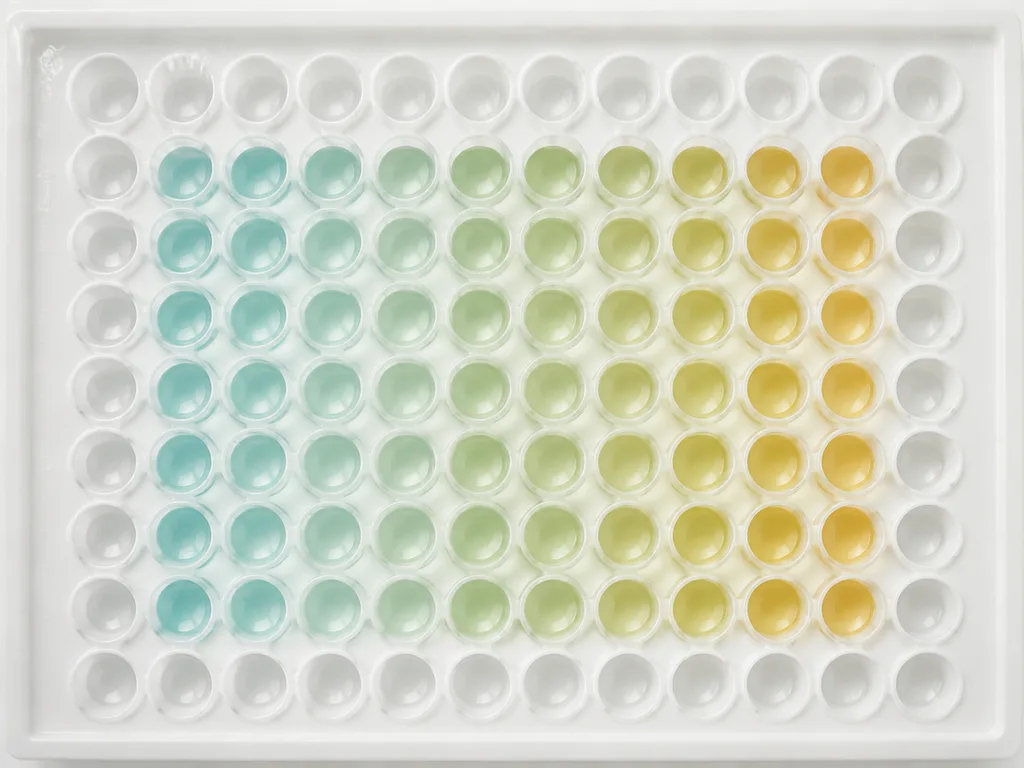
A top-down layout of a 96-well microplate set up for a dose-response assay:
eight rows by twelve columns, control wells in the outer columns, a serial
dilution gradient across the middle, and triplicate rows. Label "CONTROL",
"DILUTION SERIES", "REPLICATES" and add a small color-concentration legend.
Title: "PLATE LAYOUT".
7. Sandwich ELISA workflow
A four-step laboratory workflow for a sandwich ELISA from coating the plate
through blocking and sample incubation to detection, each step as a small labeled
panel connected by arrows. Label "COATING", "BLOCKING", "INCUBATION", "DETECTION".
Title: "SANDWICH ELISA WORKFLOW".
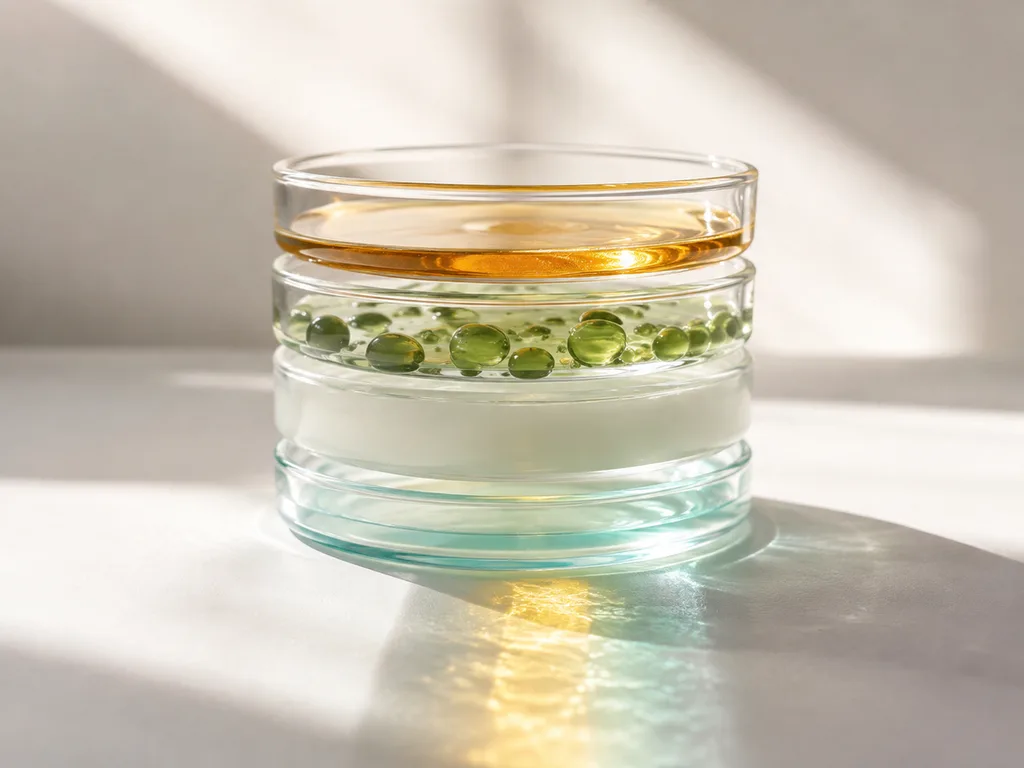
Verify: capture antibody down first, detection antibody on top.
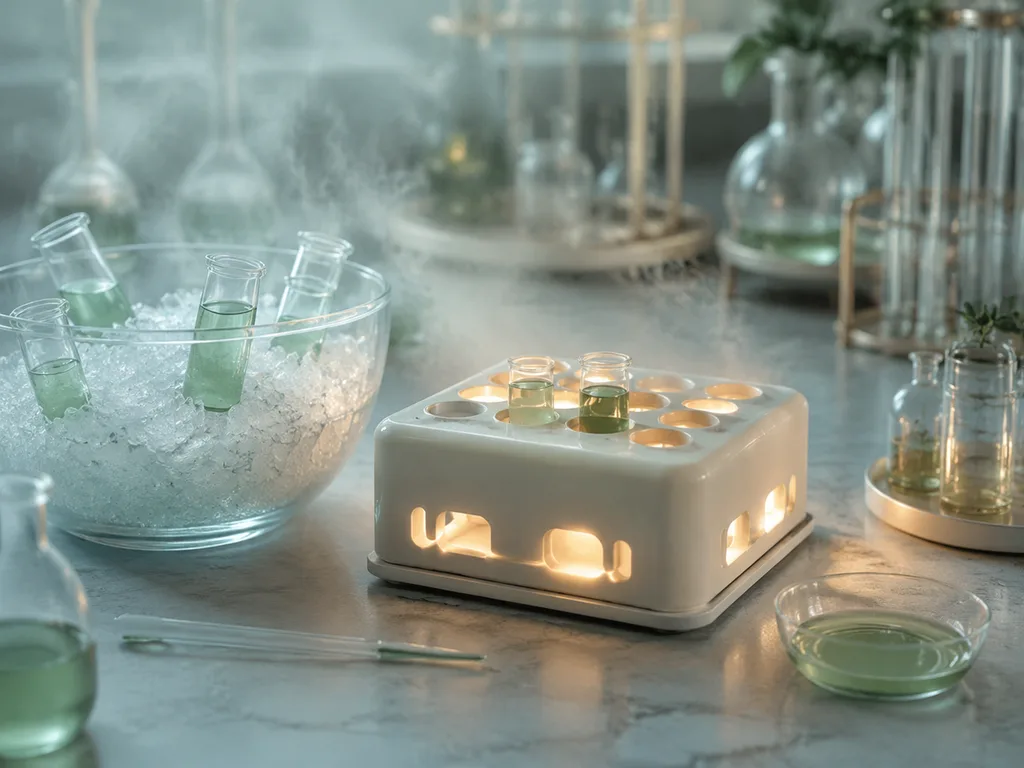
8. RT-qPCR run
A bench workflow figure for a quantitative PCR run: template and master mix on
ice, plate setup with standards and controls in a layout grid, thermal cycling
profile with annealing step, and melt-curve verification at the end.
Label "MASTER MIX", "STANDARDS", "THERMAL CYCLE", "MELT CURVE".
Title: "THE QPCR RUN".
9. Titration curve
An acid-base titration figure: buret over a flask with indicator, and beside it
the pH curve with buffer region, equivalence point marked and endpoint color
change annotated. Label "BURET", "EQUIVALENCE POINT", "BUFFER REGION".
Title: "THE TITRATION".
Verify: for strong acid–strong base the equivalence pH is 7; the steepness of the jump matters more than exact values — label it schematic.
Ten quick variants
| # | Topic | One-line change |
|---|---|---|
| 10 | Chromatography column | "A column chromatography figure: stationary phase, sample band loading, elution and separated bands… Label 'STATIONARY PHASE', 'MOBILE PHASE', 'ELUTION'" |
| 11 | Filtration vs decantation | "A two-panel comparison of gravity filtration and decantation setups… Label each" |
| 12 | States of matter | "A three-panel particle view of solid, liquid and gas with particle spacing and motion… Label each state" |
| 13 | pH scale | "A horizontal pH scale from 0 to 14 with example substances and color gradient… Label 'ACIDIC', 'NEUTRAL', 'BASIC'" |
| 14 | Collision theory | "A figure of two reacting molecules with insufficient energy bouncing and sufficient energy reacting… Label 'ACTIVATION ENERGY'" |
| 15 | Le Chatelier | "An equilibrium disturbed by added reactant, with the system's shift and re-equilibration… Label 'STRESS', 'SHIFT'" |
Scientific review checklist
- [ ] Are all labels spelled correctly (with formulas spelled out)?
- [ ] Are all requested pieces of apparatus present and connected in order?
- [ ] Do arrows show the correct direction (water flow, vapor path, electron flow)?
- [ ] Are mechanisms drawn as the chemistry says (backside = backside)?
- [ ] Is anything quantitative labeled schematic rather than exact?
- [ ] Has it been checked against a trusted source?
FAQ
Can AI draw correct structural formulas?
No. Bond geometry, stereo wedges, and electron-pair placement are exactly the precise-geometry class where generation invents plausible nonsense. Mechanism stories (who attacks whom, what leaves) draft well — the SN2 plate above — but real structures belong in ChemDraw or its equivalents. Prompt the mechanism, draw the molecule.
Are apparatus diagrams good enough for lab reports?
For the conceptual setup — what connects to what, where water flows — yes, and they beat clipart. For the graded schematic with exact joint sizes (14/20, 24/40), use the standard symbols from your course's convention. The hybrid: AI figure for the report's overview, real schematic in the appendix.
Why do the prompts spell out CO2 instead of using subscripts?
Subscripts are a rendering weak spot — the model draws a slightly-wrong small 2 that reads as noise at plate size. Spelled-out formulas (CO2, H2O) render cleanly. If the final figure needs proper subscripts, that's a five-minute fix in the vector pass, where text becomes live text and typography is yours.
Can I include numbers — molarities, temperatures, yields?
Treat numbers in generated figures as placeholders. They render but they're typed by a system that doesn't know what a mole is. If a number carries meaning, add it yourself afterward in typeset text; never let the model's placeholder survive into anything a student or colleague might cite.
Microbiology plates — agar, streaks, zones of inhibition?
They draft well as layout figures: a streak-plate four-quadrant pattern, a disk-diffusion plate with zones, both with clean annotation space. Verify the biology — quadrant progression, zone symmetry around the disk, not around the plate — and keep measured zone diameters in typeset captions, never drawn to fake scale.
Lab reports: figure versus text
The division that works: figures for arrangement (setup order, workflow steps, plate layouts) and text for measurement (every number, every condition). When a protocol step matters procedurally — "water in at the bottom of the condenser" — the figure carries it better than prose; when it matters quantitatively, no figure should carry it at all. Our label-count rule applies with extra force in lab figures, because apparatus labels are long (CONVERTER, THERMOCOUPLE) and crowd fast.
From bench notebook to figure
The workflow that keeps lab figures honest: the notebook entry names the steps in order; those step names are the label list; the prompt carries arrangement only. "Coat → block → incubate → detect" is a four-label workflow plate because the ELISA entry says so, not because four panels looked balanced. Numbers ride separately: every measurement from the notebook goes into the caption or table as typeset text, never into the generated plate (the placeholder rule). The payoff at report time — the figure matches the notebook exactly, because the notebook wrote the prompt.
Safety figures: the one place to be conservative
Lab-safety diagrams — hazard zones, PPE maps, eyewash-station layouts — are worth generating only in the most conservative way: minimal labels, no procedural claims, and verification against your institution's actual safety documentation rather than generic references. The reason is asymmetric risk: a pretty figure that's subtly wrong about, say, fume-hood clearance teaches a habit that safety officers then have to un-train. Use generated figures to show where things are; let the official documents say what to do. That division keeps the drafting speed gain without borrowing trouble from the one department that audits.
Next
Run these in the chemistry presets. Related: biology prompts · physics & engineering prompts · verification protocol.
<!-- scientific-illustration-cluster-links:start -->
Continue through the scientific illustration collection
Create a scientific illustration · Browse the scientific illustration resource hub
Related: 20 Physics and Engineering Diagram Prompts: Forces, Circuits, Gears · 30 Scientific Illustration Examples with Copyable Prompts
<!-- scientific-illustration-cluster-links:end -->