
This heritage rose plate — bloom, bud, a dissected flower, five labels, watercolor over graphite — was generated from one prompt. It is one of thirty examples in this gallery, each shown with its exact prompt, its label list, and what you should verify before using it. Copy any prompt as-is, or swap the subject line to re-point it at your own topic.
Generate your own plate · Prompt workflow guide · Biology prompt pack
Every image below was generated on glmimage.app's scientific illustration module (model: grok-imagine-image-2.0) and passed our label-spelling review before publishing. "Passed review" means the labels are legible and spelled correctly — it does not mean the anatomy was certified against a reference. The verify notes tell you what to check.
Botany
1. Heritage rose plate

A museum-style botanical plate of one old garden rose: full bloom, a half-open bud,
a dissected flower showing stamens and pistil, and a leafy stem, in graphite contour
with specimen-true watercolor. Label "BLOOM", "BUD", "STAMENS", "PISTIL", "LEAFLET".
Title: "THE OLD ROSE".
Verify: stamen count and arrangement against the actual cultivar; leaflet serration (old roses are usually 5-7 leaflets, never simple).
2. Moss life cycle
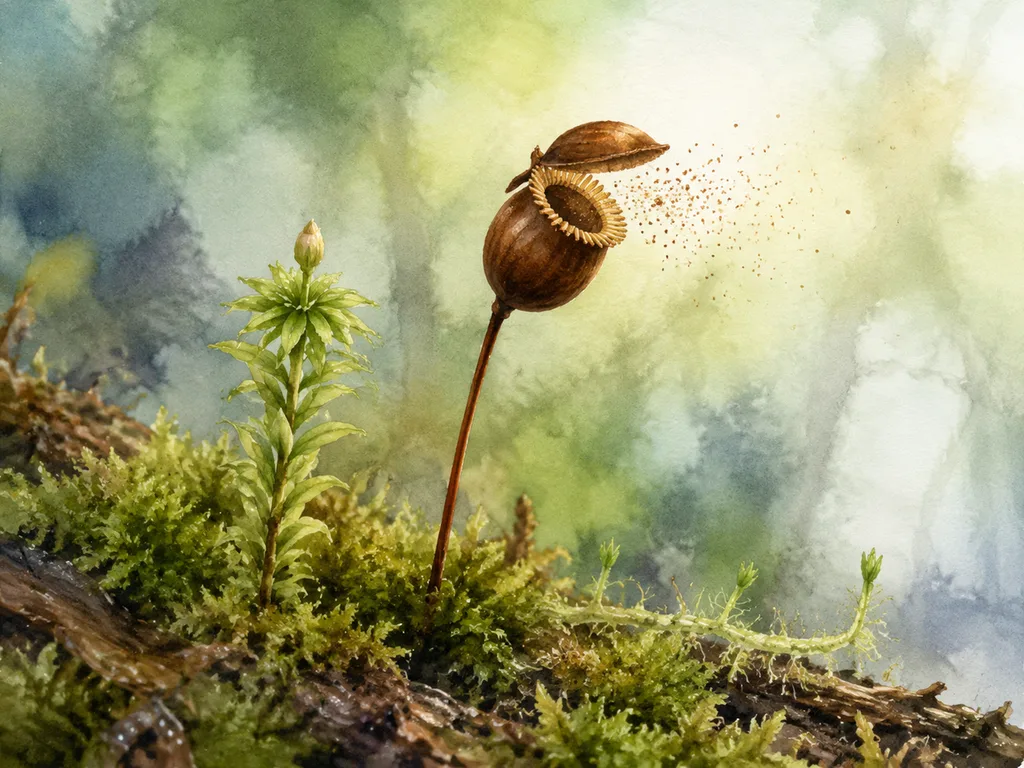
An alternating-generations plate for a moss: leafy gametophyte, magnified antheridium
and archegonium, the sporophyte with seta and capsule, capsule operculum open with
peristome teeth releasing spores, and a protonema inset. Label "GAMETOPHYTE",
"CAPSULE", "SETA", "PERISTOME", "SPORES". Title: "TWO GENERATIONS".
Verify: the sporophyte must grow from the gametophyte, not from soil; peristome teeth belong at the capsule mouth only.
Zoology
3. Beetle morphology
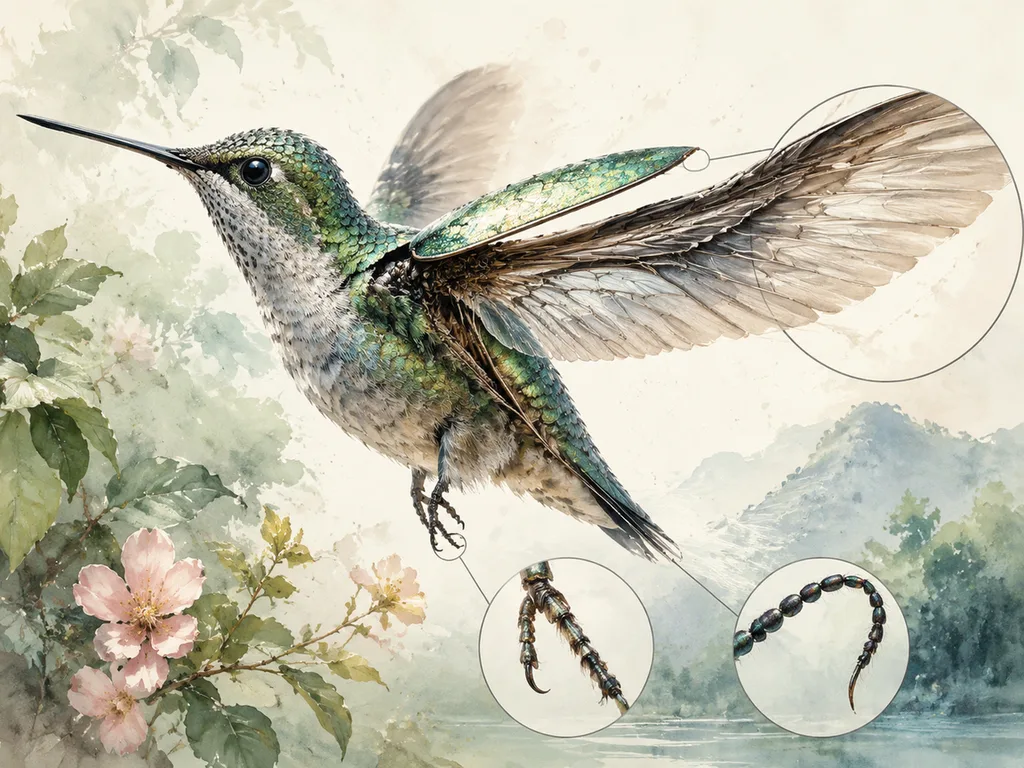
A comparative coleopterology plate: one stag beetle in dorsal view with all major
sclerites labeled, one elytron lifted to reveal the folded flight wing, a leg with
tarsal segments magnified, and an antenna detail. Label "PRONOTUM", "ELYTRON",
"FLIGHT WING", "TARSUS". Title: "ARMOR AND WING".
Verify: tarsal segment count (5-5-5 for most beetles, but stag beetles vary); the flight wing should fold under the elytron, not beside it.
4. Hummingbird flight mechanics
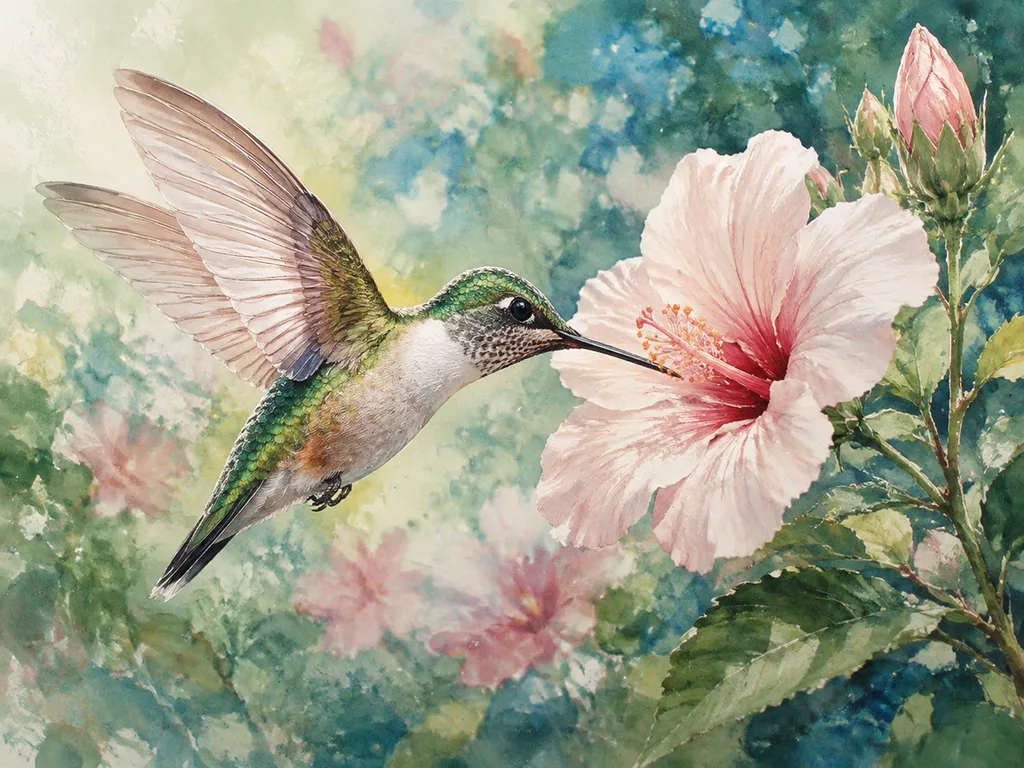
A hovering-flight figure: hummingbird in hover with figure-eight wing-path stroke
cycle, shoulder rotation at reversal points, a nectar-feeding posture inset, and
lift-vector arrows during downstroke and upstroke. Label "WING PATH", "STROKE CYCLE",
"LIFT VECTOR", "FEEDING". Title: "FEATHERED HELICOPTER".
Verify: lift arrows should be roughly symmetric between strokes — hummingbirds generate lift on the upstroke too, unlike most birds.
Medicine
5. Alzheimer pathology in the hippocampus
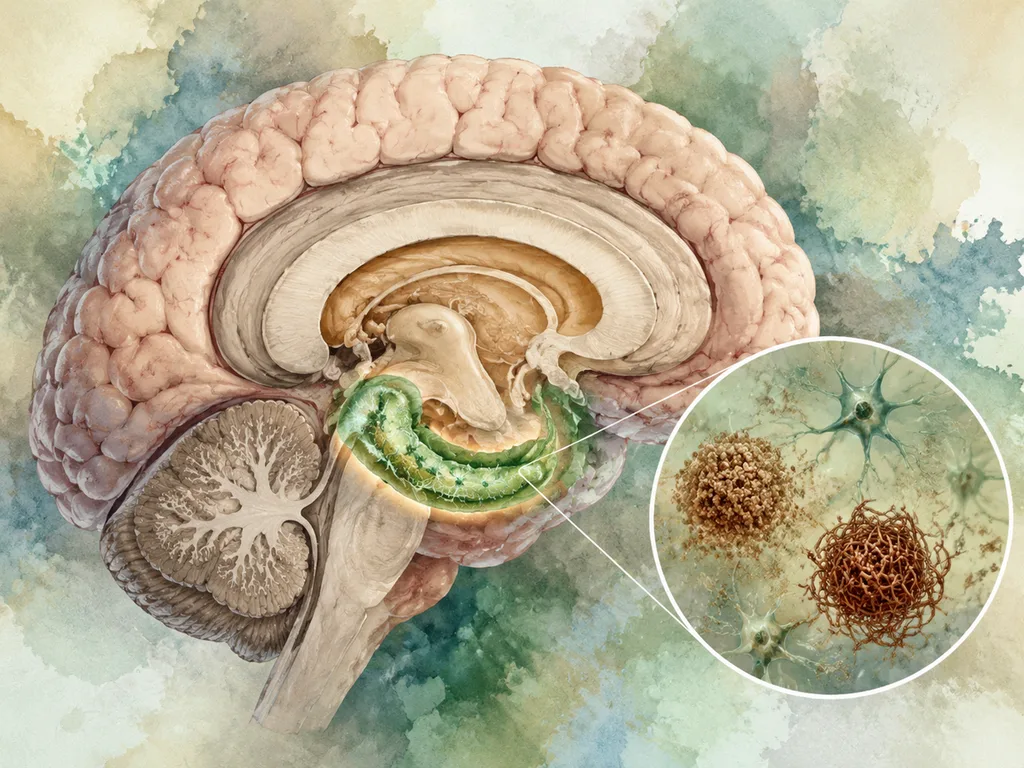
A coronal brain section highlighting the hippocampus in Alzheimer disease, with
amyloid plaques as small extracellular deposits and neurofibrillary tangles inside
neurons, plus one magnified inset of a plaque and a tangle. Label "HIPPOCAMPUS",
"PLAQUE", "TANGLE", "NEURON". Title: "ALZHEIMER PATHOLOGY".
Verify: hippocampal anatomy in a coronal plane is easy to get subtly wrong — compare against a neuroanatomy atlas before teaching use. See our medical illustration guide.
6. Blood cell family tree
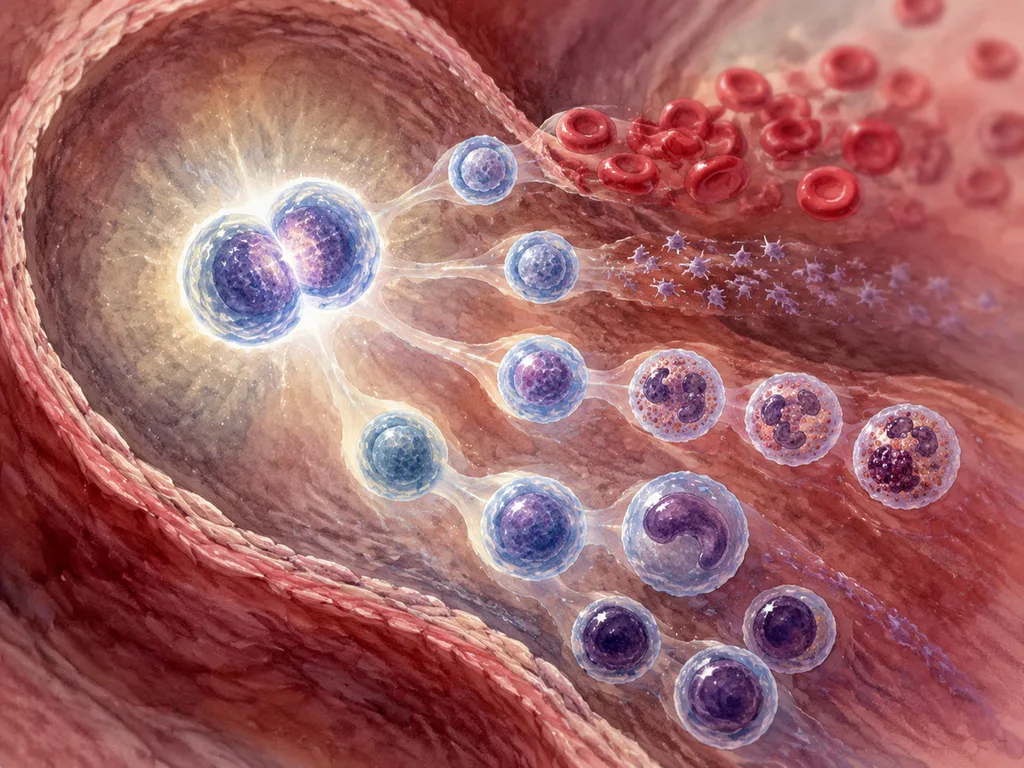
A classic hematopoiesis tree: the hematopoietic stem cell at the root branching
through progenitors into red cells, platelets, granulocytes, monocytes and
lymphocytes, each mature cell drawn at the leaf. Label "STEM CELL", "PROGENITOR",
"RED CELL", "PLATELET", "LYMPHOCYTE". Title: "BLOOD LINEAGES".
Verify: common ancestor nodes — the myeloid/lymphoid split must happen early; platelets should be fragments, not nucleated cells.
Molecular biology
7. Antibody structure
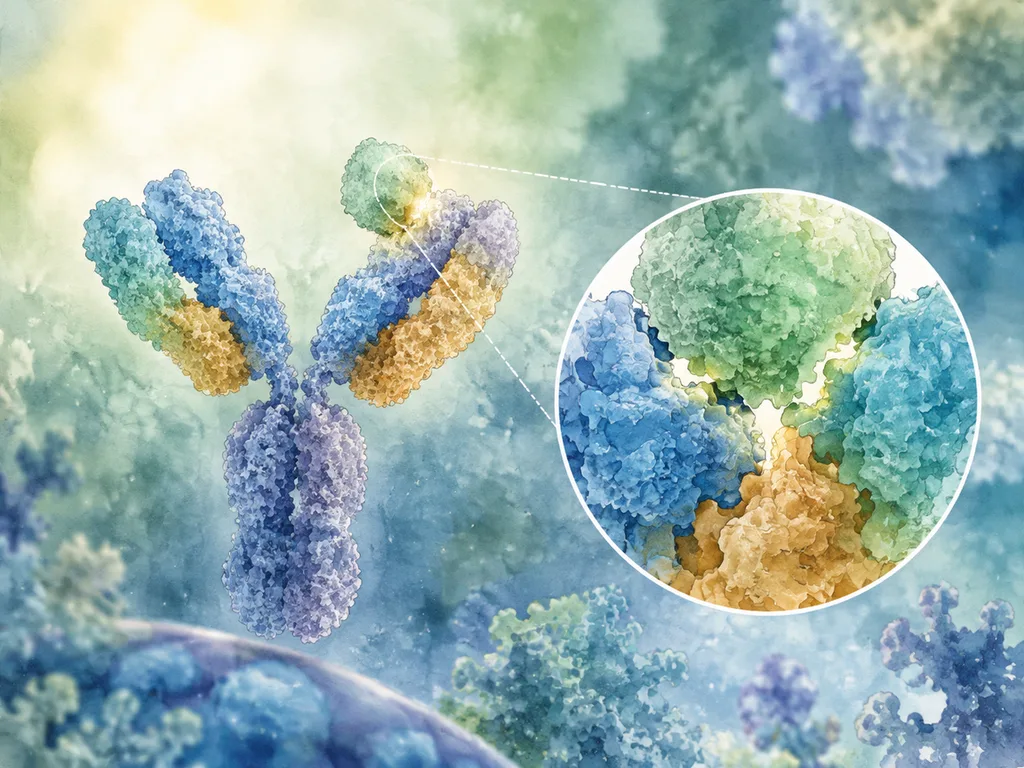
A molecular figure of an antibody with its two heavy and two light chains, the
antigen-binding sites gripping a small antigen, and one magnified inset of the
paratope-epitope interface. Label "HEAVY CHAIN", "LIGHT CHAIN", "PARATOPE",
"EPITOPE". Title: "ANTIBODY STRUCTURE".
Verify: Y-shape symmetry — both Fab arms should be identical; the paratope is on the antibody, the epitope on the antigen (they get swapped constantly).
8. Bacteriophage T4
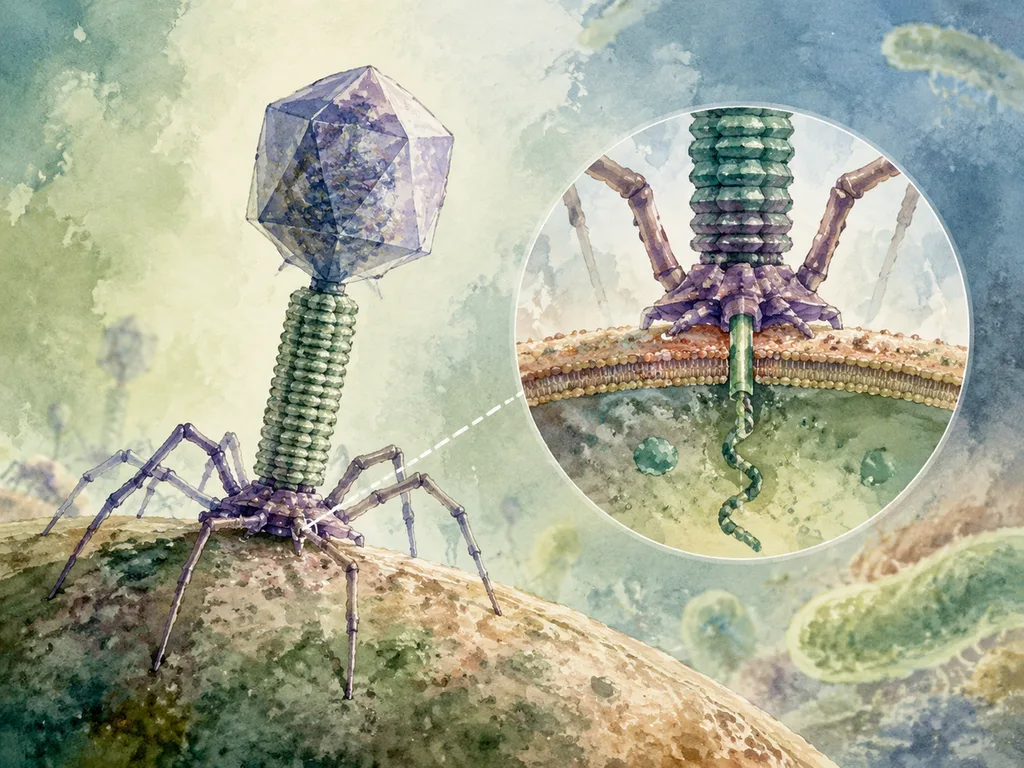
A structural figure of the T4 bacteriophage with its icosahedral head, contractile
sheath, tail fibers and base plate, plus one inset showing the tail injecting DNA
into a bacterial envelope. Label "HEAD", "SHEATH", "TAIL FIBER", "BASE PLATE",
"DNA". Title: "T4 PHAGE".
Verify: tail fibers attach to the bacterial surface before sheath contraction; the head is elongated (prolate), not a regular icosahedron.
Earth science
9. Subduction zone anatomy
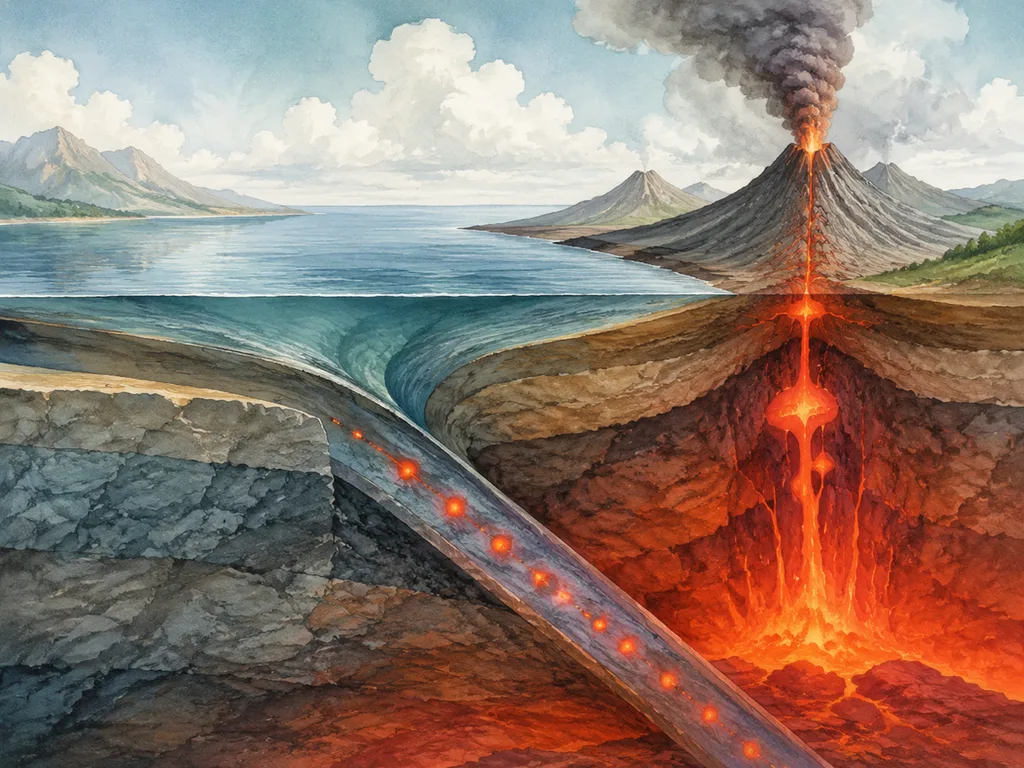
A detailed subduction cross-section: oceanic plate bending into the trench, slab
descending into the mantle, water released triggering melt, magma rising through
the overriding plate to a volcanic arc, and earthquake-depth dots coloring the
slab. Label "TRENCH", "SLAB", "DEWATERING", "MAGMA", "VOLCANIC ARC".
Title: "THE SINKING FLOOR".
Verify: earthquake depth dots must deepen with the slab (Wadati-Benioff zone); the volcanic arc sits offset inland from the trench, not above it.
10. Cloud classification chart

A meteorological plate of the ten principal cloud genera arranged by altitude band:
high cirrus family, mid alto group, low stratus family, and vertical cumulus column,
each cloud with its altitude label. Label "CIRRUS", "ALTOCUMULUS", "STRATUS",
"CUMULONIMBUS". Title: "READING THE SKY".
Verify: nimbostratus placement is the classic error — it occupies the mid-to-low band and is the one genus most often drawn at the wrong altitude.
Astronomy
11. Solar interior and activity
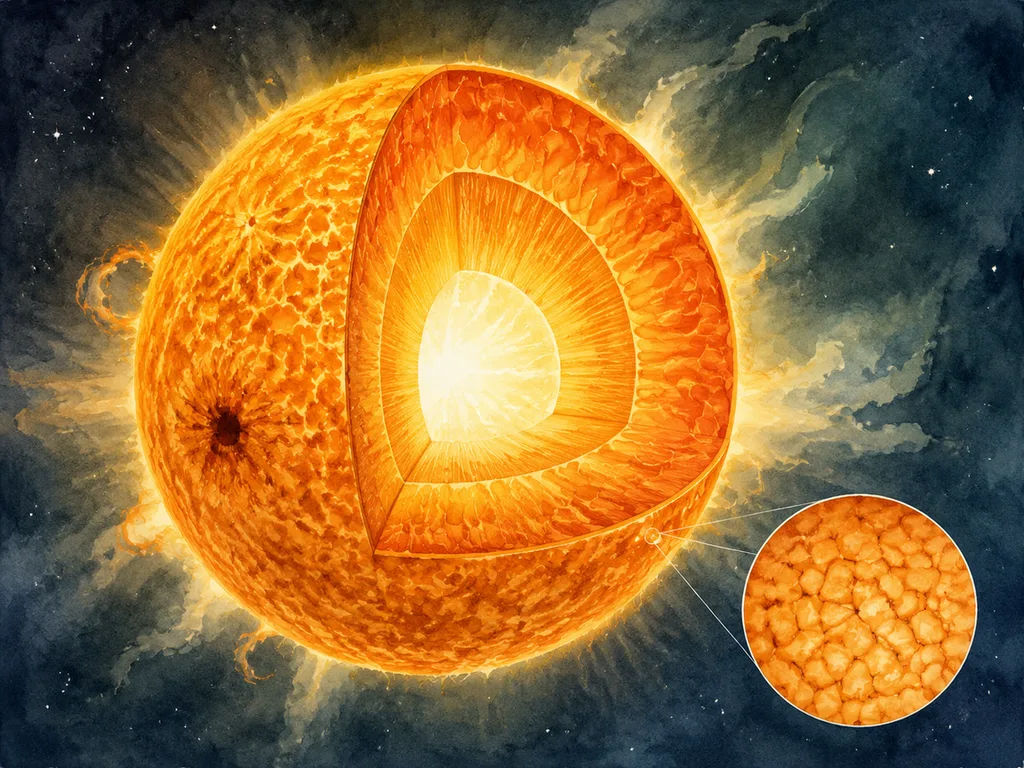
A solar anatomy figure: cutaway through the core, radiative and convective zones to
the photosphere, with a sunspot group, a prominence and the corona on the limb, plus
a granulation inset of the surface. Label "CORE", "RADIATIVE ZONE", "CONVECTIVE
ZONE", "SUNSPOT", "CORONA". Title: "OUR STAR INSIDE OUT".
Verify: zone order (core → radiative → convective); the corona should read as hotter than the photosphere, which usually needs a note since the drawing alone implies otherwise.
12. Star life cycle on the HR diagram

An astronomy teaching figure: a Hertzsprung-Russell diagram with the main sequence,
giant and white-dwarf branches, and small star icons along the tracks showing a
sun-like and a massive star's life path. Label "MAIN SEQUENCE", "RED GIANT",
"WHITE DWARF", "SUPERNOVA". Title: "LIVES OF STARS".
Verify: axis direction — temperature must increase to the left; the sun-like path should move to the red giant branch then down to the white dwarf zone, never crossing back to the main sequence.
Natural history
13. Trilobite morphology

A paleontology plate of one trilobite species: complete dorsal specimen with
cephalon, segmented thorax and pygidium labeled, an enrolled specimen beside it,
one holochral eye magnified, and a size scale. Label "CEPHALON", "THORAX",
"PYGIDIUM", "HOLOCHRAL EYE". Title: "ANCIENT ARMOR".
Verify: segment count against the actual species if you name one; enrollment should show the pygidium tucking under the cephalon. More vintage-style plates in our natural history guide.
17 more, one line each
Every plate below is live in our galleries with its full prompt — follow the link, copy the prompt, swap the subject:
| # | Discipline | Plate | Link |
|---|---|---|---|
| 14 | Botany | Plant drought response (ABA, guard cells, stomata) | Open |
| 15 | Botany | Fern sorus detail (frond, sorus, indusium, sporangia) | Open |
| 16 | Botany | Cactus adaptation anatomy (ribs, pith, areole, roots) | Open |
| 17 | Botany | Seed dispersal strategies (samara, plume, burr, berry, pod) | Open |
| 18 | Botany | Pollination syndrome flowers (four forms, four pollinators) | Open |
| 19 | Zoology | Barn owl hunting plate (facial disc, silent flight) | Open |
| 20 | Zoology | Octopus anatomy (arms, gills, ink sac, chromatophores) | Open |
| 21 | Zoology | Horse gaits study (walk, trot, canter, gallop) | Open |
| 22 | Zoology | Shark dentition comparison (grabbing, slicing, crushing) | Open |
| 23 | Ecology | Temperate forest food web (canopy to decomposers) | Open |
| 24 | Ecology | Mangrove ecosystem services | Open |
| 25 | Earth science | Glacier motion and moraines | Open |
| 26 | Earth science | River delta formation types | Open |
| 27 | Earth science | Permafrost thaw feedback | Open |
| 28 | Astronomy | Aurora mechanism | Open |
| 29 | Natural history | Dodo skeletal reconstruction | Open |
| 30 | Natural history | Amber inclusions gallery | Open |
The pattern behind all 30
Strip away the disciplines and every prompt above has the same skeleton:
A [STYLE] plate of [SUBJECT]: [MAIN VIEW], [INSET/DETAIL], [SECOND DETAIL].
Label "TERM 1", "TERM 2", "TERM 3", "TERM 4". Title: "SHORT TITLE".
Three habits make the difference between a decoration and a usable figure:
- The label list comes from the reference, not from memory. Open a real source, harvest its exact terms, put those in quotes.
- Panels are named in the prompt. "Whole specimen, one close-up, one inset" — layouts that are specified get drawn; layouts that are hoped for get guessed.
- Everything gets the verify pass. Each example above carries its own check note because each has its own classic failure mode.
Scientific review checklist
Before any of these plates goes in front of students, readers, or reviewers:
- [ ] Are all labels spelled correctly?
- [ ] Are all requested structures present?
- [ ] Are positions and proportions reasonable against your reference?
- [ ] Do arrows show the correct direction?
- [ ] Are stages shown in the correct order?
- [ ] Has it been checked against a trusted source?
Where to go next
- The full workflow behind these plates: How to create a scientific illustration with AI
- Discipline packs: biology · anatomy · botany · zoology · earth science · physics & engineering · chemistry
- Or start from a discipline preset on the scientific illustration page and paste any prompt above.
<!-- scientific-illustration-cluster-links:start -->
Continue through the scientific illustration collection
Create a scientific illustration · Browse the scientific illustration resource hub
Related: 25 Biology Diagram Prompts for Cells, DNA, Photosynthesis and Mitosis · 20 Human Anatomy Diagram Prompts for Heart, Brain and Neurons
<!-- scientific-illustration-cluster-links:end -->