
A complete pollination cycle — specimen, flower cutaway, magnified pollen, four seed stages, six labels — from one prompt. Botany is the friendliest discipline for AI illustration (structures sit still and have stable vocabulary), which makes it the best place to learn the craft. Here are 20 prompts with labels and verify notes, ready to copy.
Open the botany presets · Botanical illustration guide · Full workflow
Flowers and reproduction
1. The pollination cycle
The complete pollination cycle of a flowering plant: whole specimen, large flower
cutaway, magnified pollen detail and four small stages. Label "PETAL", "ANTHER",
"STIGMA", "OVARY", "POLLEN", "SEED". Title: "THE POLLINATION CYCLE".
Verify: pollen travels anther → stigma → down the style to the ovary; the ovary becomes the fruit, ovules become seeds — check the stage order.
2. Heritage rose plate
A museum-style botanical plate of one old garden rose: full bloom, a half-open bud,
a dissected flower showing stamens and pistil, and a leafy stem, in graphite contour
with specimen-true watercolor. Label "BLOOM", "BUD", "STAMENS", "PISTIL", "LEAFLET".
Title: "THE OLD ROSE".
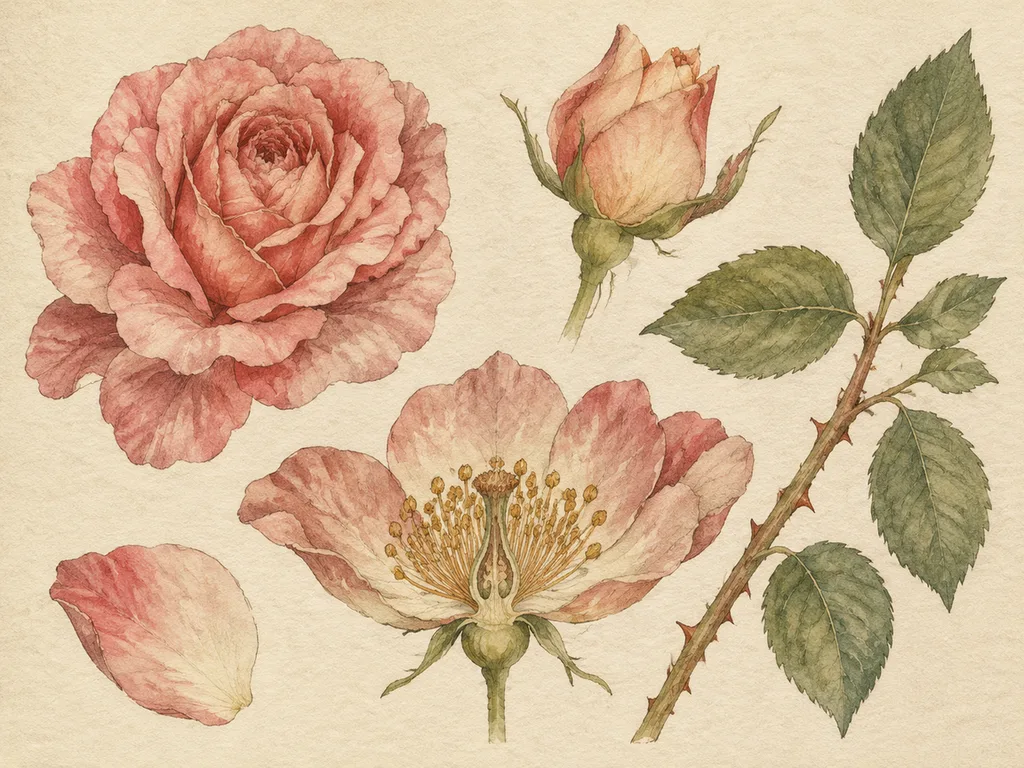
Verify: stamen count against the cultivar; leaflet number (old garden roses 5–7).
3. Pollination syndrome flowers
A pollination-syndrome comparison plate of four flower forms: tubular red
hummingbird flower, wide white moth flower, landing-platform bee flower with nectar
guides, and carrion-colored fly flower, each with its pollinator silhouette.
Label "TUBULAR", "NECTAR GUIDES", "LANDING PLATFORM", "POLLINATOR".
Title: "FLOWERS THAT ADVERTISE".
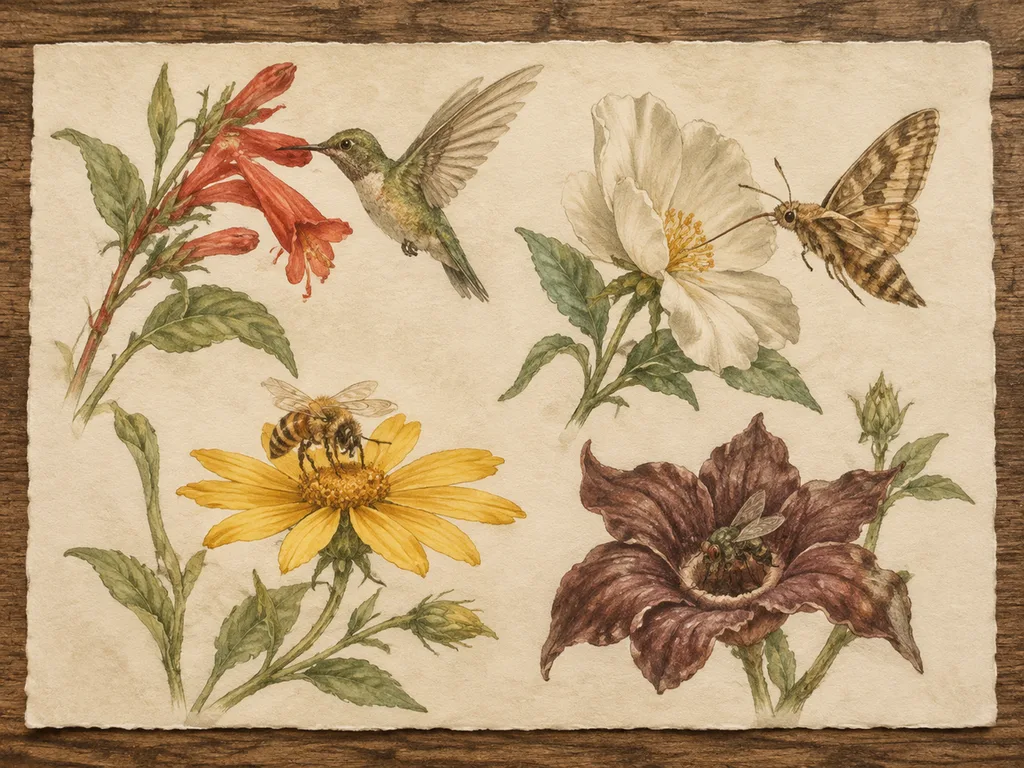
Verify: red tubular → hummingbird, white wide + evening → moth, landing platform + guides → bee; the syndromes must stay matched to the right pollinator.
4. Sunflower phyllotaxis
A mathematical-botany plate of the sunflower head: whole capitulum, a disc-floret
close-up, and an overlay spiral diagram showing Fibonacci parastichy families
counted and numbered in two directions. Label "CAPITULUM", "DISC FLORET", "RAY
FLORET", "PARASTICHY". Title: "COUNTING SPIRALS".

Verify: spiral counts should land on Fibonacci numbers (21/34/55); ray florets are the sterile petal-like ring, disc florets the fertile center.
Ferns, mosses and alternation of generations
5. Fern sorus detail
A fern life-figure: one full frond, a pinna underside magnified to show sori rows,
one sorus further magnified with indusium lifted and sporangia releasing spores,
and a heart-shaped prothallus inset. Label "FROND", "SORUS", "INDUSIUM",
"SPORANGIA", "PROTHALLUS". Title: "SPORE FACTORIES".
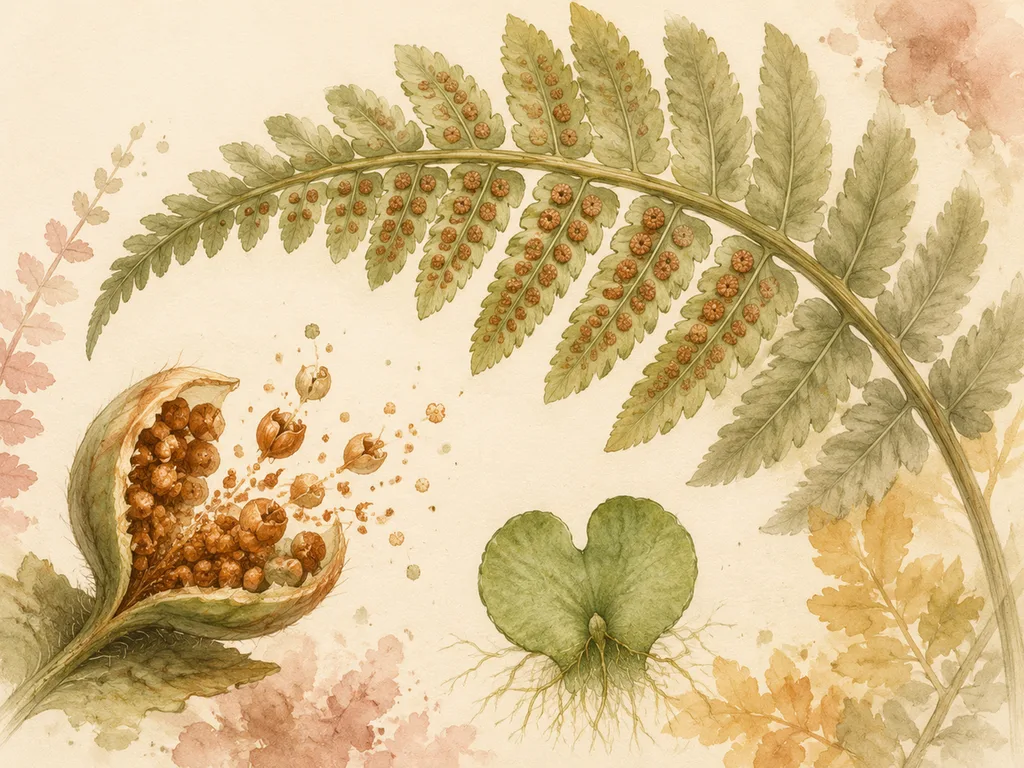
Verify: sori on the underside of the pinna; the prothallus is the gametophyte — separate from the frond plant.
6. Moss life cycle
An alternating-generations plate for a moss: leafy gametophyte, magnified
antheridium and archegonium, the sporophyte with seta and capsule, capsule
operculum open with peristome teeth releasing spores, and a protonema inset.
Label "GAMETOPHYTE", "CAPSULE", "SETA", "PERISTOME", "SPORES".
Title: "TWO GENERATIONS".
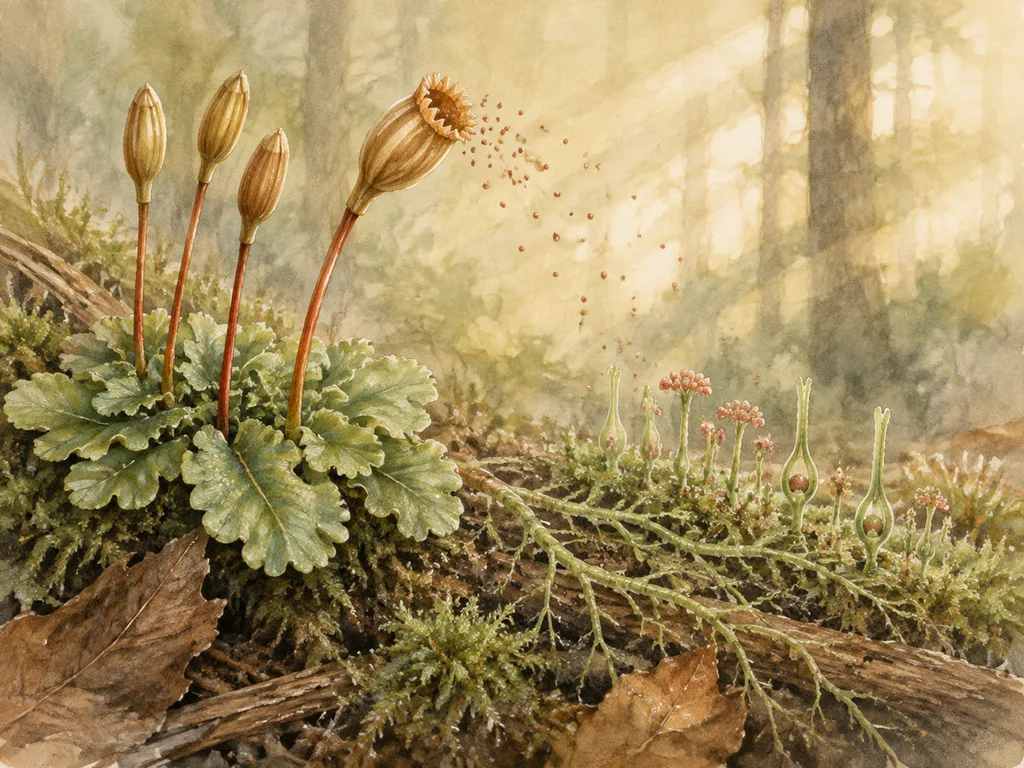
Verify: the sporophyte grows out of the gametophyte and stays attached — a free-standing capsule is wrong.
Adaptations
7. Cactus anatomy
A desert-adaptation plate of a columnar cactus: whole plant in habitat, a
transverse section showing ribs, water-storage pith and vascular bundles, an areole
with spine cluster magnified, and a shallow wide root map. Label "RIB", "PITH",
"AREOLE", "SPINE", "ROOT SPREAD". Title: "WATER TOWER OF THE DESERT".

Verify: spines grow from areoles only; roots wide and shallow (cacti absorb brief rain), not deep taproots.
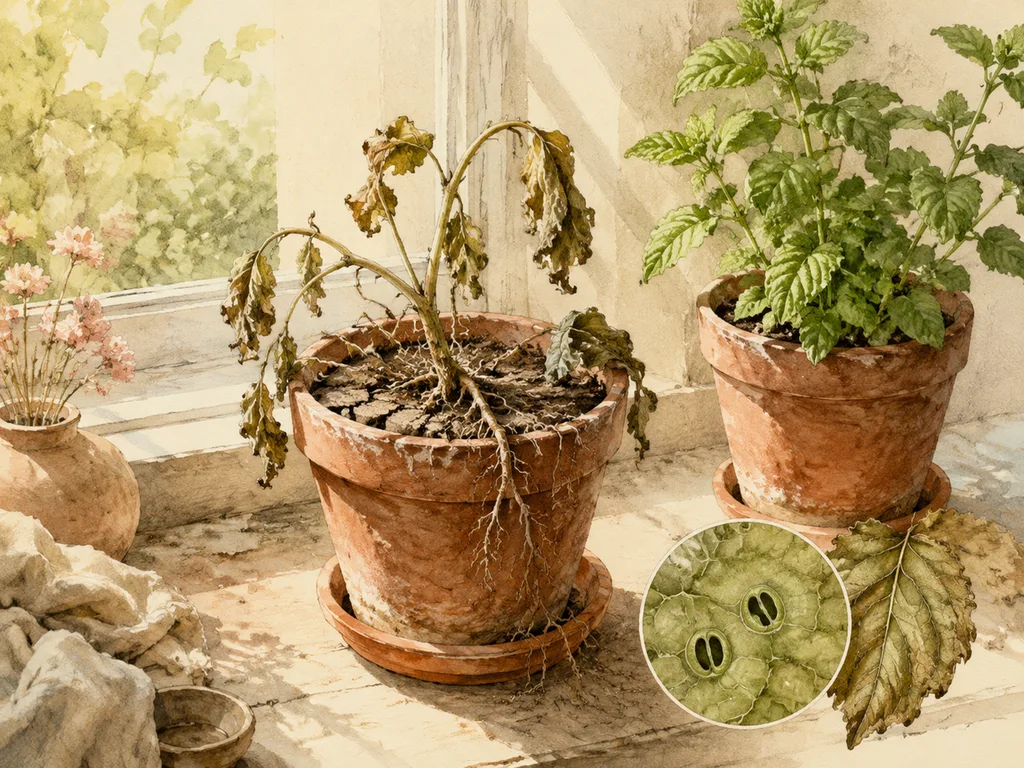
8. Plant drought response
A plant-physiology figure of drought response: roots sensing dry soil, abscisic
acid traveling up the xylem, guard cells closing stomata, leaf rolling and
osmoprotectant accumulation, with a healthy versus stressed plant pair.
Label "ABA", "GUARD CELL", "STOMATA", "OSMOPROTECTANT". Title: "SURVIVING DRYNESS".
Seeds and dispersal
9. Seed dispersal strategies
A comparative botanical plate of five dispersal modes: winged samara, plumed
dandelion seed, barbed burr, fleshy berry with bird, and ballistic pod releasing
seeds, each specimen with a small motion arrow. Label "SAMARA", "PLUME", "BURR",
"BERRY", "BALLISTIC POD". Title: "TRAVELING SEEDS".

Verify: motion arrows match the mode (wind for samara/plume, animal for burr/berry, self for pod).
Eight quick variants
Swap the subject, keep the grammar — the dissected-flower template alone covers most botany lessons:
| # | Topic | One-line change |
|---|---|---|
| 10 | Lily dissection | "A botanical plate of one lily flower dissected: tepals removed, six stamens and a prominent pistil with sticky stigma… Label 'TEPAL', 'STAMEN', 'STIGMA', 'OVARY'" |
| 11 | Pea flower | "A papilionaceous pea flower with banner, wings and keel peeled open showing stamens and pistil… Label 'BANNER', 'WING', 'KEEL', 'PISTIL'" |
| 12 | Composite head | "A longitudinal section of a daisy flower head showing many florets on a receptacle… Label 'RAY FLORET', 'DISC FLORET', 'RECEPTACLE', 'INVOLUCRE'" |
| 13 | Leaf morphology | "A comparison sheet of five leaf shapes and five margin types… Label each leaf and margin" |
| 14 | Stem cross-section | "A dicot stem cross-section with vascular bundles in a ring, plus one bundle magnified… Label 'EPIDERMIS', 'XYLEM', 'PHLOEM', 'CAMBIUM'" |
| 15 | Root anatomy | "A root cross-section with central stele and root hair zone… Label 'ROOT HAIR', 'CORTEX', 'XYLEM', 'PHLOEM'" |
| 16 | Germination | "A four-stage seed germination sequence from imbibed seed to first true leaves… Label 'RADICLE', 'COTYLEDON', 'HYPOCOTYL', 'TRUE LEAF'" |
| 17 | Venus flytrap | "A carnivorous plant plate: whole plant, open trap with trigger hairs, and a closing sequence inset… Label 'TRAP', 'TRIGGER HAIR', 'CILIUM'" |
Style variations
Botanical art has three canonical registers — specify them in the STYLE slot:
- Heritage watercolor (like plate 2):
graphite contour with specimen-true watercolor— museum look, best for whole-plant plates. - Textbook line art:
clean ink line drawing with stippled shading on white— photocopies well, best for classroom keys. - Modern flat vector:
flat minimal vector style with soft colors— best for slides and web.
One subject in all three registers is also the cheapest way to see how much "style" is doing vs "structure": the labels and panels stay identical; only the rendering changes. We cover that trade-off in one subject, five styles.
Scientific review checklist
- [ ] Are all labels spelled correctly?
- [ ] Are all requested structures present?
- [ ] Are positions and proportions reasonable against your flora or textbook?
- [ ] Do arrows show the correct direction (pollen path, water path)?
- [ ] Are life-cycle stages shown in the correct order?
- [ ] Has it been checked against a trusted source?
FAQ
Can AI draw a specific species accurately?
Genus level, reliably; species level, with verification. The rose plate above is right at the genus-and-habit level, but stamen counts and leaflet serration are species facts — pull them from your flora and put them in the prompt or the verify note. The rarer the species, the more the model leans on its generic concept of the family.
How do I add a scale bar?
Ask for it in the prompt — "with a scale bar" — and then verify it, because models draw plausible-looking bars with invented ratios. If scale matters, the honest route is to typeset the bar yourself in the vector pass (workflow).
Watercolor or line art for herbarium-style plates?
Both work; they fail differently. Watercolor bleeds softly over fine venation — verify small structures didn't melt. Line art is the most reliable register but flattens texture. The styles guide compares all five registers on one subject.
What about cultivated varieties vs wild species?
Cultivars are where accuracy gets genuinely hard: a 'Heritage' rose and a wild Rosa can be far apart morphologically. For cultivars, include the distinguishing features in the prompt from a reference photo or cultivar description — don't rely on the variety name alone carrying the morphology.
Herbarium-style layout — worth prompting for?
Yes, and it's an underused pattern: herbarium sheet layout, specimen centered, label block bottom-right, collection date and locality lines produces plates that read as archival documentation. The label block becomes typeset text in the vector pass, and the style flatters pressed-specimen subjects — ferns, grasses, composites — especially for collections and teaching herbaria.
Harvesting labels from a flora
The professional habit that upgrades every botanical prompt: pull the label list from a real flora entry, not from memory. Open the species account — field guide, county flora, or herbarium page — and copy its exact diagnostic terms into the prompt's label slots. Two things happen: the vocabulary arrives pre-verified (the flora already did the synonym checking), and the prompt stops describing "a rose" and starts describing the rose — its specific stamen count, its stipules, its sepal character. That's the difference the verify notes in this pack keep asking for, made structural instead of corrective. One flora page, five minutes, and the plate drafts right the first time measurably more often.
Next
Paste any prompt into the botany presets. Then keep going: 30 examples across all disciplines · zoological prompts · biology diagram prompts · the botanical illustration guide.
<!-- scientific-illustration-cluster-links:start -->
Continue through the scientific illustration collection
Create a scientific illustration · Browse the scientific illustration resource hub
Related: 20 Zoological Illustration Prompts for Fish, Insects, Birds and More · 20 Earth Science Diagram Prompts: Water Cycle, Rock Cycle, Erosion, Strata
<!-- scientific-illustration-cluster-links:end -->