
A honeybee in two views with six labels and a wing-vein inset — one prompt. Zoological illustration is where field-guide conventions meet anatomy: whole-animal habitus plus magnified details, arranged on one plate. These 20 prompts follow that convention, and each carries the verify note that keeps the anatomy honest.
Open the zoology presets · Animal illustration guide · Full workflow
Insects
1. Honeybee anatomy
A honeybee in dorsal and lateral views with an enlarged wing-vein inset and a small
pollination vignette. Label "ANTENNA", "COMPOUND EYE", "FOREWING", "ABDOMEN",
"POLLEN BASKET", "STINGER".
Verify: three body segments (head, thorax, abdomen), four wings, six legs; the pollen basket is on the hind leg.
2. Beetle morphology
A comparative coleopterology plate: one stag beetle in dorsal view with all major
sclerites labeled, one elytron lifted to reveal the folded flight wing, a leg with
tarsal segments magnified, and an antenna detail. Label "PRONOTUM", "ELYTRON",
"FLIGHT WING", "TARSUS". Title: "ARMOR AND WING".
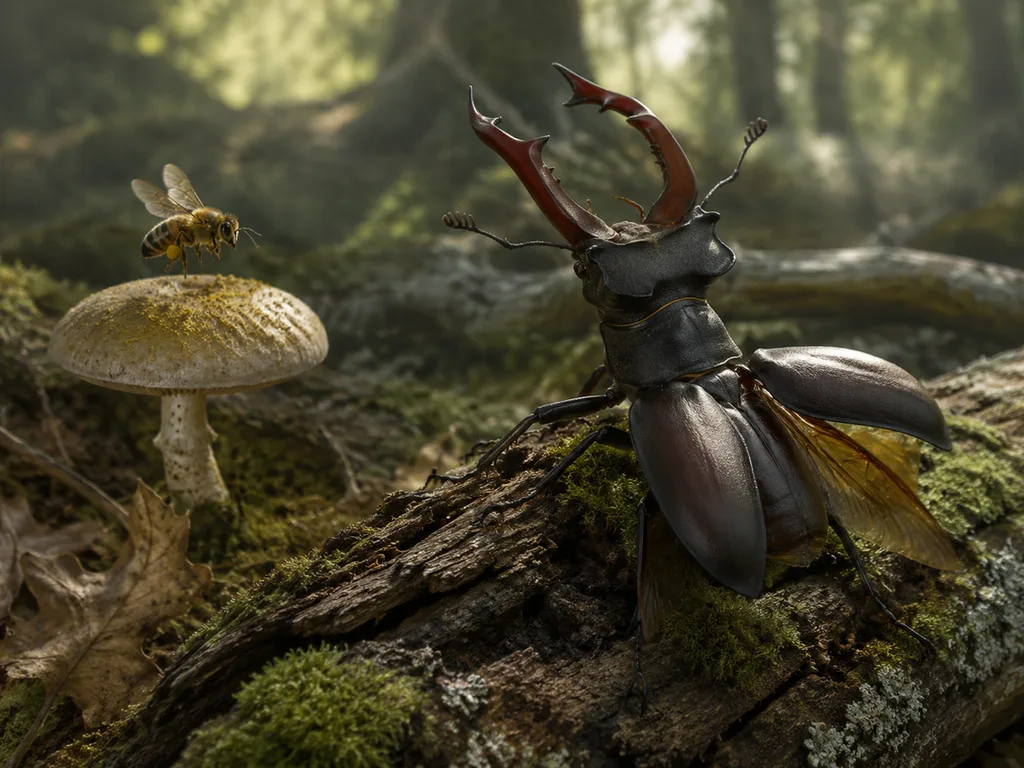
Verify: six legs attached to the thorax; the flight wing folds under the elytron, not beside it.
3. Butterfly wing scales
A lepidopteran figure bridging macro and micro: whole butterfly dorsal side, a wing
patch magnified to overlapping shingle-like scales, one scale at higher power
showing ridge ridges, and a structural-color diagram inset. Label "FOREWING",
"SCALES", "RIDGES", "STRUCTURAL COLOR". Title: "SHINGLES OF LIGHT".
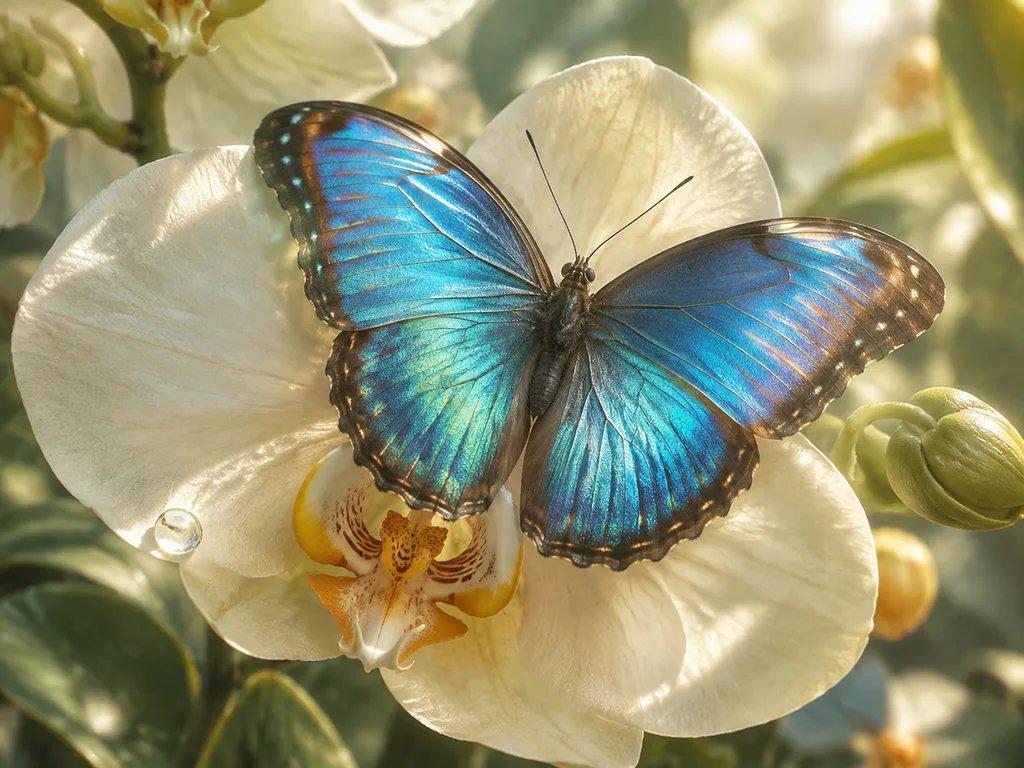
Verify: scales overlap like roof shingles from the base outward; blue morpho color is structural, not pigment — the inset must say so.
4. Butterfly wing venation
A lepidopteran wing-venation plate: forewing and hindwing spread, veins traced and
named, one fritillary scale detail, and a wing-coupling mechanism inset.
Label "COSTA", "RADIUS", "MEDIAL", "FRENULUM". Title: "VEIN MAP".
Verify: vein names follow the Comstock-Needham system; the frenulum couples wings in moths, not butterflies.
Birds
5. Barn owl hunting plate
A field-guide plate of the barn owl in three studies: perched frontal showing the
heart-shaped facial disc, wings spread from above, and a silent-flight hunting
dive, plus a feather-edge silence inset. Label "FACIAL DISC", "TALONS", "SECONDARY
FRINGE", "ASYMMETRIC EARS". Title: "SILENT HUNTER".

Verify: the facial disc is heart-shaped and frames the bill; ear openings asymmetrical (left higher) — the fact that lets ows triangulate sound.
6. Hummingbird flight mechanics
A hovering-flight figure: hummingbird in hover with figure-eight wing-path stroke
cycle, shoulder rotation at reversal points, a nectar-feeding posture inset, and
lift-vector arrows during downstroke and upstroke. Label "WING PATH", "STROKE
CYCLE", "LIFT VECTOR", "FEEDING". Title: "FEATHERED HELICOPTER".
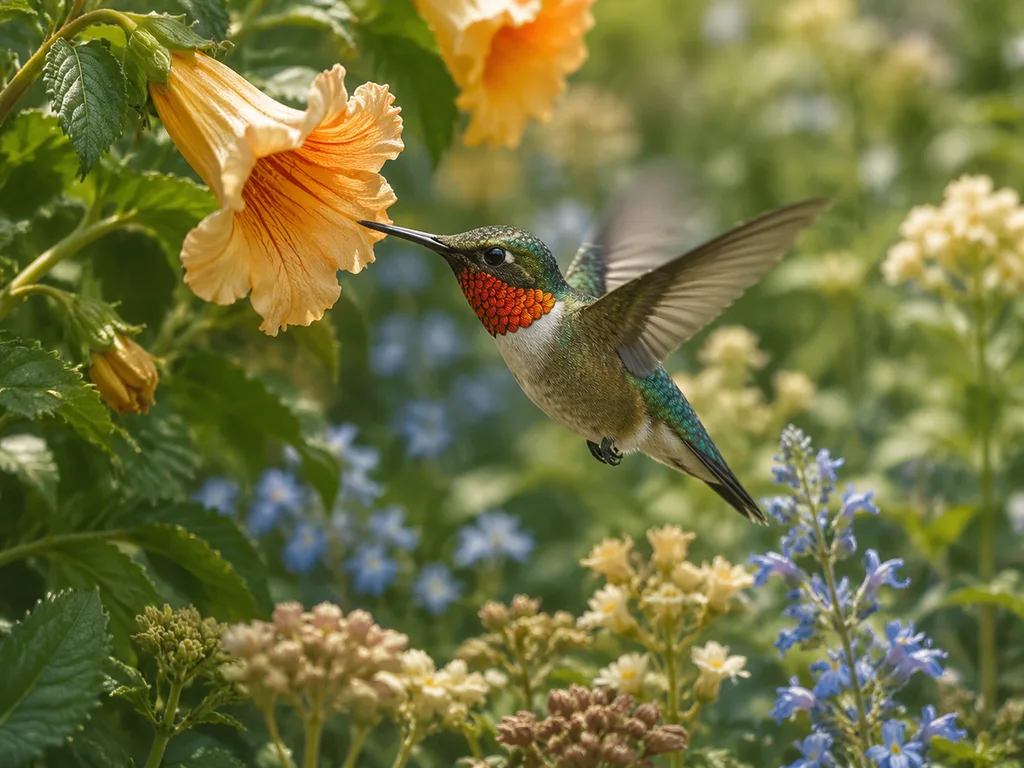
Verify: lift on both strokes; wing path is a figure-eight when viewed head-on.
Marine life
7. Octopus anatomy
A cephalopod anatomy figure: whole octopus in ventral view with arms numbered,
mantle cutaway exposing gills, ink sac and digestive gland, a chromatophore skin
inset, and a sucker magnification. Label "MANTLE", "GILL", "INK SAC",
"CHROMATOPHORES", "SUCKER". Title: "THE EIGHT-ARMED ENIGMA".
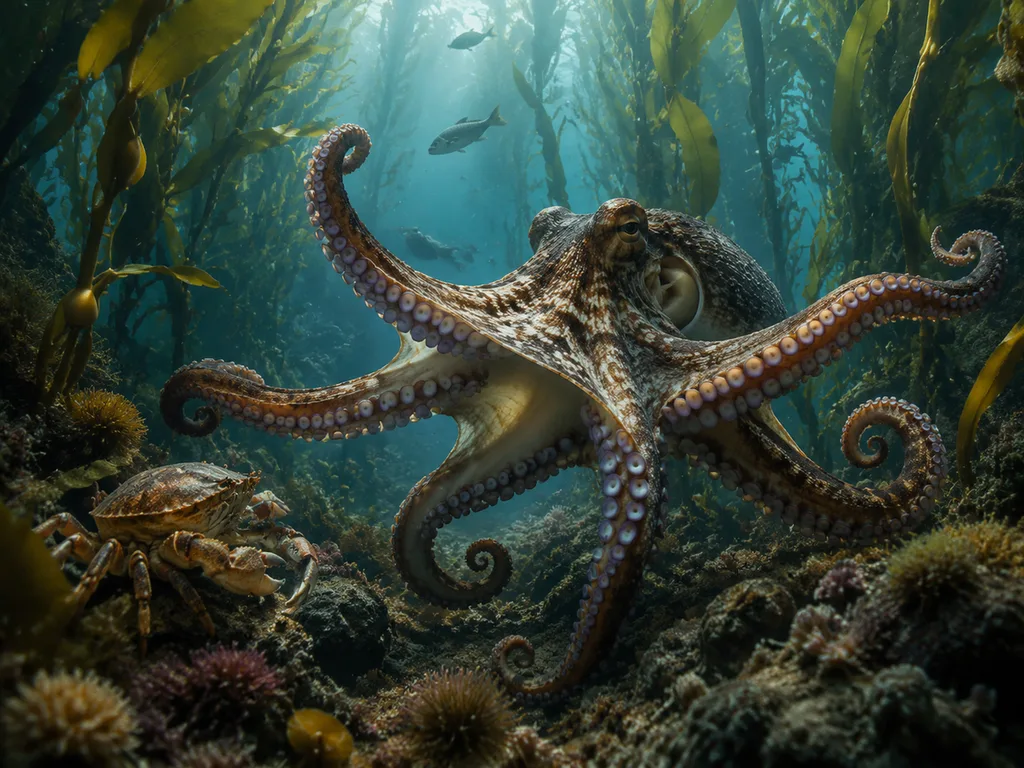
Verify: eight arms, no tentacles (that's squid/cuttlefish); suckers on the oral side of the arms only.
8. Shark dentition comparison
A comparative odontology plate of three shark feeding strategies: pointed grabbing
teeth of the mako, triangular slicing teeth of the white shark, and flat crushing
plates of the nurse shark, each row with jaw arc and one tooth enlarged.
Label "GRABBING", "SLICING", "CRUSHING", "JAW ARC". Title: "TEETH TELL THE DIET".
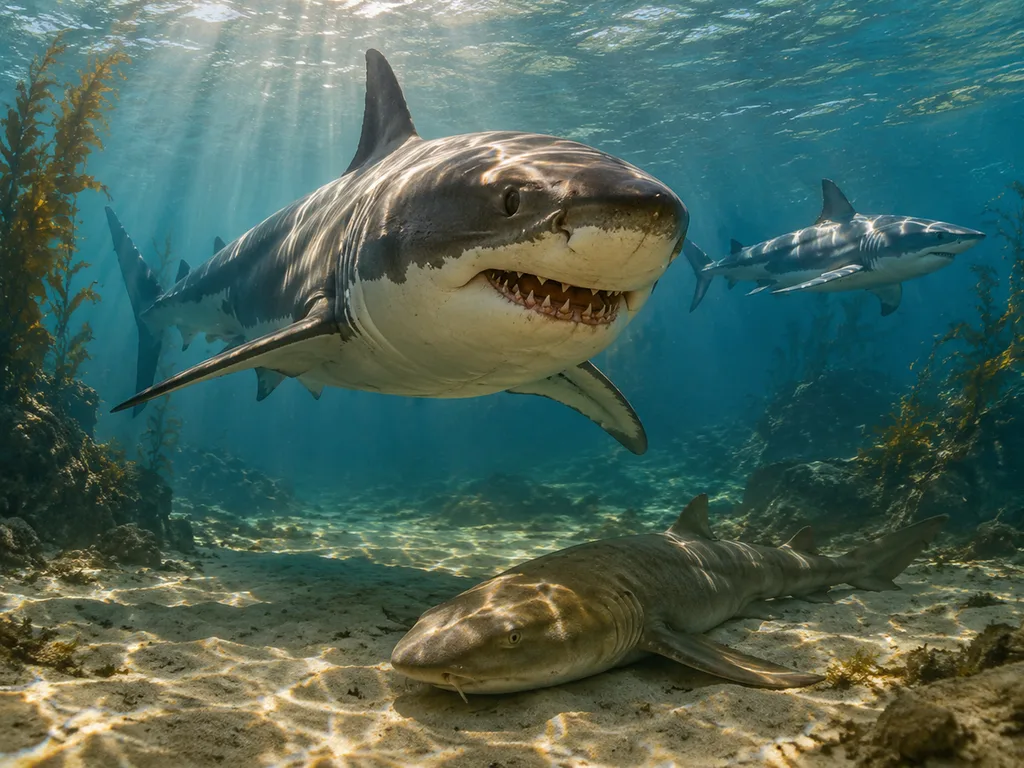
Verify: match each tooth form to its diet (fish → grabbing, seals → slicing, shellfish → crushing); teeth in multiple rows with replacements behind.
9. Deep ocean trench zones
A vertical ocean-trench cross-section from sunlit surface through twilight and
midnight zones to the hadal trench floor, with representative species at each depth
band and a pressure scale beside. Label "TWILIGHT ZONE", "MIDNIGHT ZONE",
"HADAL ZONE", "PRESSURE". Title: "THE DEEP LADDER".
Verify: species must sit in their real depth band — the classic error is a lanternfish drawn at surface depth.
Comparative anatomy
10. Horse gaits
A locomotion study plate of the horse's four natural gaits: walk, trot, canter and
gallop in sequence rows, each with footfall phase marks beneath and stride-length
arrows, drawn with anatomically correct legs. Label "WALK", "TROT", "CANTER",
"GALLOP", "FOOTFALL". Title: "GAIT STUDY".

Verify: footfall patterns — walk is 4-beat, trot 2, canter 3, gallop 4 with a suspension phase; Muybridge's photos are the reference.
Twelve quick variants
| # | Topic | One-line change |
|---|---|---|
| 11 | Fish external anatomy | "A perch in lateral view with fins, operculum and lateral line labeled, plus a scale detail inset… Label 'DORSAL FIN', 'OPERculum', 'LATERAL LINE', 'PECTORAL FIN'" |
| 12 | Fish gills | "A fish head with operculum lifted showing gill filaments, one filament magnified with countercurrent flow arrows… Label 'GILL FILAMENT', 'COUNTERCURRENT'" |
| 13 | Frog skeleton | "A frog skeleton in dorsal view with limbs spread, one leg magnified showing fused radioulna… Label 'VERTEBRAE', 'RADIOULNA', 'UROSTYLE'" |
| 14 | Bird egg development | "A cross-section of a bird egg at mid incubation with embryo, membranes and air cell… Label 'ALBUMEN', 'CHALAZA', 'AMNION', 'AIR CELL'" |
| 15 | Snake skull | "A viper skull with hinged fangs shown closed and open, plus a venom duct path… Label 'FANG', 'VENOM DUCT', 'MAXILLA'" |
| 16 | Moth vs butterfly | "A paired comparison of moth and butterfly: antennae, wing coupling, resting posture… Label each difference" |
| 17 | Spider anatomy | "A spider dorsal and ventral view with spinnerets and book lungs inset… Label 'CEPHALOTHORAX', 'SPINNERET', 'BOOK LUNG'" |
| 18 | Coral polyp | "A coral colony surface with one polyp magnified showing tentacles, mesentery and zooxanthellae… Label 'TENTACLE', 'MESENTERY', 'ZOOXANTHELLAE'" |
| 19 | Amphibian metamorphosis | "A five-stage tadpole-to-frog sequence with gills to lungs transition… Label 'GILLS', 'HIND LIMB', 'FORELIMB', 'TAIL RESORPTION'" |
| 20 | Plankton diversity | "A plankton sheet of eight forms: diatoms, copepod, jellyfish larva, foraminifera… Label each" |
Scientific review checklist
- [ ] Are all labels spelled correctly?
- [ ] Are all requested structures present?
- [ ] Are positions and proportions reasonable against your field guide?
- [ ] Do arrows show the correct direction?
- [ ] Are behavioral sequences (gaits, flight) in the correct order?
- [ ] Has it been checked against a trusted source?
FAQ
How species-accurate are the markings?
Common species (honeybee, barn owl) come out close because their field-guide depictions dominate the training space. Rare or lookalike species drift toward the family average — a classic case for adding distinguishing marks to the prompt from your field guide, then verifying. Never let a labeled "species" claim ride on the model's generic concept.
How do I control dorsal versus lateral views?
Name the view in the subject slot — "dorsal view", "ventral view", "lateral view" — and for paired views, ask for both explicitly as panels: "dorsal and lateral views side by side", like the honeybee plate. Unnamed orientation is how you get a stylish three-quarter view with the anatomy angled away from every label.
Can it do extinct animals?
Yes — paleontological plates draft surprisingly well (see the natural history guide and the trilobite in our examples) — but reconstruction claims (posture, color, soft tissue) are scientific claims. Verify against current literature, and where the field is actively debating, show the debate or caption the speculation.
What's the difference between a field-guide plate and an anatomy plate?
Habitus plus distinguishing marks versus internal structure. The owl plate is field-guide register (three studies of the whole animal); the octopus plate is anatomy register (cutaway with organs). The prompt difference: "field-guide plate, three studies" vs "anatomy figure, cutaway exposing". Mixing registers without naming panels produces figures that do neither job.
How do I prompt specimen consistency across plates?
Anchor the species description in every prompt — same size descriptor, same posture, same view clause — and hold the style clause constant, then generate the set in one session and cull outliers immediately. Consistency comes from repeated anchors and prompt-session proximity, not from hoping the model remembers your beetle.
Building a field-guide plate set
A coherent plate set for one taxon — the owl, the bee, the beetle — follows a fixed recipe: a habitus plate (whole animal, two views), a morphology plate (d labeled structures plus one magnified detail), and a behavior or mechanism plate (the hunting dive, the wing stroke cycle). Same style clause throughout (styles rule), six labels each, consistent orientation between plates. Built this way, three prompts cover a unit's worth of material and share one verification session with the field guide open. Our zoology plates above follow exactly this split — owl for behavior, beetle for morphology, bee for the set-piece overview — which is why they interlink cleanly instead of competing.
Magnification insets and scale honesty
Zoology plates lean on magnification insets — the wing-scale detail, the sorus, the tarsal claw — and insets are where scale honesty goes to die. The convention that works: each inset carries its own magnification note ("×40"), the main figure keeps its scale bar, and the prompt names the relationship ("one scale at ×8 life size, inset at ×40"). What never works: silent magnification, where a detail drawn large next to a habitus reads as same-scale anatomy. Verify insets hardest — their isolation from context is exactly what lets errors hide (the checklist earns its last two boxes here).
Next
Run these in the zoology presets. Related reading: 30 examples gallery · botanical prompts · biology prompts · the animal illustration guide.
<!-- scientific-illustration-cluster-links:start -->
Continue through the scientific illustration collection
Create a scientific illustration · Browse the scientific illustration resource hub
Related: 20 Earth Science Diagram Prompts: Water Cycle, Rock Cycle, Erosion, Strata · 15 Chemistry and Laboratory Diagram Prompts (With Examples)
<!-- scientific-illustration-cluster-links:end -->